
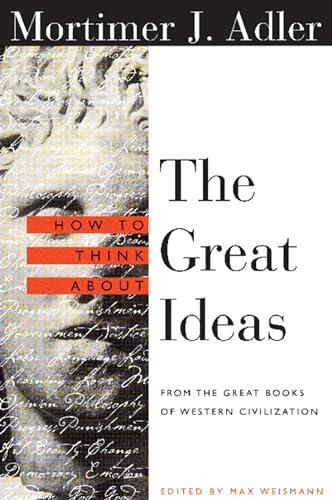
How to Think About the Great Ideas: From the Great Books of Western Civilization
Adler, Mortimer
ISBN 10: 0812694120 ISBN 13: 9780812694123
Published by Open Court, 2000
Used
paperback
From
Evergreen Goodwill, Seattle, WA, U.S.A.
Seller rating 5 out of 5 stars

AbeBooks Seller since November 7, 2006
This specific item is no longer available.
About this Item
Description:
Seller Inventory # mon0000057697
Synopsis:
Time magazine called Mortimer J. Adler a "philosopher for everyman." In this guide to considering the big questions, Adler addresses the topics all men and women ponder in the course of life, such as "What is love?", "How do we decide the right thing to do?", and, "What does it mean to be good?" Drawing on his extensive knowledge of Western literature, history, and philosophy, the author considers what is meant by democracy, law, emotion, language, truth, and other abstract concepts in light of more than two millennia of Western civilization and discourse. Adler's essays offer a remarkable and contemplative distillation of the Great Ideas of Western Thought.
Reviews:
Decades before Allan Bloom famously attacked multicultural education in The Closing of the American Mind (1988), there was Mortimer Adler. A university-trained philosopher, Adler (b. 1902) is the controversy-prone inventor of Great Books-driven college curricula; during the 1930s, he caused such a stir at the University of Chicago that the faculty members demanded his dismissal. Later (1953-1954), he starred in his own TV show, The Great Ideas--and it's that show that gives this book its structure. Composed of transcripts of 52 half-hour segments, the book showcases Adler's ideas about all the big categories--truth, beauty, freedom, love, sex, art, justice, rationality, humankind's nature, Darwinism, government. In each chapter ("How to Think about God," "How to Read a Book," etc.), readers encounter Adler's philosophical instructions and opinions: he argues that the goal of both prison sentences and spankings should be to avenge, to reform and to deter others; he suggests that beauty is not just in the eye of the beholder; and--no surprise here--he confesses that he favors "the ancient and traditional meaning of art." Adler even takes up the subject of whether (and how) TV can be an effective educational tool. In the end, whether or not you agree with Adler, there's no question that the ideas he presents in these chapters are important. After all, they set the terms of a series of cultural and intellectual debates we're still having today--about art, curriculum and freedom. (May)
Copyright 2000 Reed Business Information, Inc.
"Philosophy is everybody's business," according to Adler. He sought to prove his point in a Great Ideas television series broadcast in the San Francisco Bay area in 1953 and 1954. The programs were filmed, later transferred to videotape and audiotape, and finally transcribed on behalf of the Center for the Study of the Great Ideas; it is those transcripts that are the basis for the discussions here. Adler addresses a wide range of philosophical subjects, from epistemology to evolution, from art and work to law and government, sex, love, and friendship, progress and change, good and evil, war and peace, truth and beauty. In some programs, Adler advances his discussion alone; in others, questions from associate Lloyd Luckman give the reader (or TV audience) a surrogate with whom to identify. The prolific Adler produced more than 60 books over the past 70-plus years; this first volume of the new century is most likely to find readers where his previous general works have circulated. Mary Carroll
Copyright © American Library Association. All rights reserved
"About this title" may belong to another edition of this title.
Bibliographic Details
Title: How to Think About the Great Ideas: From the...
Publisher: Open Court
Publication Date: 2000
Binding: paperback
Condition: Good