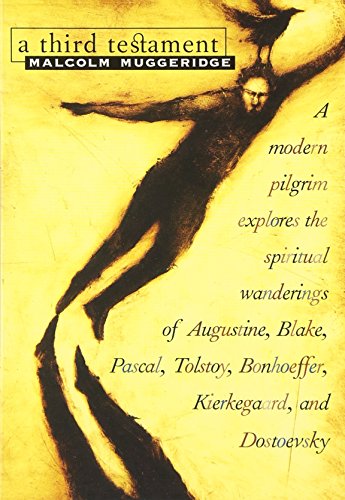
A modern pilgrim explores the spiritual wanderings of Augustine, Pascal, Blake, Kierkegaard, Dostoevsky, Tolstoy, and Bonhoeffer. Based on a television series on these notable thinkers, A Third Testament brings to life seven men whose names are familiar enough, but whose iconoclastic spiritual wanderings make for unforgettable reading. Muggeridge’s concise biographies are an accessible and manageable introduction to these spiritual giants who carried on the testament to the reality of God begun in the Old and New Testaments.
St. Augustine, a headstrong young hedonist and speechwriter who turned his back on money and prestige in order to serve Christ…
Blaise Pascal, a brilliant mathematician who pursued scientific knowledge but warned people against thinking they could live without God…
William Blake, a magnificent artist-poet who pled passionately for the life of the spirit and warned of the blight that materialism would usher in…
Soren Kierkegaard, a renegade philosopher who spent most of his life at odds with the church, and insisted that every person must find his own way to God…
Fyodor Dostoevsky, a debt-ridden writer and sometime prisoner who found, in the midst of squalor and political turmoil, the still small voice of God…
Leo Tolstoy, a grand old novelist who swung between idealism and depression, loneliness and fame—and a duel awareness of his sinfulness and God’s grace…
Dietrich Bonhoeffer, a pastor whose writings—and agonized involvement in a plot to kill Hitler—cost him his life, but continue to inspire millions…
World-renowned philosopher, humorist, newspaper editor, and university rector, British writer Malcolm Muggeridge (1903 1990) is best known to American audiences for his book Something Beautiful for God (a classic biography of Mother Teresa that essentially introduced her to the West) and for his frequent appearances on Firing Line. A tart-tongued agnostic, Muggeridge was fascinated by the idea of faith, and eventually converted to Catholicism. But he never stopped searching or asking questions, which may explain his enduring appeal, which is often compared to that of his compatriots G. K. Chesterton and C. S. Lewis.