Synopsis
In a richly illustrated tale with a Middle East setting, a beautiful and wise princess tests her three suitors by sending them into the world to bring back to her the rarest thing that they find.
Reviews
Grade 2-4-A wise and beautiful princess is wooed by three princes. Two are men of wealth and renown, while the third, Mohsen, possesses "little more than his handsome face, his cloak, and his camel." It is he, of course, whom she wishes to marry. To give him a chance to compete with them, she sends them all on a quest, vowing to marry the one who returns with the greatest wonder. The first finds a crystal ball; the second, a flying carpet; Mohsen, a curative orange. On their return journey, the men see tragedy in the crystal ball-the princess is dying. The carpet whisks them back to the princess, and Mohsen feeds her his orange. She is saved, but still the question remains-which prince should she marry? She chooses Mohsen because he has sacrificed his treasure for her. Storytellers familiar with Virginia Tashjian's With a Deep Sea Smile (Little, 1974; o.p.) or Harold Courlander's The King's Drum & Other African Stories (Harcourt, 1962; o.p.) will recognize this as a variant of the African story, "The Search." But where these earlier versions leave the final question unresolved, Kimmel's tale provides a satisfying conclusion. His smooth narrative is strong and direct-traditional in structure, but with a fresh, contemporary voice. Dark underpainting and dense blocks of bold color give Fisher's illustrations weight and dimension, while his dramatic use of light focuses the eye effortlessly through the pictures. A welcome addition that deserves to become a read-aloud standard.
Linda Boyles, Alachua County Library District, Gainesville, FL
Copyright 1994 Reed Business Information, Inc.
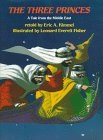
Kimmel's sprightly retelling of a Middle Eastern folktale and Fisher's ambient artwork shimmer with wisdom and magic. A princess sends each of three princes to find a "wondrous object" so that one will prove himself worthy of her hand. The suitors are cousins, and after a year's search they reconvene to display their treasures: a crystal ball that shows what is happening anywhere, a flying carpet that speeds to any destination, and an orange that will cure any illness. When the ball reveals the princess on her deathbed the men combine their gifts to rescue her and, revived, she decides to marry the one "most responsible for saving her." Love and uncommon good sense prevail. Sly humor and high spirits buoy Kimmel's text. At the same time a sense of mystery and wonder ("In the tomb of a forgotten king I discovered this") underlines the work, so that it becomes both fairy tale and modern fable. Fisher ( Kinderdike , Children's Forecasts, Dec. 20) suggests the exotic Arabian setting with a rich palette of striking tones--pink desert skies, violet vistas--and by incorporating unexpected closeups and unusual angles in his compositions. The play of light and shadow is spectacular. Ages 4-8.
Copyright 1994 Reed Business Information, Inc.
Determined to marry the poorest--and most handsome--of the princes vying for her hand, the princess sends them for ``the rarest thing'' each can find. The wonders they bring when they meet a year later are similar to those in ``The Princess Nouronnihar and the Three Rarities'' in The Arabian Nights: a flying carpet, a crystal ball, and a life-restoring orange. Kimmel eliminates details of the princes' quests to focus on their discovery (through the crystal ball) that the princess is deathly ill, their return to her via the carpet, her recovery after eating the orange, and her choice of her original beloved on the grounds that only he has given up his treasure to save her life (in The Arabian Nights version, the princess's uncle--who's also the princes' father--makes this judgment; Kimmel makes the princes cousins, not brothers). Both Fisher and Kimmel provide notes. The artist details using acrylics over chalk and black underpainting to create his luminous double spreads; Kimmel doesn't cite specific sources, but he does mention Egyptian, Moroccan, and Persian versions as well as the tale's inclusion in ``later editions'' of The Arabian Nights. A smooth, accessible adaptation, much enhanced by the spare, powerful art. (Folklore/Picture book. 4-8) -- Copyright ©1994, Kirkus Associates, LP. All rights reserved.
Ages 5-8. "Once there was and once there was not a princess, who was as wise as she was beautiful." So begins a tale that is as endearing as it is enduring. In this story from the Middle East, the princess is courted by three cousins--Prince Fahad, Prince Muhammed, and Prince Moshen. Although it is Moshen the princess loves, he has nothing to give her. So the princess sends her three suitors off: "I will marry the prince that finds the greatest wonder." A year later, the cousins meet in the desert. Fahad has discovered a crystal ball. In it he sees that the princess is ill. Fortunately, Muhammed has found a flying carpet that will take them to the princess' side, but it is the healing orange brought by Moshen that cures her. When the princess is asked to choose her husband on the basis of who is the most responsible for her cure, she cannot; but she has decided whom she will marry--Moshen. Fahad still has his crystal ball, and Muhammed his carpet, but Moshen has given all he has to cure her. Kimmel uses the familiar fairy-tale construct, but his telling has precision and a bouyancy that gives the story wonderful life. The text is well matched by Fisher's muscular artwork, here executed in bold evening colors that masterfully mix the Middle Eastern setting and the Arabian Nights goings-on. Unfortunately, unlike her male counterparts, the princess has not been given a name; nevertheless, she is a heroine who is wise, resourceful, and ready to make decisions about her own life. Ilene Cooper
"About this title" may belong to another edition of this title.