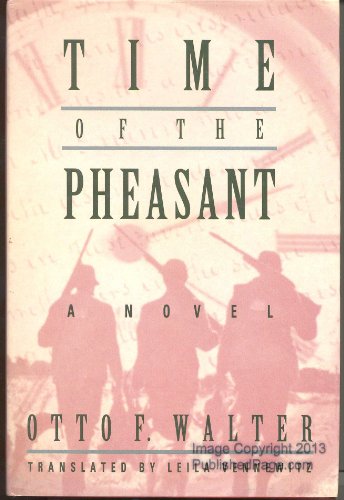
Synopsis
In Berlin researching the role of his native Switzerland during Facism, Thom Winter discovers by chance that his mother had not died of natural causes, but was instead murdered, a fact that leads him to investigate his family further
Reviews
Simultaneously a political inquiry, a murder mystery and a novel of ideas, Walter's broad narrative focuses on Switzerland's dubious neutrality during WW II when many facist, anti-Semitic groups sprouted on Swiss soil, calling for an authoritarian government. In 1982 Thom Winter, a Swiss historian in Berlin, leaves behind his German journalist girlfriend and returns to his hometown in Switzerland to investigate what prompted an entry in his aunt's diary that indicates his mother may have been murdered years ago. Buffeted by his eccentric, slightly sinister aunt, his unapproachable alcoholic sister and his anarchist mentor, Thom digs for the circumstances of his mother's death, and in so doing, discovers unpleasant truths about his collaborationist family, owners of a steelworks. With flashbacks to the 1930s, shards of European history, letters and mythic tableaux featuring the matricidal Orestes as a symbol of war-like patriarchy vanquishing peaceful matriarchy, Walter sustains a powerful meditation on the nightmare of modern history.
Copyright 1991 Reed Business Information, Inc.
In time for Switzerland's 700th anniversary, Swiss novelist Walter's first appearance in English journeys into a family and a country's past to uncover a devastating truth in each. When historian Thom Winter, on his way south in 1982 with German girlfriend Lis, stops in at the old Winter home in Jammers to visit now-alcoholic sister Gret, he finds he can't leave--at least not yet. Lis goes on alone while Thom tries to find out the truth of a diary entry that claims that his mother was murdered in 1961. As he searches for explanations, Thom recalls his fear-ridden childhood, his family's history, its rise to prominence, and its current decline. Thom remembers, too, how his father, like many other Swiss businessmen, had sympathized with Nazi ideals, as well as carried on lucrative business with Germany during the war. This behavior not only alienated Thom's mother, a woman of piety and high principles, but provides a convenient link to the other purpose of the novel--a revisionist look at Swiss policy during WW II, for Thom has also been busy investigating documents that suggest Swiss leaders violated the country's long-held policy of neutrality. Memories and conversations with family and servants finally lead Thom to the unpalatable truth both about his mother's death and his country's history. An intriguing double-plot, with satisfying substance and vivid characters--though Thom himself is a bit sappy, and the leisurely pace, plus the abundance of material and ideas, tends to undercut the underlying dramatic premises. An interesting if flawed debut. -- Copyright ©1991, Kirkus Associates, LP. All rights reserved.
"About this title" may belong to another edition of this title.