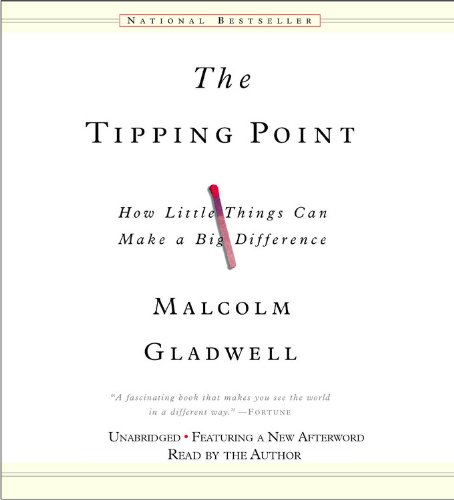
Why did crime in New York drop so suddenly in the mid-nineties? How does an unknown novelist end up a bestselling author? What makes TV shows like Sesame Street so good at teaching kids how to read? Why did Paul Revere succeed with his famous warning? In this brilliant and groundbreaking audiobook, New Yorker writer Malcolm Gladwell looks at why major changes in our society so often happen suddenly and unexpectedly. Ideas, behavior, messages, and products, he argues, often spread like outbreaks of infectious disease. Just as a single sick person can start an epidemic of the flu, so too can a few fare-beaters and graffiti artists fuel a subway crime wave, or a satisfied customer fill the empty tables of a new restaurant. These are social epidemics, and the moment when they take off, when they reach their critical mass, is the Tipping Point. Gladwell introduces us to the particular personality types who are natural pollinators of new ideas and trends, the people who create the phenomenon of word of mouth. He analyzes fashion trends, children's television, and the early days of the American Revolution for clues about making ideas infectious, and visits market mavens and great salesmen to show how to start and sustain social epidemics. The Tipping Point is an intellectual adventure story and a road map to change, with a profoundly hopeful message -- that one imaginative person applying a well-placed lever can move the world. Malcolm Gladwell is a staff writer for The New Yorker. He was formerly a business and science reporter at the Washington Post. He is the author of The Tipping Point and Blink, both of which have become #1 New York Times bestsellers as well as bestsellers in translation throughout the world.
"The best way to understand the dramatic transformation of unknown books into bestsellers, or the rise of teenage smoking, or the phenomena of word of mouth or any number of the other mysterious changes that mark everyday life," writes Malcolm Gladwell, "is to think of them as epidemics. Ideas and products and messages and behaviors spread just like viruses do." Although anyone familiar with the theory of memetics will recognize this concept, Gladwell's
The Tipping Point has quite a few interesting twists on the subject.
For example, Paul Revere was able to galvanize the forces of resistance so effectively in part because he was what Gladwell calls a "Connector": he knew just about everybody, particularly the revolutionary leaders in each of the towns that he rode through. But Revere "wasn't just the man with the biggest Rolodex in colonial Boston," he was also a "Maven" who gathered extensive information about the British. He knew what was going on and he knew exactly whom to tell. The phenomenon continues to this day--think of how often you've received information in an e-mail message that had been forwarded at least half a dozen times before reaching you.
Gladwell develops these and other concepts (such as the "stickiness" of ideas or the effect of population size on information dispersal) through simple, clear explanations and entertainingly illustrative anecdotes, such as comparing the pedagogical methods of Sesame Street and Blue's Clues, or explaining why it would be even easier to play Six Degrees of Kevin Bacon with the actor Rod Steiger. Although some readers may find the transitional passages between chapters hold their hands a little too tightly, and Gladwell's closing invocation of the possibilities of social engineering sketchy, even chilling, The Tipping Point is one of the most effective books on science for a general audience in ages. It seems inevitable that "tipping point," like "future shock" or "chaos theory," will soon become one of those ideas that everybody knows--or at least knows by name. --Ron Hogan