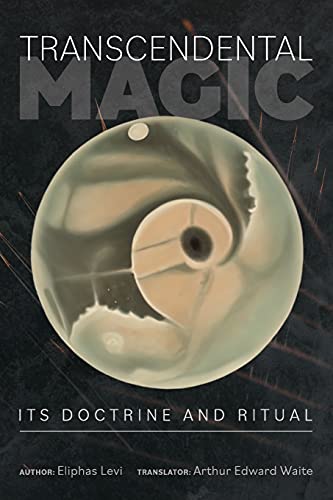
Transcendental Magic: Its Doctrine and Ritual by Éliphas Lévi explores magic, the "esoteric science," and its place between science and religion.
Born Alphonse Louis Constant in 1810, this French occultist originally planned for a career in the Catholic Church. Constant was educated at Saint Sulpice's seminary, and planned to become a priest. Yet just before he was to receive his ordination at age 26, Constant renounced his ecclesiastical goals and returned to civilian life.
The following years tested Constant's conscience and resilience. He was disowned by his family, and worked as a tutor to earn an income. Without the structure from the seminary, he found himself adrift.
Constant dedicated much of his early life to promoting the ideals of a utopian socialist society that worked for the economic improvement of all people. He shared these ideas in an early work called The Bible of Liberty. Within an hour of its release, the copies were seized by French authorities, and Constant spent the next six months in prison.
After a failed marriage and the death of his young daughter, Constant discovered the world of the occult and mysticism. He became a ceremonial magician, and developed a social circle of many of the occultists and Kabbalists of the time. Writing on the subject under the Hebrew name Éliphas Lévi, he began to share his ideas on magic with the public in the 1850s.
Lévi's first published book on ritual magic is the two-part work, Transcendental Magic: Its Doctrines and Rituals. The two parts were first published as single work with a thorough biographical introduction in 1958.
This work explores the magician's foundations for his spiritual beliefs, as well as his idea that an elite class of priests would be necessary to lead the people into both social and magical order. He writes, "Occult philosophy seems to have been the nurse and godmother of all intellectual forces, the key of all divine obscurities, and the absolute mistress of society, in those ages when it was exclusively reserved for the education of priests and of kings...Magic is the traditional science of the secrets of Nature which comes to us from the Magi."
Part One, The Doctrine of Transcendental Magic, was first published in 1854. This work establishes the concepts behind symbols like the tetragram and pentagram, the significance of Hebrew letters and numbers, and the relationship between science, occultism, and formal religion. Lévi was the first to document the meaning of the points of the pentagram. He stated that a pentagram with only one point up and two down is a symbol of the Savior, and a pentagram with two points up and one down is a "symbol of evil and attracts sinister forces."
Part Two, The Rituals of Transcendental Magic, was published in 1856. It discusses the actual materials, processes, and settings for conducting ritual magic. The practitioner must purify himself through a temperate diet, regular sleep, and thorough attention to cleaning and hygiene. A complete description of tools like a magical lamp, rod, sword, and dagger follows, leaving the magician well equipped to perform ceremonies and rituals. Lévi also added the Tarot to the tools of the magician, which was a new development in the occultism of the time.
Although Lévi didn't enjoy much notoriety during his life, his works eventually became highly influential among other occultists, and he is now considered one of the fathers of modern mysticism. Famous occultist Aleister Crowley even claimed to be Lévi himself in one of his past lives. Additionally, Arthur Edward Waite and Pamela Colman Smith created the Waite-Smith deck based on Éliphas Lévi's writings, which is the basis for most modern Tarot decks.