Synopsis
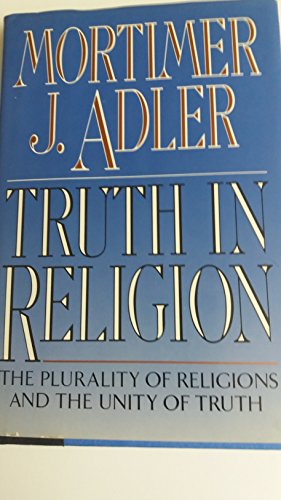
Draws on the principles of logic to locate a meeting ground for the world's organized religions, in an attempt to reconcile reason and faith in the tradition of the great religious thinkers
Reviews
In this parochial, dogmatic essay, philosopher Adler ( Six Great Ideas ) argues that pluralism, while desirable in matters of taste, has no place in the realm of truth. Arguing that religious beliefs, even if beyond proof, ought to obey the logic of truth, he suggests that the major religions of the Far East foster cultural schizophrenia by compartmentalizing scientific facts and religious views. After determining that Eastern cosmological religions cannot be considered "logical and factual," Adler weighs the three monotheisms--Christianity, Judaism, Islam--and indecisively posits, "We can only say that one of these religions is truer than the other two." His skewerings of Joseph Campbell, of Protestant thinker Harvey Cox, and of Roman Catholic theologian Hans Kung add to the controversial nature of this devisive tract.
Copyright 1990 Reed Business Information, Inc.
Distinguishing between matters of truth and taste, Adler examines the problem of truth in religion. He takes as his criterion the principle of noncontradiction. Those systems that accept a unitary logical coherence have the possibility of truth, while those that allow the existence of contradictory states of being at the same time are matters of taste, while the various Western monotheisms share the possibility of logical truth. Adler's arguments are provocative, but his understanding of Eastern thought is shallow, and he glosses over many problems in Western thought. In the final analysis, Adler begs more questions than he answers.
- T.L. Cooksey, Armstrong State Coll., Savannah, Ga.
Copyright 1990 Reed Business Information, Inc.
"About this title" may belong to another edition of this title.