Synopsis
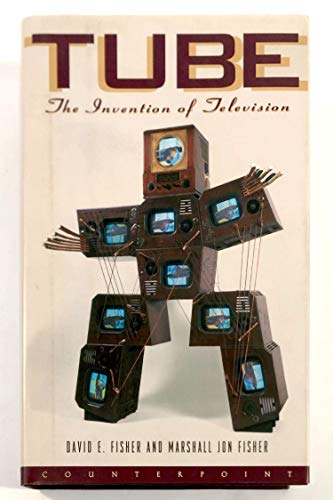
In the half century since its commercial unveiling, television has become the undisputed master of communications media, revolutionizing the way postwar generations have viewed the world. Yet almost no one in America knows how television was created, who created it, or how it actually works.
The inventors of television were a diverse group of iconoclasts from different corners of the world - including an Idaho farm boy turned college dropout, an eccentric, sickly Scotsman, and two Russian Americans. These men - Philo T. Farnsworth, John Logie Baird, Charles Francis Jenkins, Ernst Alexanderson, Vladimir Zworykin, and the corporate visionary David Sarnoff - each had one eye on the others as they raced for fortune and scientific glory. Tube traces their progress, from the laboratory prototypes that drew public laughter to the vicious courtroom battles for control of what would become an enormous market power. Taking us through the advent of "living color" and beyond, authors David E. Fisher and Marshall Jon Fisher conclude with a forecast of the latest digital technologies and their impact.
Reviews
As the authors say in their preface, "[W]ho invented television? Nobody knows." But the genius of several individuals coalesced into today's modern TV. In this personality-driven book, the authors look at the key players and their contributions: John Logie Bair, the eccentric Scot who went from marketing hemorrhoid cream to making the first TV in Britain; Vladimir Zworykin, the Russian immigrant who blazed the trail for RCA; and Ernst Alexanderson, who led RCA to the promised land but lost out to Zworykin. But the two stars are Philo T. Farnsworth and David Sarnoff. Farnsworth was the boy-genius who first visualized TV as a 14-year-old and invented one of the first totally electronic TVs, only to be defeated by corporate in-fighting. "General" David Sarnoff, a Jewish immigrant on New York City's Lower East Side, rose to become the head of RCA, leading it to the vanguard because of his keen perceptions of both radio and television. David Fisher, a professor of cosmochemistry at the University of Miami, and Marshal Joe Fisher, a freelance writer, offer an engrossing, in-depth look at the history of the medium. Photos not seen by PW. 35,000 first printing; major ad/promo; author tour.
Copyright 1996 Reed Business Information, Inc.
Cogent technological exposition combines with Saturday- matinee melodrama to create a nearly moving saga of the many men who wanted singlehandedly to create what one inventor called ``radiovision.'' Beginning with an 1872 experiment on selenium rods that made British engineer Willoughby Smith imagine a system of ``visual telegraphy,'' Scientist David Fisher (Univ. of Miami; The Scariest Place on Earth 1994, etc.) and son, freelance writer Marshall Fisher, chart the scientific progression that culminated with the debut of commercial television programming in 1941. Throughout, they stress the linked discoveries that made it possible: British inventor John Logie Baird's 1923 electrified hatbox with Nipkow disks, which constituted the world's first working television set; the cathode-ray Image Dissector of young American inventor Philo Farnsworth; Russian-American scientist Vladimir Zworykin's Kinescope; and many others. Simultaneously they tell the story of big business and its equally fierce race to control the as-yet imperfect invention. AT&T made claims on TV in the 1920s, but RCA and its leader, David Sarnoff, prevailed, hiring top scientists and using the government to moderate progress when his creations (like the early RCA color TV) were not ready for prime time. In a crowd of businessmen/speculators and scientists/tinkerers, Sarnoff and Farnsworth stand out: Both triumph with their vision of television, but only one succeeds in accumulating the corporate muscle needed in the modern age to make a lasting mark. Tapped out and underappreciated, Farnsworth and many other television pioneers faced sad ends--alcoholism, suicide, oblivion. Though most useful as a record of scientific apparatus and exploration of the modern symbiosis of technology and commerce, this volume is most memorable for its views of quixotic men who, when down to their last dollar, proclaim, ``I must invent something.'' (First printing of 35,000; author tour; PBS American Experience documentary) -- Copyright ©1996, Kirkus Associates, LP. All rights reserved.
A gallery of visionaries, eccentric geniuses, and hard-boiled businessmen fill this gripping rendition of the creation of the tube. We might have nicknamed television the "disk" had the competing mechanical method of transmitting pictures been triumphant. The Fishers' story of its failure and of Briton John Logie Baird's triumph is an engaging blend of technical explanation and biography. Their narrative of Baird and others evokes an archetype, the independent inventor, all but eliminated in the modern age of corporate-or government-sponsored research. Television, among the last revolutionary devices invented by individual visionaries, attracted colorful figures in addition to Baird: Philo Farnsworth, an Idaho farm boy who transmitted the first electronic picture in 1927; Vladimir Zworykin, a Russian immigrant who developed the electron-gun picture tube; and the legendary David Sarnoff, the RCA chief determined to rule TV even while the box was but an ungainly knot of electrical ganglia in the inventors' workshops. A Farnsworth victory in a patent suit denied Sarnoff total manufacturing control, but he still pioneered broadcasting. An informative, entertaining account of the box, its earliest broadcasts, and the ambitions that drove the people who created it, which will be enhanced by a related American Experience program to air on PBS in early 1997, featuring interviews with David Fisher. Gilbert Taylor
"About this title" may belong to another edition of this title.