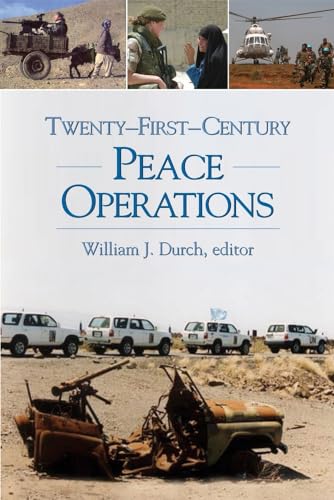
In this new century, a rising proportion of the world s societal wars are ending not in victory for one side but in stalemate and negotiated peace, outside military intervention, or both, as events in Afghanistan, Bosnia and Herzegovina, East Timor, and Sierra Leone have borne witness. Additionally, a rising number of soldiers, police officers, and other personnel from the international community have helped war-damaged lands regain their footing through peace operations run by the United Nations, NATO, and other organizations. After ten years of sustained effort, what has been accomplished and what lessons have been learned? This volume, the third in a sequence on peacekeeping and post-conflict security edited by William J. Durch, addresses these questions through focused, structured case studies of operations in the above four countries, the Democratic Republic of the Congo, and Kosovo. The common structure walks the reader into and through the problems that have driven each conflict and the solutions derived to deal with them. The focus is on how peace operations work and why they succeed, fail, drift, or recover. The editor and case authors provide constructive and practical guidance for future operations, anticipating how international peace support, its objectives, and its participants may change in the years ahead. This accessible, insightful, and superbly edited volume is sure to be widely read by scholars, analysts, and practitioners alike and will no doubt be regarded as the single most important source for data on and analysis of these important missions. "Twenty-first Century Peace Operations" is a joint publication of the Henry L. Stimson Center and the United States Institute of Peace."
"Clear-headed and hard-hitting, with straightforward recommendations and lessons learned, Twenty-First Century Peace Operations is a superb volume that should stand as the definitive external analysis of the UN missions in these countries for the foreseeable future. In its detail, coverage, and organization, it is the most comprehensive treatment of these efforts I have seen." --Jack A. Goldstone, George Mason University
"The publication of Bill Durch's third in a series of books on peackeeping is a much anticipated event. The carefully-researched case studies, tied together by crisp introductory and concluding chapters, represent the state of the art of thinking about contemporary peace operations." --Ian Johnstone, Associate Professor of International Law, Fletcher School and Volume Editor, Annual Review of Global Peace Operations
"This third volume by Bill Durch on the evolution of peace operations follows the pattern of superior analysis and insight set by the first two. He examines six cases in what he calls the `third surge' of complex peace operations, the essential elements of each for success or failure, and what lessons can be drawn for the future. The book serves the interests of practitioners, scholars and those who have a more general interest in one of the critical tools for conflict resolution in our dangerous world."--Robert B. Oakley, U.S. Ambassador (Ret.)