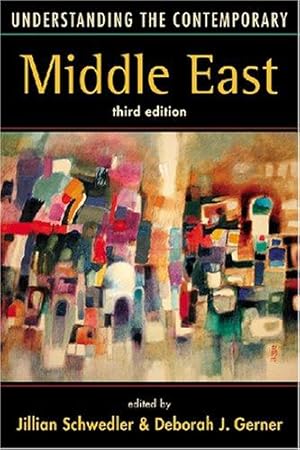
The third edition of "Understanding the Contemporary Middle East" includes two entirely new chapters, one on religion and politics and one on the economies of the Middle East, as well as a greatly expanded discussion of the 2003 invasion of Iraq. In addition, all of the chapters have been fully updated. Maps, photographs, and tables of basic political data enhance the text, which has already made its place as the best available introduction to the region.
Understanding the Contemporary Middle East is an interdisciplinary book designed for use both as a core text for "Introduction to the Middle East" courses and as a supplement in a variety of discipline-oriented curriculums. The geographical domain of the volume is the Arab world (the Levant, the Arabian Peninsula, and North Africa), Iran, Israel, and Turkey; its temporal focus is post-World War II, with a particular emphasis on the 1990s.
There are very few books for classroom use that introduce students to the Middle East as a whole rather than focusing on a specific discipline. Understanding the Contemporary Middle East fills this gap. The fifteen authors, writing with clarity and precision, address a range of crucial issues facing the region in the twenty-first century: there are chapters addressing geography, history, politics, economics, international relations, the israeli-Palestinian conflict, the status of women, religion, class and ethnicity, patterns of population growth, and the literature of the region. Each chapter provides up-to-dateand engagingdescription and analysis, along with sugestions for further reading. Numerous maps and photographs help the reader gain a feel for the region.