About this Item
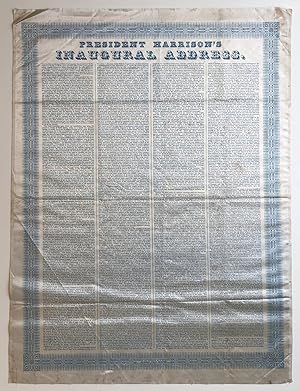
Inaugural Address. Printed on silk, ca. March 1841. Baltimore: John Murphy. 1 p., 18 x 24 in. The last U.S. president born a British subject, he was the first to die in office. "Always the friend of my countrymen, never their flatterer, it becomes my duty to say to them. that there exists in the land a spirit hostile to their best interests-hostile to liberty itself. It is union that we want, not of a party for the sake of that party, but a union of the whole country for the sake of the whole country, for the defense of its interests and its honor against foreign aggression, for the defense of those principles for which our ancestors so gloriously contended." On March 4, 1841, a cold, wet day, Harrison, without hat or overcoat, rode on horseback to his inauguration, and delivered the longest inaugural speech of any American president. He became ill three weeks later and died of pneumonia on April 4, having been president for 31 days. Harrison wrote the entire speech himself, before editing by his soon-to-be Secretary of State, Daniel Webster, who said afterwards that in the process of editing the text, he had "killed seventeen Roman proconsuls," referring to Harrison's predilection for classical references. In the 8,460-word address, Harrison presents a detailed statement of the Whig agenda and a repudiation of the populist policies of Democratic presidents Andrew Jackson and Martin Van Buren. Harrison promises to reestablish the Bank of the United States, to issue paper currency, to use his veto power sparingly, and to appoint qualified officers of government, in contrast to the spoils system that Jackson heralded. He favors term limits, limits on the powers of the presidency, and devotion to nation rather than party. Harrison avoids specifics on the divisive issue of slavery. This unique printing by printer and publisher John Murphy of Baltimore features the entire text of Harrison's Inaugural Address printed in blue ink on silk. Murphy also printed badges on silk for the Young Men's National Convention held in Baltimore in May 1840 in support of Harrison's candidacy. Murphy (1812-1880) was born in Ireland but immigrated to Delaware with his parents in 1822. After serving as a printer's apprentice in Philadelphia, he established his own printing business in Baltimore in the 1830s. He published the United States Catholic Magazine, a monthly periodical, from 1842 to 1849 and several Catholic theological books. For printing the Proceedings of the Plenary Council of Baltimore (1866), Murphy received the honorary title of Printer to the Pope, a distinction never before given to a resident of an English-speaking country. Excerpts"We admit of no government by divine right, believing that. the beneficent Creator has made no distinction amongst men; that all are upon an equality, and that the only legitimate right to govern is an express grant of power from the governed. Limited as are the powers which have been granted, still enough have been granted to constitute a despotism if concentrated in one of the departments." (c1)"it is the part of wisdom for a republic to limit the service of that officer at least to whom she has intrusted the management of her foreign relations, the execution of her laws, and the command of her armies and navies to a period so short as to prevent his forgetting that he is the accountable agent, not the principal-the servant, not the master. Until an amendment of the Constitution can be effected, public opinion may secure the desired object, I give my aid to it by renewing the pledge heretofore given that under no circumstances will I consent to serve a second term." (c1)"I consider the veto power.solely as a conservative power, to be used only first, to protect the Constitution from violation; secondly, the people from the effects of hasty legislation where their will has been probably disregarded or not well understood, and, thirdly, to prevent the ef. (See website for full description).
Seller Inventory # 25607.02
Contact seller
Report this item