The figure of Gary Cooper as the proud frontier sheriff striding down the street in the 1952 American Western High Noon is as much a symbol of dignity and courage in contemporary Poland as it is in the United States. In 1989, for Poland?s first free election since the Communist takeover, the political party Solidarity dramatically and successfully used that image of Cooper on a campaign poster urging voters to respond to their country?s own ?high noon??their critical moment of decision.
The Western motion picture, from its silent days on, exported an epic vision of America. William S. Hart, John Wayne, James Stewart, Henry Fonda, Gregory Peck, Clint Eastwood, and Kirk Douglas became legendary heroes throughout the world, and especially in Poland.
In postwar Poland, film poster artists employed the universally recognized symbols of the Western?horse, six-shooter, boots, tin-star badge, Stetson, saddle?to convey violence as a negative force. Unlike many other art forms, the film poster did not fall within the censor?s domain because it was not expected to pose a threat to the social order. But messages were conveyed through subtle means of symbol and color. The Polish poster has been likened to the Trojan horse, with the artist smuggling messages onto the streets in the guise of ephemera.
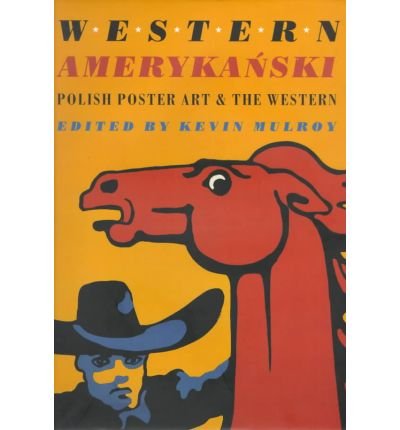
The posters displayed so strikingly in this book, and discussed in three essays, are from the golden age of Polish poster-making, the mid-1940s to the 1970s. They are part of the collection assembled by the Autry Museum of Western Heritage, the Western poster holdings of which include more than a hundred created in Poland?the largest such collection outside of Poland itself.
This arcane work, published concurrently with a show at the Autry Museum of Western Heritage in Los Angeles, is a history of Polish-made film posters that advertised American Westerns during the Communist era. The Western genre and its iconography have resonated powerfully for moviegoers living under repressive governments, and since the silent era Polish audiences have flocked to American Westerns. The fact that the genre itself evolved into less heroic and idealized iterations during the Cold War sometimes played into the hands of the East's ideological goals. For Polish artists the Western film poster offered a chance to pursue aesthetic goals otherwise unattainable within the official canonic style. This book offers a huge range in the quality of the poster art--all by artists virtually unknown outside of Poland--with the pinnacle perhaps being the cartoonish typography and figures of the 1960s. This is truly a niche item, of use only to art libraries supporting a graphic arts curriculum.
-Douglas F. Smith, Oakland P.L., CA
Copyright 2000 Reed Business Information, Inc.