Synopsis
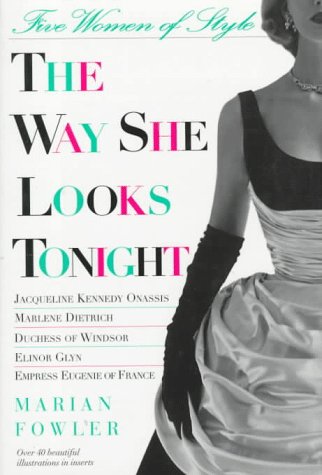
The Way She Looks Tonight shows how five icons of style used the language of fashion to define themselves and their eras - in the tradition of The Power of Style by Annette Tapert and Diana Edkins.
In this elegantly written and erudite study of that elusive quality called style, acclaimed biographer Marian Fowler explores the lives of five very different women through a new and unusual source: their choice of clothes. In this history lesson through fashion, Fowler examines what each woman was communicating through her dress and why the female public identified with these trendsetters.
Reviews
Reading this curious and frustrating book is like playing a game of Trivial Pursuit based on the history of fashion. There are lots of anecdotes, well told, many familiar, about the five disparate women spotlighted here: Jacqueline Kennedy Onassis, Marlene Dietrich, the Duchess of Windsor, Elinor Glyn and Eugenie Bonaparte. We learn that Eugenie's famous Parisian designer, Worth, was originally from a British village and was the first male to design clothes for women. Elinor Glyn was famous for her draped tiger skins and "it," whatever "it" was. (Douglas Fairbanks Jr., she opined, didn't have "it" because his ears stuck out too much.) There's little new about Wallis Simpson, and Jacqueline Kennedy is portrayed as a fanatic, extravagant shopper who wore 400 outfits in 16 months in the White House. The telling of tales is competent, but Fowler (In a Gilded Cage) tries to force the book to carry a sociological weight far beyond its strength. A heavy-handed introduction that quotes, among others, Thomas Carlyle and Thorstein Veblen, is followed by an absurd afterword in which Fowler insists: "There's another lesson here, and it's a moral one. Outer beauty can produce inner." Illustrations.
Copyright 1996 Reed Business Information, Inc.
Five stylish women in five vignettes-cum-case studies: how they lived, how they dressed, and how the closet reflects the soul. Canadian biographer Fowler, author of quartets and quintets of women's history (Below the Peacock Fan: First Ladies of the Raj, 1987, etc.) groups those old stylish chestnuts--Marlene Dietrich, the Duchess of Windsor, Jacqueline Kennedy Onassis--with a pair of lesser-known clothes horses,Empress Eugenie Bonaparte of France, wife of Louis Napoleon; and Belle Epoque writer and socialite Elinor Glyn. All five, Fowler states, ``wrote their life stories in fabric and feathers and furs.'' After a beginning academic essay defining style as ``a mode of expression which is laudable in its order, conspicuousness, consistency and cohesion of separate elements,'' she launches into five tales that utulize the rather less academic device of inhabiting the minds of the subjects: ``Now, she could feel his hot, heavy-lidded gaze on the black serge stretched taut across her breasts.'' Each heroine's wardrobe is described vis-…-vis her social, political, psychological, and sexual environment. Clothes are a metaphor: Jackie's pillbox hats were crowns for America's royalty; Eugenie's huge crinolines (ten feet of fabric at the hem) represented the ``sham'' that was the Second Empire in France--solid on the outside, but with no stability. If you can get past all the socially relevant chitchat, there's the good stuff: the clothes and jewels. These women had closets bigger than houses; they traveled with hundreds of trunks; they were never far away from servants with ironing boards. And best of all, they were self-invented and self-dramatizing. Elinor Glyn had five tiger skins, each one given to her by a different lover. Jackie wore evening gloves with 20 buttons. Dietrich had a swansdown coat with a four-foot train made out of 2,000 dead birds. Cruel and not environmentally correct, yes. But a nice dose of vicarious opulence for those of us who buy our duds at the Gap. -- Copyright ©1996, Kirkus Associates, LP. All rights reserved.
It is significant that Fowler chose the word style to modify five well-known women of the nineteenth and twentieth centuries. It is sad, too, because, as she documents all too well, few (if any) of the five possessed much substance. Fashion was everything--vesto ergo sum ("I dress, therefore I am" )--and compensated for brutal childhoods, uncaring parents, and a parade of fickle, saintless men and husbands. The book itself falls into the titular trap; considering the emphasis on clothes and couturiers and vast sums of money, nothing remarkably profound is communicated. Instead, we're treated to People-style gossip. Jackie O's maid was instructed to iron and neatly fold all her panty hose. Naughty novelist Elinor Glyn admitted through the words of a fictional character that "it is wiser to marry the life you like because after a little the man doesn't matter." And Marlene Dietrich truly existed for words from kind strangers and friends as well as alcohol for more than occasional ego boosts. A tragedy in five acts. Barbara Jacobs
Combining biography with social commentary, Fowler (In a Gilded Cage, St. Martin's, 1994) provides an intelligent analysis of the style and influence of five very different women who turn out to have had more in common than one would have expected. She gives a fascinating chronological look at the lives and fashions of Empress Eugenie of France, Elinor Glyn, Marlene Dietrich, the Duchess of Windsor, and Jacqueline Onassis. Though readers will probably pick the book up for the chapter on Onassis (which unfortunately makes no mention of the Sotheby's auction of her property), the chapters on the other women are also well worth reading. One learns, for example, that the Duchess of Windsor's formidable mother, on her deathbed, asked her daughter if she was wearing a brown dress. Wallis replied that she was. " 'Thought so,' sniffed her mother in the same exasperated tone that had greeted Wallis's childhood misdemeanors and preceded the hairbrush's whack. 'Whatever made you choose such an unbecoming color?'" Fowler's work is full of revealing moments like this and will be enjoyed by anyone with an interest in fashion or in the lives of these five fashionable women. Recommended for public libraries.?Elizabeth Mellett, Brookline P.L., Mass.
Copyright 1996 Reed Business Information, Inc.
"About this title" may belong to another edition of this title.