
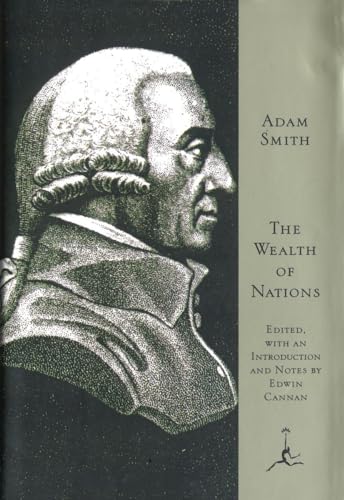
The Wealth of Nations
Adam Smith
ISBN 10: 0679424733 ISBN 13: 9780679424734
Published by Random House USA Inc, 1994
Used
Hardback
From
World of Books Inc, Montgomery, IL, U.S.A.
Seller rating 2 out of 5 stars

AbeBooks Seller since March 23, 2026
This specific item is no longer available.
About this Item
Description:
Widely credited with laying the theoretical and philosophical foundations for capitalism, this work had an immediate impact on economic thinking, in light of its arguments for the freedom of trade. It presents a powerful blueprint for a stable and peaceful society which rests upon a hard-headed and realistic assessment of humans and their natures. Seller Inventory # CIN0679424733G
Synopsis:
First published in 1776, The Wealth of Nations is generally regarded as the foundation of contemporary economic thought. Adam Smith, a Scottish professor of moral philosophy, expounded the then-revolutionary doctrine of economic liberalism. The book’s importance was immediately recognized by Smith’s peers, and later economists have shown an unusual consensus in their admiration for his ideas.
Combining economics, political theory, history, philosophy, and practical programs, Smith assumes that human self-interest is the basic psychological drive behind economics and that a natural order in the universe makes all the individual, self-interested strivings add up to the social good. His conclusion, that the best program is to leave the economic process alone and that government is useful only as an agent to preserve order and to perform routine functions, is now known as laissez-faire economics or noninterventionism.
In noting for the first time the significance of the division of labor and by stating the hypothesis that a commodity’s value correlates to its labor input, Smith anticipated the writings of Karl Marx. Like Marx’s Das Capital and Machiavelli’s The Prince, his great book marked the dawning of a new historical epoch.
About the Author: Adam Smith was born in a small village in Kirkcaldy, Scotland in 1723. He entered the University of Glasgow at age fourteen, and later attended Balliol College at Oxford. After lecturing for a period, he held several teaching positions at Glasgow University. His greatest achievement was writing The Wealth of Nations (1776), a five-book series that sought to expose the true causes of prosperity, and installed him as the father of contemporary economic thought. He died in Edinburgh on July 19, 1790.
"About this title" may belong to another edition of this title.
Bibliographic Details
Title: The Wealth of Nations
Publisher: Random House USA Inc
Publication Date: 1994
Binding: Hardback
Condition: Good