"Tackles the very difficult issue of why ELLs are disproportionately represented in special education and how, as educators, we need to look at our instruction and assessment to verify that there is a true need for referral versus a lack of understanding of the language acquisition process."
―Christine Engel, ESL Teacher
Webster Stanley Elementary School, Oshkosh, WI
Make appropriate instructional and eligibility decisions for English language learners!
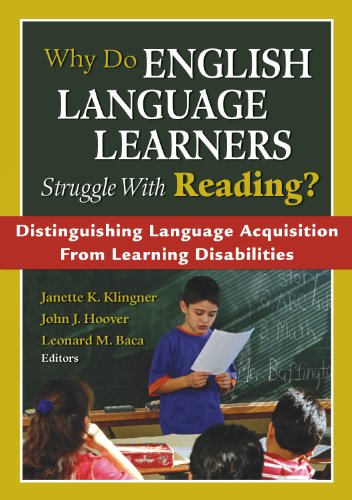
This research-based guide offers educators proven methods for determining when English language learners (ELLs) are having reading difficulties that are related to the language acquisition process and when students′ performance issues might be linked to learning disabilities.
An excellent resource for general and special education teachers and service providers, the text provides an overview of the language acquisition process and offers a variety of best practices to prevent inappropriate referrals of ELLs to special education. Additionally, to help teachers meet NCLB and IDEA 2004 requirements, the authors outline:
- Assessment techniques for identifying learning disabilities and measuring proficiency in English as a second language
- Instructional tips for working with ELLs who struggle with reading
- A multi-tiered, data-driven intervention model to assist in determining a student′s learning needs
- The role of Response to Intervention (RTI) in instruction
Each chapter includes practical ideas, suggestions, and checklists for easy reference and use in assessment and referral efforts.
Janette K. Klingner was a bilingual special education teacher for ten years before earning a PhD in Reading and Learning Disabilities from the University of Miami. Her recently coauthored or coedited books include
Teaching Reading Comprehension to Sudents With Learning Difficulties (Guilford Press),
Methods for Teaching Culturally and Linguistically Diverse Exceptional Learners (Merrill/Prentice Hall),
Case Studies in the Social Construction of Disability: Minority Students in Special Education (Teachers College Press),
Evidence-Based Practices for Response to Intervention (Brookes), and
Why Are so Many Minority Students in Special Education?: Understanding Race and Disability in Schools (Teachers College Press).
John J. Hoover is Associate Research Professor at the University of Colorado Boulder and a former K–12 special educator, teaching diverse students representing multiple languages and cultures in western, southwestern, and mid-western states. He earned a BA in Elementary and Special Education (Intellectual Disabilities), an MA in Learning Disabilities and Emotional Disorders with an emphasis in Reading, and a PhD in Curriculum specializing in Special Education. His research agenda for the past two decades has focused on the topic of culturally and linguistically responsive special education referral and assessment of English language and other diverse learners. He is currently PI on a multi-year grant funded project addressing ELs and multi-tiered supports, special education referral and assessment of culturally and linguistically diverse learners, and graduate level teacher preparation for teaching English language and other diverse learners with and without disabilities. Select recent coauthored/coedited books include: Why do English learners struggle with reading: Distinguishing language acquisition from learning disabilities (Pearson); Linking assessment to instruction in multi-tiered models: A teacher’s guide to selecting reading, writing and mathematics interventions (Pearson); Differentiating learning differences from learning and behavioral disabilities: Teaching diverse learners through multi-tiered response to intervention (Allyn & Bacon); and Methods for teaching culturally and linguistically diverse exceptional learners (Pearson Merrill). He also is co-author of a nationally normed reading test, Early Reading Assessment (Pro-Ed), and of a research-based educator self-assessment and professional development tool, Core ESL Instructional Practices (CEIP) Guide. Recent referred journal publications include: Increasing usage of ESL instructional practices in a rural county elementary school, Rural Educator (2015); Culturally responsive special education referrals of English learners in one rural county school district: Pilot project, Rural Special Education Quarterly (2015), and Reducing unnecessary referrals: Guidelines for teachers of diverse learners, Teaching Exceptional Children (2012).
Leonard M. Baca is Professor Emeritus at the University of Colorado Boulder. He earned an Ed.D. from the University of Northern Colorado and has been a professor of Education at the University of Colorado Boulder since 1973. He has taught courses in bilingual and bilingual special education and served as the program chair. Professor Baca is founder and Executive Director of the BUENO Center for Multicultural Education where he has directed and managed millions of dollars in grant funded projects promoting the education of ELs and students with disabilities. He is author or co-author of numerous publications dealing with English learners with and without disabilities, including the Bilingual special education interface (Merrill) and Methods for teaching culturally and linguistically diverse exceptional learners (Pearson).