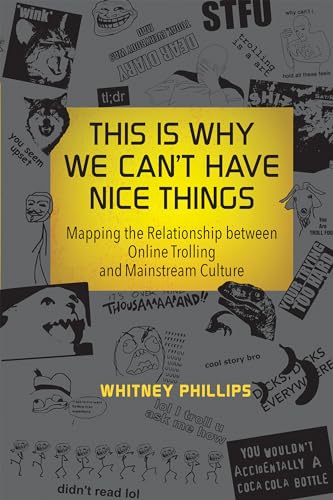
This Is Why We Can't Have Nice Things: Mapping the Relationship between Online Trolling and Mainstream Culture (Mit Press)
398 ratings by Goodreads
Language: English
Published by The MIT Press (edition Illustrated), 2016
- Softcover
- Used

Seller: BooksRun, Philadelphia, PA, U.S.A.BooksRun
5-star seller
AbeBooks seller since February 2, 2016
Softcover
Condition: Used - Very good
US$ 5.98
Free Shipping
Ships within U.S.A.
Quantity: 1 available
Add to basketFree 30-day returns
Item description from seller
It's a well-cared-for item that has seen limited use. The item may show minor signs of wear. All the text is legible, with all pages included. It may have slight markings and/or highlighting.
Seller Inventory # 0262529874-8-6
- Title
- This Is Why We Can't Have Nice Things: Mapping the Relationship between Online Trolling and Mainstream Culture (Mit Press)
- Author
- Phillips, Whitney
- Publisher
- The MIT Press (edition Illustrated)
- Publication year
- 2016
- Condition
- Very Good
- Binding
- Paperback
- Language
- English
- ISBN 10
- 0262529874
- ISBN 13
- 9780262529877
- Edition
- Illustrated.
Why the internet troll problem is actually a culture problem: how online trolling fits comfortably within today’s media landscape.
Internet trolls live to upset as many people as possible, using all the technical and psychological tools at their disposal. They gleefully whip the media into a frenzy over a fake teen drug crisis; they post offensive messages on Facebook memorial pages, traumatizing grief-stricken friends and family; they use unabashedly racist language and images. They take pleasure in ruining a complete stranger’s day and find amusement in their victim’s anguish. In short, trolling is the obstacle to a kinder, gentler Internet. To quote a famous Internet meme, trolling is why we can’t have nice things online. Or at least that’s what we have been led to believe. In this provocative book, Whitney Phillips argues that trolling, widely condemned as obscene and deviant, actually fits comfortably within the contemporary media landscape. Trolling may be obscene, but, Phillips argues, it isn’t all that deviant. Trolls’ actions are born of and fueled by culturally sanctioned impulses—which are just as damaging as the trolls’ most disruptive behaviors.
Phillips describes the relationship between trolling and sensationalist corporate media—pointing out that for trolls, exploitation is a leisure activity; for media, it’s a business strategy. She shows how trolls, “the grimacing poster children for a socially networked world,” align with social media. And she documents how trolls, in addition to parroting media tropes, also offer a grotesque pantomime of dominant cultural tropes, including gendered notions of dominance and success and an ideology of entitlement. We don't just have a trolling problem, Phillips argues; we have a culture problem. This Is Why We Can't Have Nice Things isn’t only about trolls; it's about a culture in which trolls thrive.
Internet trolls live to upset as many people as possible, using all the technical and psychological tools at their disposal. They gleefully whip the media into a frenzy over a fake teen drug crisis; they post offensive messages on Facebook memorial pages, traumatizing grief-stricken friends and family; they use unabashedly racist language and images. They take pleasure in ruining a complete stranger’s day and find amusement in their victim’s anguish. In short, trolling is the obstacle to a kinder, gentler Internet. To quote a famous Internet meme, trolling is why we can’t have nice things online. Or at least that’s what we have been led to believe. In this provocative book, Whitney Phillips argues that trolling, widely condemned as obscene and deviant, actually fits comfortably within the contemporary media landscape. Trolling may be obscene, but, Phillips argues, it isn’t all that deviant. Trolls’ actions are born of and fueled by culturally sanctioned impulses—which are just as damaging as the trolls’ most disruptive behaviors.
Phillips describes the relationship between trolling and sensationalist corporate media—pointing out that for trolls, exploitation is a leisure activity; for media, it’s a business strategy. She shows how trolls, “the grimacing poster children for a socially networked world,” align with social media. And she documents how trolls, in addition to parroting media tropes, also offer a grotesque pantomime of dominant cultural tropes, including gendered notions of dominance and success and an ideology of entitlement. We don't just have a trolling problem, Phillips argues; we have a culture problem. This Is Why We Can't Have Nice Things isn’t only about trolls; it's about a culture in which trolls thrive.
"Synopsis" may belong to another edition of this title.
About the Author
Whitney Phillips is Assistant Professor of Communication, Culture, and Digital Technologies at Syracuse University
"About the title" may belong to another edition of this title.
BooksRun
Philadelphia, PA, U.S.A.
5-star seller
AbeBooks seller since February 2, 2016
Shipping rates within U.S.A.
| Item | 3 to 8 business days | 3 to 6 business days |
|---|---|---|
| First item | US$ 0.00 | US$ 3.99 |
Payment methods
Store description
BooksRun helps save money on books. Founded in 2014, we are an independent online bookseller with thousands of happy customers and top ratings. With millions of titles in stock, from fiction to textbooks, we have the best book selection and prices 90% below the list price.
We ship all orders the same day or the next business day. Expedited shipping arrives in 2 - 5 business days. Returns are accepted within 30 days of delivery.
We are committed to providing each customer with the highest standard of customer service. Please carefully check the book’s description and condition before ordering. If you have any questions or issues, please contact us first.
Thank you for choosing BooksRun!
Specialty
Сollege textbooks and trade booksSeller's business information
AZ Texts LLC
228 Park Ave S Suite 38827
New York, NY U.S.A. 10003
Terms of sale
30 days hassle-free returns guaranteed!