
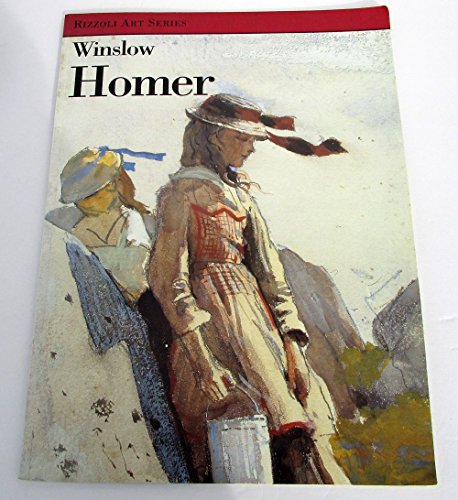
Winslow Homer (Rizzoli Art Classics)
Cikovsky, Nicolai Jr.
ISBN 10: 0847815838 ISBN 13: 9780847815838
Published by Rizzoli, 1992
Used
Paperback
From
Your Online Bookstore, Houston, TX, U.S.A.
Seller rating 5 out of 5 stars

AbeBooks Seller since July 6, 2010
This specific item is no longer available.
About this Item
Description:
Seller Inventory # 0847815838-3-21280535
Synopsis:
Briefly describes Winslow Homer's life and career, shows fourteen of his major paintings, and includes comments on their composition
From Library Journal:
The 19th-century realist Winslow Homer first gained wide renown with his Civil War battlefield illustrations in Harper's Weekly. A year spent in Paris after the war led to a greater acuity of vision, and by the mid-1870s he was one of the leading progenitors of naturalism and the most celebrated American painter of his day. Known for his watercolors, which have all the intensity and ardor of the most accomplished oil paintings, the solid outlines and luminosity of his surfaces show little influence from his contemporaries the Impressionists. His art was unquestionably individual and native. He was a reclusive outdoorsman who captured dozens of scenes highlighting the milieus he loved: seafaring vessels, Adirondack and Canadian hunting grounds, Bahamian beaches, and the rocky coast of Maine, to which he retreated in his last years. This outstanding new book is the catalog of a retrospective of 235 paintings touring East Coast museums?the largest gathering of his work ever. Cikovsky and Kelly (curators of American and British art at the National Gallery of Art) divide his career into eight chronological chapters, each with a straightforward, expository essay securely planting the work in a geographical and biographical context. The format is large but unostentatious, striking the perfect balance between text and illustration. This is easily the fairest, most intelligent, and best survey to date on this popular American master.?Douglas F. Smith, Oakland P.L., Cal.
Copyright 1996 Reed Business Information, Inc.
"About this title" may belong to another edition of this title.
Bibliographic Details
Title: Winslow Homer (Rizzoli Art Classics)
Publisher: Rizzoli
Publication Date: 1992
Binding: Paperback
Condition: Good