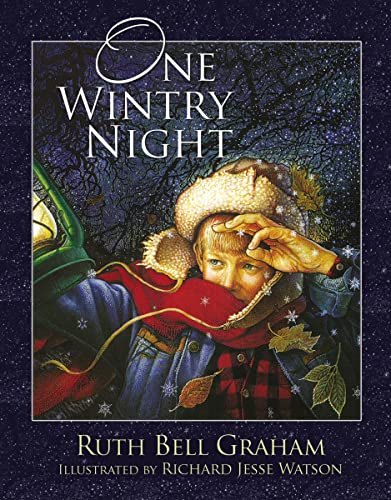
One Wintry Night
By Ruth Bell GrahamThomas Nelson
Copyright © 2012 Ruth Bell Graham
All right reserved.ISBN: 978-1-4003-2116-2 Chapter One
Caught in the Storm
The boy hunkered down and yanked his cap farther over his ears as the wind rose to a roar across the ridge. Low, dark clouds moving down from the north were bringing darkness early. A snowflake touched his cheek. The boy was mountain tough, but his grandpa had warned him against taking a long hike alone on such a cold day. Still, the boy had the urge.
He loved the mountains—especially the Seven Sisters. They were home to him. He'd lost track of how many times he had hiked them. His grandpa used to climb with him; only Grandpa's heart wasn't up to it now.
Another gust of wind caught the boy off balance. Grabbing a tree for support, he lit the old possum lantern against the oncoming darkness. Then, in its flickering yellow glow, he noticed the leaves of the laurel were curled up tight like pencils in the bitter cold.
Again the roar of the wind rose in the bare branches above him. The boy wasn't scared, but for the first time he wondered if he would make it home.
He wasn't only mountain tough; he was mountain smart. He figured he was well past Big Piney now. Then he remembered the cove, the one his great-grandpa had settled. It couldn't be far—on the south side of the ridge between Big Piney and Stompy Knob. Other folks had bought the property from the mountain family some time ago. His grandpa used to tell stories of how he had helped build the place for them, fetching rocks from the mountain streambeds—even from old still furnaces—for the chimneys and walls.
If the boy could make it down there, they'd let him in.
* * *
Inside the log and frame house, the woman heard the dogs bark. Not a friendly bark, but mean and fierce. She turned on the outside lights, peering through the little window by the front door. They were quiet now. But something was going on out there.
The wind sounded like a freight train coming over the ridge, and the snowflakes were blowing sideways instead of falling straight down.
Then she saw them, the two big dogs with a boy walking between, like he'd known them before.
The woman opened the door.
"I'm Zeb Morris," the boy yelled breathlessly as he ran toward the lighted entrance. "My grandpa, he helped build this—"
Before he could finish the sentence, the boy stumbled. The woman caught him and helped him inside.
Chapter Two
The Boy and the Woman
Next morning the boy woke up and peered drowsily out the window upon a strange world. Where the sky was usually blue, the clouds were almost black. And where the ridge should have risen dark, it was white and soft. The dark, leafless trees—they, too, were white. And huge snowflakes were falling silently.
Snow always filled the boy with excitement. He jumped from the big bed before noticing how high it was, and nearly cried out in pain. He didn't. But when he looked at the ankle he had twisted last night, he saw it was swollen and blue.
"Doggone it!" he exclaimed. Now how would he get home? He pulled on all but his left sock and shoe and limped across the hall to what looked to be the kitchen.
"Good morning, Zeb," the woman said.
"Mornin', ma'am," he replied. The smell of frying bacon, fresh coffee, and wood smoke made him feel at home.
He stood shyly beside the door, the large gray-and-white-striped cat rubbing against his good leg.
"Lost a shoe?" the woman asked.
"No'm. Comin' down by the old bear's den last evenin' where it's almighty steep, I twisted it. Didn't really notice it till I jumped off that bed. It shore is high."
"That's because there's a trundle bed under it. Now, let me have a look."
With gentle hands she carefully felt the ankle.
"You've got a bad sprain. We'll soak it in ice water, then wrap it well. I'm afraid you couldn't have hiked home today anyway. We're snowed in. I called a friend in North Fork to get word to your grandfather that you are here."
"I'm obliged to you," the boy said.
He stuffed down two helpings of the scrambled eggs and bacon while the puffy ankle soaked in a pan of water. Then the woman carefully wrapped it in a wide elastic bandage.
"You take this cane," she said, "and explore the house to see what your grandfather helped to build. If your ankle begins to hurt, climb on a sofa and raise your ankle with some pillows. I'll read to you and we'll talk about your grandfather. When evening comes, if you like, I'll tell you the Christmas story."
* * *
It had been a full day, a fun day. By the time darkness fell, snow had covered the second rail of the fence outside the living room window. The woman lit a fire in the fireplace that was large enough for a boy to stand in. A Christmas tree with little white lights that twinkled against the old hewn logs reached to the beamed ceiling. The boy leaned back, a pillow tucked comfortably behind him and another under the sprained ankle.
"I like your house," he said suddenly. "Feels like home."
"That's the nicest thing anyone could say about it," she said, smiling. "It's fun dressing it up for Christmas—always has been. We have five children, and they're all married now with homes of their own. But we dress up Little Piney Cove for Jesus' birthday every Christmas, and if any of them can come home, they're more than welcome."
"Got any grandkids?"
"Nineteen."
"Golleee!" the boy exclaimed. "Just like some mountain folks."
"Thank you, Zeb. I consider that a real compliment. You know," she continued, eyes smiling, "there's a gift for you under the tree."
"For me?" Gray eyes widened in surprise.
From among the piles of gifts awaiting the family's arrival, she picked up a long, skinny one wrapped in bright red with a shiny ribbon.
Slowly he opened it. Unused to gifts, he didn't want to spoil the ribbon or tear the paper. There across his lap lay a walking stick made from a vine-strangled sapling.
"It was here when we bought the place," explained the woman. "They said it belonged to your grandfather. When you showed up last night, I remembered it. I said to myself, 'This stick ought to belong to Zeb.'"
The boy's hands felt along the curved groove left by the vine, his eyes bright.
"I shore am pleased t' get it," the boy said, "mighty pleased ..." And he couldn't say any more.
"Now," the woman announced, "the Christmas story!"
Chapter Three
In the Beginning
The woman put a log on the fire, which exploded into hundreds of tiny red stars. They twinkled against the sooty back of the fireplace and disappeared up the chimney.
"The first Christmas happened almost two thousand years ago," she began. "That's when the angel appeared to shepherds outside Bethlehem. But the story doesn't begin there. It couldn't have because the angel called Jesus a 'savior,' or a rescuer. Someone must have been in trouble.
"To find out about it, we have to jump into a time machine and go back before Mary and Joseph were born. Back before there was any town of Bethlehem. In fact, so far back there was no earth. (Whoops—now our time machine has nothing to sit on!)"
She glanced at him, and the boy grinned back. Then she continued.
* * *
In the beginning, the earth was shapeless and empty, and darkness was over the face of the deep. Then God began to move.
"Light!" God commanded in a voice that cracked like thunder. There was a brilliant flash, and God separated the light from the darkness.
Next He set the sun, moon, and stars in their orbits. Then He shaped our earth and began filling it with wonders. He scooped out deep oceans and heaped up high mountains. In the oceans He put huge fish, prickly sea urchins, octopuses, and great sea turtles. On the mountains He set down goats, bears, and bobcats. The valleys and plains He filled with all sorts of surprises: porcupines, tigers, parrots, and deer, then rhinoceroses, giraffes, and warthogs.
You couldn't count all the creatures He made. Some looked like they were made with love, others with a chuckle. Some even looked like a bad joke. And not one was exactly like any other. It was a real zoo.
Then came the most exciting moment of all. God made a man and a woman to rule over all He had made. He called the man Adam, and the woman He called Eve. He brought all His creatures to Adam so the man could give them names. Whatever Adam decided to call them, that became their name—whether an owl, a whale, or a pig. Adam must have had a ball!
God was enjoying Adam and Eve; in fact, He loved them more than anything else He had created.
He chose the most beautiful spot on earth for them to live—the garden of Eden. And He gave Adam and Eve everything they needed to be happy. They had crystal clear rivers to drink from and swim in, nuts and berries to eat, vines to swing on, flowers to smell, and birds to sing them songs. They didn't need clothes, and were not embarrassed.
They didn't need spears or slings, for they had no enemies. The lions purred instead of growling. Horses and hyenas came loping and leaping when Adam called because they knew he was their loving master.
Adam and Eve had a wonderful time as they pruned branches and turned the soil around the plants. Working was fun, and they never grew tired. In the afternoon, when the last tool was put away, Adam and Eve would run with the antelope, swim with the otter, and sing with the oriole.
The best part always came in the cool of the day. As the leaves began to dance in the gentle evening breezes, God would walk with Adam and Eve in the garden.
Everything was beautiful; it looked like all would live happily ever after.
* * *
The woman's voice trailed off. She sat silent, thinking.
"Did they?" the boy asked.
"No, I'm afraid not," she said. "For soon, something was about to go terribly wrong in the garden."
Chapter Four
The Testing Tree
The woman paused briefly and adjusted the cushion near the boy's ankle. Tickled that the cat was curled up on Zeb's chest, she tended the fire and began again.
* * *
In the very center of the garden of Eden, God planted a beautiful tree. Prettier than any Christmas tree, its ornaments were a strange and lovely fruit. But this tree was off-limits to Adam and Eve. For this was the Testing Tree.
God put it there on purpose, to test and see whether Adam and Eve would obey Him.
Of course, He could have made humans more like other creatures, which do things without question. A caterpillar does not ask himself, "Let's see. Shall I spin myself into a cocoon and turn into a butterfly? Or is it more fun to be a caterpillar?" He just does what he does and cannot do otherwise.
God had decided He wouldn't get much pleasure from humans who acted like caterpillars. He wanted people who would obey Him and be His children because they chose to.
And so the Testing Tree! It wasn't a hard test—not like putting a candy bar in front of you and saying you mustn't eat it. After all, there were lots of other trees in the garden of Eden. Plenty of juicy apples and oranges to choose from, and figs, grapes, cherries, plums—better than the best candy bars.
God told Adam to help himself to all but that one tree in the middle of the garden. "For if you eat of it," He said, "you will surely die." This is when all the trouble started.
One day a serpent slipped through the bushes and whispered to Eve in a smooth, silky voice, "Did God really say, 'You must not eat from any tree in the garden'?"
"Oh, no," Eve replied. "We can eat from most trees. But the fruit that grows on the tree in the middle of the garden is not for us. God told us that if we eat it, we will die."
The serpent's forked tongue f licked out and about as he said slyly, "S-s-urely you won't die. God knows when you eat it you will begin to understand secrets. You will become as wise as He is. Just take it," the serpent urged.
This serpent, as you might already know, was no ordinary snake. It was really a disguise—a costume—for Satan himself. Satan had once been an angel called "son of the morning." But he was a real troublemaker, and in his pride he had begun to want to be as great and wise as God Himself. So Satan fell from heaven, sending shock waves still felt today.
Now, seeing Adam and Eve, whom God loved, Satan thought of a way to get even. A way to spoil God's plan.
To Eve, the snake's words sounded exciting. She ran to the center of the garden and looked up into the branches of the Testing Tree. There, ripe and tempting, hung the fruit. She remembered what Satan said about it making her as wise as God.
So she picked one. For a moment, she wondered if it would really kill her. She took a tiny bite of it and waited. Nothing happened. She waited some more. Still nothing. Eve felt as strong as ever, and the fruit was so sweet! Quickly she gulped down the rest of it. Then picking a piece for Adam, she took it to him. Adam ate it.
And joy died; fear came.
What Adam and Eve did doesn't sound too awful, does it? No worse, anyway, than stealing cookies from the cookie jar. But this was the first time anyone on earth had ever disobeyed God. And from that day on, all was ruined.
When Adam and Eve failed the test at the Testing Tree, it may not have been the end of the world. It was, however, the end of the happiness God's world had enjoyed. Every horrible thing you can think of—sickness, war, loneliness, thorns, nightmares—got its start the moment Eve disobeyed God. And since God loved His children, He already knew He would come to our rescue. From the beginning of time, we needed Christmas.
Meanwhile God had to deal with Adam and his wife.
Now, where had they disappeared to?
Chapter Five
Eden Lost
The boy's eyes were solemn as he listened. The cat, no longer curled up, was sprawled out across the boy, sound asleep.
"Would you like a cup of hot chocolate?" the woman asked. "No, thank you, ma'am. What happened next?"
* * *
That evening, in the cool of the day, Adam and Eve walked in the garden.
"Adam," God called, "where are you?"
Adam and Eve looked at each other in terror. Always before they had run to meet Him. But now they were shaking. For the first time, they did not want to be near God. They wanted to run away, to put their fingers in their ears and pretend they didn't hear Him.
So they dashed behind some trees and waited, hoping God would go away. It had been like this all day. Waiting ... feeling afraid ... waiting ... feeling guilty ... waiting some more. Sure, when they tasted the fruit that morning, nothing had seemed to happen. Yet God's words kept echoing in their minds: "If you eat the fruit, you will die."
Perhaps, they thought, God did not really mean it. After all, we are still alive, aren't we?
But when God said they would die, He meant their friendship with Him would die. They would want to live without Him. And they would die inside.
So they did. Adam and Eve started to feel things they had never felt before—rotten things like fear and anger and shame. Their bodies slowly began to get older. They felt tired, even sick at times—a hint that, sooner or later, their earthly lives would be no more.
And God knew that after this death there awaited a death that would never end.
Adam slowly came out from behind the trees. Trembling, he said to God, "I heard Your voice in the garden and was afraid."
"Have you eaten from the tree I told you not to eat?" God asked.
Adam replied, "The woman You gave me—she gave me some fruit from the tree and I ate it."
"Eve!" God said sternly. "What is it that you and Adam have done?"
"The snake did it!" Eve protested. "He talked me into it! It was his fault!"
But God is not impressed by excuses. All three had sinned—which means they had disobeyed Him. And all three had to be punished.
God turned first to the snake. "You will crawl on your belly and eat dust all the days of your life." Ever since then, as you well know, snakes have slithered along the ground.
Turning to Adam and Eve, God said, "Now you will find life hard; you must leave the garden." Then He made coats of skins to clothe them, for they were ashamed.
Adam and Eve looked with horror at the skins. They recognized the fur; it had belonged to their animal friends.
Darkness fell. Over the garden swept a great storm—low, black clouds boiling. The leaves of the Testing Tree began shaking, and all the other trees bent low in the howling wind. It struck Adam and Eve with such force, they ran to keep from falling.
So God drove them out of the garden. At the entrance, He placed a tall angel with a flashing sword to block the way back.
Outside Eden, life was cold and hard. Instead of simply reaching up into the trees for dinner, Adam and Eve had to plant seeds and pull weeds to raise their own food. Working was exhausting. Thorns and bugs thrived. Rottenness, decay, germs—all these ugly things came as a result of Adam and Eve's sin. The earth and all who lived on it were under a curse.
The garden of Eden had been Adam and Eve's home. But what really made them feel at home was the loving presence of their heavenly Fatherly. God Himself had been their true "home." Now all was lost. Adam and Eve were the world's first home less people.
Chapter Six
The Man Who Listened
That ain't the end," the boy said hopefully as he smoothed the purring cat.
"No." The woman smiled. "It's just the beginning. You see, God was determined to make a way for man to come back Home. It happened like this ..."
* * *
God still loved these people He had made. For He does not change. No matter how badly Adam and Eve had sinned, they were still His. So, though He drove them from the garden, He continued to watch over them.
Many years passed, and God kept watching over Adam and Eve. They had two sons, Cain and Abel. When these boys grew up, Cain killed Abel, his only brother. For the first time ever, Adam and Eve saw someone dead—and their own son at that! They wept till there were no tears left and awoke the next day to weep again. They realized once more what a terrible thing it is to disobey God.
Adam and Eve had more children, and those children had children until there were whole cities of people—and most of them acted as badly as Cain. God kept looking for someone who would listen to Him and obey. Someone to whom He could be a friend. But they didn't listen. Just as the first two people forgot about God, so did those who came after them.
Instead of living in peace, they fought with each other. The soldier who killed the most people was the greatest hero. And when they weren't fighting, the children of Adam liked noisy pleasures. At their parties, they stuffed themselves, shouted, and drank far into the night.
In all the noisy confusion people did not hear the voice of God speaking to their hearts. No one heard Him saying, over and over, that this was not the way to live, that this was not what He had created them for.
God saw how wicked the people had become; their thoughts were continually evil. It made Him very angry. Grieving, He decided to wash mankind from the face of the earth so He could start all over again.
In all that wickedness, one man stood out. For he was just and upright, a man who walked with God. His name was Noah. God decided to save Noah and his family from the flood that was coming. He told Noah to build an ark—a huge boat with many rooms inside. And God told him exactly how to build it.
(Continues...)
Excerpted from One Wintry Nightby Ruth Bell Graham Copyright © 2012 by Ruth Bell Graham. Excerpted by permission of Thomas Nelson. All rights reserved. No part of this excerpt may be reproduced or reprinted without permission in writing from the publisher.
Excerpts are provided by Dial-A-Book Inc. solely for the personal use of visitors to this web site.