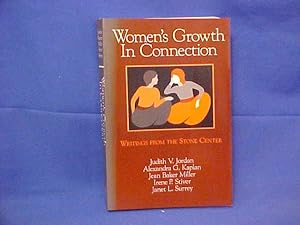
This book presents an innovative relational perspective on women's ways of being in the world. It offers an alternative to traditional models of human development that define health and maturity in terms of separation and consistently define women as deficient. Written by leading clinicians and teachers from the Stone Center at Wellesley College, the book foregrounds women's meaning systems, values, and organization of experiences, which often revolve around relationships rather than the self. The authors set out basic relational principles and consider the implications for life challenges that many women face, as well as for psychotherapy.
JudithV Jordan, Ph.D., is the Director of the Jean Baker Miller Institute, the Stone Center, Wellesley College, and Assistant Professor of Psychology at Harvard Medical School. She has received several prestigious awards including: the Massachusetts Psychological Association's Career Achievement Award for Outstanding contributions to the advancement of psychology as a science and a profession; Doctor of Humane Letters from New England college with"utmost admiration for your contritbution to the science and practice of psychology"; the Distinguished Psychologist Award for contributions to psychology and psychotherapy, division29 of the of the American Psychological Association" ( given to one psychologist from the United States or Canada each year).; the Mary Margaret Vorhees Distinguished Professor at the Menninger School of Psychiatry and Mental Health Science, in recognition of an outstanding teacher and contributor in the field of psychiatry/psychology; commendation from Harvard University Department of Clinical Psychology for outstanding academic performance; She published about twenty chapters, 50 journal articles, 10 books (authored or edited). and has presented at over 1000 conferences and workshops. She has appeared on the Oprah Winfrey show. Jon Carlson, co-editor of the
American Psychological Associations' Theory of Psychotherapy series, referred to RCT (Relational-Cultural Theory) as one of the ten most important psychological theories today." Jean Kilbourne, noted speaker and feminist leader, noted "Relational Cultural theory not only changes individual lives, it has the power to transform the world". The work is increasingly recognized for its insights into establishing social justice. As Aaron T Beck ,the father of cognitive therapy said, "RCT embodies an outstanding advance in psychotherapy with broad implications for social justice by challenging stratification and marginalization and promoting connectedness and relationships,"