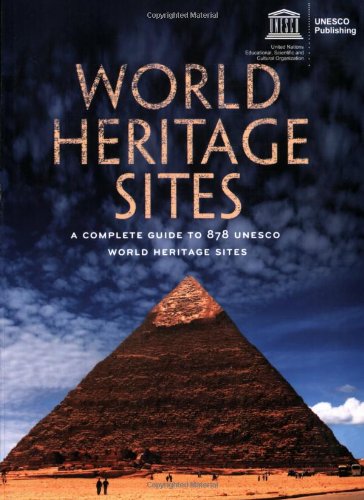
Updated for 2010, this guide fully describes every official UNESCO World Heritage site.
In 1959, UNESCO launched an international campaign to safeguard the world's most important sites, which led to the first World Heritage List. In clear text that highlights all the fascinating facts, this revised edition of World Heritage Sites details all 890 properties, including the 13 new sites added in 2009.
Covering 148 countries, the World Heritage List has proved to be a valuable tool in the battle to preserve much of the world's cultural and natural heritage. Its strict criteria result in only the world's most spectacular and extraordinary sites making it onto the list, including:
- The Statue of Liberty in New York
- The Rideau Canal in eastern Ontario
- Waterton Glacier International Peace Park, the world's first international peace park, which straddles the US-Canada border
- The ancient Nabataean city of Petra in Jordan
- The remarkable Dazu Rock Carvings in China
- Cahokia Mounds State Historic Site in Missouri, the largest pre- Columbian settlement north of Mexico
- The unique ecosystem of the Serengeti in Tanzania
The new sites added to this edition are:
- Stoclet House in Belgium
- The Ruins of Loropeni in Burkina Faso
- Cidade Velha, the historic center of Ribeira Grande, in Cape Verde
- Mount Wutai in China
- Shushtar, a historic hydraulic system in Iran
- The Dolomites in Italy
- The royal tombs of the Joseon Dynasty in South Korea
- Sulamain-Too Sacred Mountain in Kyrgyzstan
- The Wadden Sea in Germany and the Netherlands
- The Sacred City of Caral-Supe in Peru
- The Tower of Hercules in Spain
- La Chaux-de-Fonds and le Locle, historic centers of watch-making and town-planning in Switzerland Pontcysyllte Aqueduct and Canal in the United Kingdom
Featuring gorgeous photographs and updated maps, World Heritage Sites is uniquely comprehensive.
The United Nations Educational, Scientific and Cultural Organization (UNESCO) was founded in 1945 with the ambitious goal to build peace in the minds of men and women through education, social and natural science, culture and communication.
World Heritage sites are decided each year by a 21-member intergovernmental committee only after a rigorous preselection, nomination, and evaluation process. According to this highly attractive and informative guide, selected sites “must be of outstanding universal value and meet at least one out of ten selection criteria,” such as human creative genius, significance in human history, or natural phenomena or beauty. Moreover, “the protection, management, authenticity, and integrity of properties are also important considerations.” It is because of failures in some of these areas that certain properties have been removed from the list of World Heritage sites. What makes this compact, sturdily covered and bound paperback an invaluable reference book is its coverage of the complete list of current sites; organization by date of selection as well as access by country and alphabetical indexes; nearly 900 maps (including one the size of a large postage stamp pinpointing each site in its country and region); at least 100 words of text for each site, but in many cases a full page; and a photograph (from tiny to full page) for most of the sites. The dozens of entries given fullest coverage contain text and a small map on one page and a full-page or two half-page photographs on the facing page; such entries include Grand Canyon National Park, Old City of Jerusalem and Its Walls, and Historic Monuments of Ancient Kyoto. Though the phrase “recommended for all libraries” is overused, no school, public, or academic library could go wrong including the very affordable World Heritage Sites in both reference and circulating collections. The official World Heritage Web site, which includes many additional photographs and features, is also highly recommended. --Craig Bunch