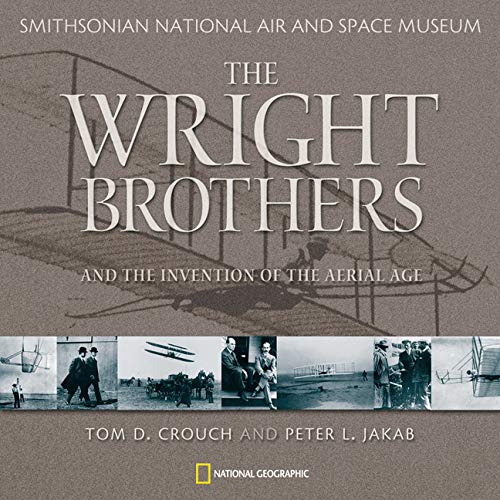
With the hundredth anniversary of the Wright Brothers’ history-making flight at Kitty Hawk, world attention is once again turning to these intrepid American inventors. Written by two of the world’s leading experts on the Wrights, The Wright Brothers and the Invention of the Aerial Age will provide a definitive, richly illustrated look at the lives of the brothers and their world-changing invention.
Wilbur and Orville were two eccentric owners of a bicycle shop in the heartland. But it was invention, engineering, and the new possibilities of manned flight that obsessed them. In just three years, they went from designing and flying a glider and creating a test wind tunnel to Wilbur’s history-making moments in December 1903 above the dunes at Kitty Hawk, North Carolina. In moving prose, Crouch and Jakab explain the Wrights’ achievements and the moments of their great successes, and they paint a masterful personal portrait of the two sometimes erratic, genius personalities (never married, the brothers lived together all their lives), and, most important, the world of pioneering aviation in which they operated.
Poignant archival photographs throughout the book capture that world, where ox carts and airplanes co-existed and where two determined brothers from Dayton were celebrated by presidents and kings. But the most poignant of all the images remains that of an airplane, almost kite-like in its simplicity, struggling skyward from the dunes at Kitty Hawk.
This is the latest book marking the hundredth anniversary of the Wright brothers' epic flight at Kitty Hawk. Crouch and Jakab, curators at the Smithsonian National Air and Space Museum, trace the brothers' lives from their early years in Dayton, Ohio, and the events leading up to the invention of the airplane. The authors describe how the two men spent five years of work on a flying machine before the first flight; their relationship to Octave Chanute, "the grand old man of aeronautics"; their problems in obtaining an engine that met their weight limitation; and the flight itself. "At every critical juncture in the Wrights' journey to practical flight, these innate skills and approaches to invention are readily apparent," the authors write. "As we follow the brothers' remaining steps toward final success, it will become clear that Wilbur and Orville were far more than fine mechanics who managed to coax a flying machine into the air." With 100 archival photographs, this work offers the most comprehensive portrait of these ingenious brothers yet written. George Cohen
Copyright © American Library Association. All rights reserved