Andrew Wender Cohen
Andrew Wender Cohen is a historian and professor at Syracuse University's Maxwell School of Citizenship and Public Affairs. He obtained his undergraduate degree at Columbia University and his doctorate at the University of Chicago.
Cohen specializes in the history of crime, especially the intersection of crime, law, and capitalism.
In a recent interview with the Organization of American Historians, he described his process:
"To keep me interested for during the lengthy writing process, a topic has to appeal to me on three levels: the intellectual, the political, and the personal.
The intellectual. I wanted to study the clash between globalization and nationalism, but I did not want to bore readers with the traditional discussion of tariffs and treaties. It occurred to me that smuggling could reveal how the federal government actually regulated relations between Americans and the world before the United States became a global power. And this also offered a perspective on the developing American state.
The political. I started thinking about the project in 2005 during the Iraq War. I wondered how the United States, a nation that once lacked a standing army or a navy, became a superpower engaged in wars of choice on other continents. I dwelled on the contempt some Americans had for coastal urbanites, like myself, whom they deemed effete, cosmopolitan, and unpatriotic. I wanted to know where that trope came from. And smuggling helped answer both questions.
The personal. I had an twice-great uncle, Ed Stern, who made his living as a smuggler in Regina, Saskatchewan. He died when I was a teenager, and I heard stories of his exploits. One time, my grandfather had to bail him out when he was caught entering the U.S. carrying too much currency. When he died, his sister went up to Canada searching for his gold hoard, which he allegedly hid in an old automobile. Around 1910, he had run away from his mother, a widowed abortionist in a Washington, D.C. ghetto. When he was in his eighties, he shot at the Royal Canadian Mounted Police, who seized $400,000 in jewelry (about $1.8M today) from his house.
And yet, because of NAFTA, most of Ed’s activities today would be legal. Something that was deeply criminal in the 1970s is now acceptable and even romantic."
Popular items by Andrew Wender Cohen
View all offers-
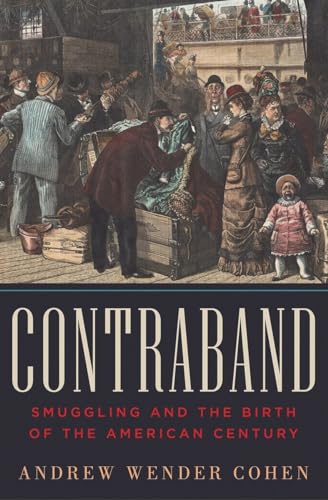
Contraband: Smuggling and the Birth of the American Century
Cohen, Andrew Wender
Item prices starting from
View 40 offersUS$ 4.67
-
The End of the Ottoman Empire and the Forging of the Modern Middle East: A Short History with Documents (Passages: Key Moments in History)
Wender, Andrew; Bunton, Martin
Item prices starting from
View 25 offersUS$ 21.51
-
The Racketeer's Progress: Chicago and the Struggle for the Modern American Economy, 1900–1940 (Cambridge Historical Studies in American Law and Society)
Cohen, Andrew Wender
Item prices starting from
View 34 offersUS$ 24.84