

Mikhail ?pshte?n
Mikhail Naumovich Epstein (Russian: Михаи́л Нау́мович Эпште́йн; born 1950) is an Anglo–American and Russian literary theorist and critical thinker. Mikhail Epstein is S. C. Dobbs Professor of Cultural Theory and Russian Literature at Emory University, USA, and Professor of Russian and Cultural Theory at Durham University, UK. He moved from the USSR (Moscow) to the USA (Atlanta) in 1990 and from the USA to England (Durham) in 2012. He is founder and director of Centre for Humanities Innovation at Durham University.
His research interests include cultural and literary theory, the history of Russian literature and philosophy, Western and Russian postmodernism, semiotics and linguistics, and new methods and interdisciplinary approaches in the humanities. He is especially interested in the practical extensions and applications of the humanities and their creative contributions into the areas of their study. Mikhail Epstein is the author of 30 books and more than 700 articles and essays, many of which are translated into 23 languages.
Epstein was born in Moscow of Jewish heritage. He was the founder and director of the Laboratory of Contemporary Culture in Moscow.
He moved to the USA in 1990 and was fellow of Woodrow Wilson International Center for Scholars (Washington D.C.) in 1990-1991. He joined Emory faculty in 1990. In 1992-1994 he received grant from National Council for Soviet and East European Research to work on the history of Russian thought of the late Soviet period. He has authored inteLnet and a number of other interdisciplinary web sites in the humanities.
Mikhail Epstein's work is a growing compendium of ideas that diverge from the existing paradigms in the humanities. His favorite intellectual occupation is inventing new disciplines and methods. His writings are full of proposals for such disciplines, for new genres and concepts, and for new words to describe them.
Moscow period
While engaged in his scholarly work on Russian and comparative literature, Epstein struck out in two related directions: involvement with Moscow's "underground" poetry scene, establishing close ties with the Conceptualists and Metarealists; and the establishment of a new type of cultural interaction and its institutions, a virtual 'laboratory' for what he calls "transculture." In 1983–1988 he published several influential manifestos on the new poetic and intellectual trends in such journals as "Voprosy literatury", "Oktiabr'" and "Novyi mir". He has written both under his own name and under a variety of heteronyms, including the spiritual teacher Iakov Abramov, the sexual theorist Ivan Solovyov, and the Marxist sociologist of religion R. O. Gibaydulina. He has been both a central analyst and publicist for Russian postmodernism as well as its pathologist, having declared it dead in the mid-1990s.
In 1982, attempting to expand interdisciplinarity and the "crossing" of intellectual borders, Epstein founded and directed the Essayists' Club in Moscow. Its purpose was to explore and inspire the growth of a genre that he considered the most appropriate to postmodern culture: it is the genre "legitimated by its existence outside of any genre" ("Russian Postmodernism," pg. 152), existing by its nature on the margins of all genres. For six years (till 1989) the members of the Club met regularly (once in three weeks) to practice "collective improvisations", the brainstorming sessions of writing on the topics emerging during the discussion. Later, under glasnost', Epstein started the association known as "Image and Thought"(1986-Present); one of his projects was the establishment of a "Bank of New Ideas and Terms."
American period. Major Projects and Evolution of Interests
In the 1990s, Epstein dealt with issues of postmodernism and the emergence of a new, future–oriented cultural formation coming to take its place under the name of "proto–", "or proteism" ("After the Future: The Paradoxes of Postmodernism and Contemporary Russian Culture", 1995; "Russian Postmodernism: New Perspectives on Post-Soviet Culture", with Alexander Genis and Slobodanka Vladiv- Glover, 1999; revised and expanded edition in 2016).
At the same time, Epstein was drawn to the interdisciplinary approach involving the juxtaposition and interplay of different cultures, particularly Russian and American culture which helped him formulate the concept of transculre and transculturalism in its distinction from "melting pot" and multiculturalism models ("Transcultural Experiments...", 1999). His interests gradually migrated toward the field of philosophy and metaphysics, especially modality theory ("Filosofiia vozmozhnogo" [The Philosophy of the Possible], 2001), as well as modern theology, with a focus on researching the spiritual condition of a post-atheist society ("Religiia posle ateizma. Novye vozmozhnosti teologii [Religion After Atheism: New Opportunities for Theology], 2013).
In the 2000s, Epstein also began to be interested in linguistics and its transformative potential — how it can influence the development of language and broaden its lexical-morphological system (Dar slova. Proektivnyi leksikon russkogo iazyka [The Gift of the Word: A Projective Lexicon of the Russian Language], 2000-16).
In the 2000s and 2010s, Epstein have become increasingly concerned with the fate of the humanities as a whole and the potential for developing humanities-based practices and technologies capable of influencing the lifeof society. This is the subject of the books "Znak probela. O budushchem gumanitarnykh nauk" (Mapping Blank Spaces: On the Future of the Humanities, 2004), "The Transformative Humanities: A Manifesto" (2012), and "Ot znaniia — k tvorchestvu. Kak gumanitarnye nauki mogut izmeniat’ mir" (From Knowledge to Creativity: How the Humanities Can Change the World, 2016).
Ideas and Terms
The synthesis of Epstein's work in various areas of the humanities is his monumental "Proektivnyi slovar' gumanitarnykh nauk" (The Projective Dictionary of Humanistic Disciplines, 2017) Predictionary, as Epstein defines this genre of future–oriented dictionary, does not register terms of the present, but anticipates a culture’s future developments, maps out its conceptual and terminological possibilities. This Predictionary contains 440 concepts and terms in 14 thematic areas that encompass general issues of the humanities, the philosophy of being and knowledge, society and technology, ethics, aesthetics, religious studies, culturology, literary studies, linguistics, and several new disciplines that are only now emerging. The purpose is to radically update the humanities’ conceptual and terminological apparatus, and to sketch their immediate and long-term prospects. This dictionary is heuristic in that it demonstrates various methods of meaning-making, of forming new ideas and concepts. It reflects intellectual, linguistic, and technological processes of the early third millennium that call for new methods of articulation. This is the logical extension of Epstein's previous work on the transformative humanities, or humanistic technologies, that are designed to transform the areas of their study (transpoetics, translinguistics, transaesthetics, etc.)
In the realm of aesthetics, Epstein (together with poet and conceptual artist Dmitry Prigov) is credited with introducing the concept of "new sincerity" (novaia iskrennost) as a response to the dominant sense of absurdity in late Soviet and post-Soviet culture.[4] In Epstein's words, "Postconceptualism, or the New Sincerity, is an experiment in resuscitating "fallen," dead languages with a renewed pathos of love, sentimentality and enthusiasm."[5]
In his exploration of contemporary spirituality, Epstein focuses on the concept of "post-atheism," or "minimal [or poor] religion," discussed in particular in his correspondence with the protestant thinker Thomas Altizer and extensively examined in Charles Taylor's book "The Secular Age" (2007) that refers to Epstein's innovative work. Evocative of both Italian "arte povera" and Grotowski "poor theater," "poor religion," apophaticism as a way of life, marks an entire post-athetistic generation: lacking a visible church, this generation finds God only at the borders of the religiously intelligible.
Bibliography
This list is incomplete; you can help by expanding it.
In library catalogs, publications are listed under the names: Mikhail Epstein, Mikhail Epshtein, Michail Epstein. 37 books published in English and Russian, and 19 books translated into German, Serbo-Croatian, Slovenian, Hungarian, Lithuanian, Ukranian, and Korean. Articles and essays have been translated and published in 23 languages. Full list of publications includes more than 700 items.
Books in English
The Irony of the Ideal: Paradoxes of Russian Literature. Boston: Academic Studies Press, 2017 ISBN 1618116320
Russian Postmodernism: New Perspectives on Post-Soviet Culture (with Alexander Genis and Slobodanka Vladiv-Glover). New and revised edition. New York, Oxford: Berghahn Books, 2016, 578 pp.(of 28 chapters, 19 are written by this author). http://www.berghahnbooks.com/title.php?rowtag=EpsteinRussian
(1st ed. 1999). ISBN 978-1-78238-864-7
The Transformative Humanities: A Manifesto. New York–London: Bloomsbury Academic, 2012, 318 pp.ISBN 9781441155078
PreDictionary. Berkeley: Atelos, 2011, 155 pp. (paperback). ISBN 1-891190-34-2
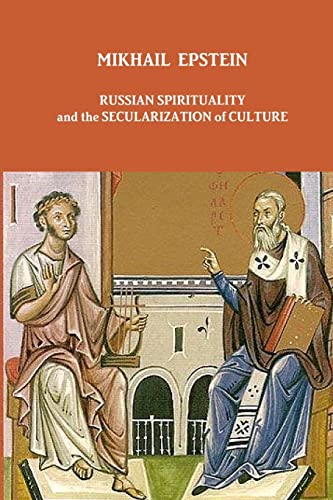
Russian Spirituality and the Secularization of Culture. New York: FrancTireur-USA, 2011, 135 pp.
Cries in the New Wilderness: From the Files of the Moscow Institute of Atheism. Trans. and intr. by Eve Adler. Philadelphia: Paul Dry Books, 2002, 236 pp. (hardcover and paperback). ISBN 0-9679675-4-6
Transcultural Experiments: Russian and American Models of Creative Communication (with Ellen Berry). New York: St. Martin's Press (Scholarly and Reference Division), 1999, 340 pp. (of 23 chapters in this book, 16 are written by this author). ISBN 0-312-21808-7
After the Future: The Paradoxes of Postmodernism and Contemporary Russian Culture, Amherst: The University of Massachusetts Press, 1995, 392 pp. Hardcover and paperback editions. Electronic edition, Boulder, Colo.: NetLibrary, Inc., 2000. ISBN 0-585-15509-7
Relativistic Patterns in Totalitarian Thinking: An Inquiry into the Language of Soviet Ideology. Kennan Institute for Advanced Russian Studies, Occasional Paper, #243. Washington: Woodrow Wilson International Center for Scholars, 1991,94 pp.
Books in English and Russian
Amerussia: Selected essays. / Amerossiia. Izbrannaia esseistika. (parallel texts in English and Russian). Moscow: Serebrianye niti, 2007, 504 pp.
The Constructive Potential of the Humanities. / Konstruktivnyi potential gumanitarnykh nauk. Moscow, Russian State University of the Humanities, 2006, 74 pp.
Books in Russian
SCHOLARLY BOOKS
Proektivnyi slovar' gumanitarnykh nauk (The Projective Dictionary of Humanistic Disciplines) (the author of all 440 entries in 14 thematic rubrics). Moscow: Novoe literaturnoe obozrenie, 2017, 616 pp.
Ot znania k tvorchestvu. Kak gumanitarnye nauki mogut izmeniat' mir (From Knowledge to Creativity:
How the Humanities Can Change the World). Moscow–S.–Petersburg, izd. Tsentr gumanitarnykh initsiativ (series Humanitas), 2016, 480 pp.
Poeziia i sverkhpoeziia: O mnogoobrazii tvorcheskikh mirov (Poetry and Superpoetry: On the Variety of Creative Worlds). S.–Petersburg: Azbuka (a volume in the series Cultural Code), 2016, 478 pp.
Ironia Ideala. Paradoksy russkoi literatury. (The Irony of the Ideal: Paradoxes of Russian Literature). Moscow: Novoe literaturnoe obozrenie, 2015, 384 pp.
Religia posle ateizma: Novye vozmozhnosti teologii (Religion after Atheism: New Possibilities for Theology). Moscow: AST-Press, 2013, 415 pp.
Slovo i molchanie. Metafizika russkoi literatury (Word and Silence: The Metaphysics of Russian Literature). Moscow: Vysshaia shkola, 2006, 550 pp.
Filosofiia tela (Philosophy of the Body). St.-Petersburg: Aleteia, 2006, 194 pp.
Znak probela: O budushchem gumanitarnykh nauk (Mapping Blank Spaces: On the Future of the Humanities). Moscow: Novoe literaturnoe obozrenie, 2004, 864 pp.
Proektivnyi filosofskii slovar'. Novye terminy i poniatiia (A Projective Philosophical Dictionary. New Terms and Concepts). St.-Petersburg: Aleteia, 2003, 512 pp. (coeditor with G. L. Tulchinsky and the author of the Preface and of 90 entries out of overall 165).
Filosofiia vozmozhnogo. Modal'nosti v myshlenii i kul'ture (The Philosophy of the Possible: The Modalities in Thought and Culture). St.-Petersburg: Aleteia, 2001, 334 pp.
Postmodern v Rossii: literatura i teoriia (The Postmodern in Russia: Literature and Theory). Moscow: LIA Elinina, 2000, 370 pp.
2nd edition, revised and expanded: Postmodern v russkoi literature (The Postmodern in Russian Literature). Moscow: Vysshaia shkola, 2005, 495 pp.
Vera i obraz. Religioznoe bessoznatel'noe v russkoi kul'ture XX veka (Faith and Image: The Religious Unconscious in Twentieth Century Russian Culture), Tenafly (New Jersey): Hermitage Publishers, 1994, 270 pp.
'Priroda, mir, tainik vselennoi. . .' Sistema peizazhnykh obrazov v russkoi poezii ('Nature, the World, the Mystery of the Universe...': The System of Landscape Images in Russian Poetry). Moscow: Vysshaia Shkola [the central university press of Russia], l990, 304 pp.
2nd, revised edition: Stikhi i Stikhii. Priroda v russkoi poezii 18 – 20 cc. (Verses and Elements: Nature in Russian Poetry of the 18-20 cc.). Samara: Bakhrakh-M, 2007, 352 pp.
Paradoksy novizny. O literaturnom razvitii XIX-XX vekov (The Paradoxes of Innovation: On the Development of Literature in the l9th and 20th Centuries). Moscow: Sovetskii Pisatel', l988, 4l6 pp.
BOOKS OF NON–FICTION. PUBLIC SCHOLARSHIP. CULTURAL, LITERARY AND PHILOSOPHICAL ESSAYS
Entsiklopedia iunosti (Encyclopedia of Youth), with Sergei Iourienen. Moscow: Eksmo, 2009, 590 pp.
Ot sovka k bobku. Politika na grani groteska (From Homo Soveticus to Dostoevsky's Bobok Character. Politics on the Edge of Grotesque). 2nd, revised and expanded edition. Kiev. Dukh i Litera, 2016, 312 pp.
1st ed. New York: FrancTireur-USA, 2015, 253 pp.
Prosto proza (Just the Prose). New York: FrancTireurUSA, 2016, 194 pp.
Kleikie listochki: Mysli vrazbros i vopreki. (Leaves in Bud: Scattered Untimely Reflections). Moscow: ArsisBooks, 2014, 266 pp.
Ottsovstvo: Roman–dnevnik. Fatherhood: A Novel–Diary. Moscow, Nikea, 2014, 320 pp. (3rd revised edition). Previous editions: Ottsovstvo (An Essay), Tenafly (New Jersey): Hermitage Publishers, 1992, 160 pp.; Ottsovstvo. Metafizicheskii dnevnik (Fatherhood. A Metaphysical Journal); 2nd revised edition, St.-Petersburg: Aletheia, 2003, 248 pp.
Sola Amore: Liubov' v piati izmereniiakh (Solo Amore: Love in Five Dimensions). Moscow: Eksmo, 2011, 492 pp.
Katalog (Catalogue), with Ilya Kabakov. Vologda: Library of Moscow Conceptualism published by German Titov, 2010, 344 pp.
Vse esse, v 2 tt., t. 1. V Rossii, 1970-e – 1980-e; t. 2. Iz Ameriki, 1990-e-2000-e (All Essays, or All is Essay), in 2 volumes: vol. 1. In Russia, 1970s-1980s; vol. 2. From America, 1990s-2000s. Ekaterinburg: U-Faktoriia, 2005, 544 pp. + 704 pp.
Bog detalei. Narodnaia dusha i chastnaia zhizn' v Rossii na iskhode imperii (A Deity of Details: The Public Soul and Private Life at the Twilight of the Russian Empire). New York: Slovo/Word, 1997, 248 pp. 2nd, revised and expanded edition. Moscow: LIA Elinina, 1998, 240 pp.
Na granitsakh kul'tur. Rossiiskoe - amerikanskoe - sovetskoe (On the Borders of Cultures: Russian - American - Soviet). New York, Slovo/Word, 1995, 343 pp.
Novoe sektantstvo: tipy religiozno-filosofskikh umonastroenii v Rossii, 1970-80-e gody (New Sectarianism: The Varieties of Religious-Philosophical Consciousness in Russia, the 1970s-1980s). Holyoke (Massachusetts): New England Publishing Co., 1993, 179 pp. 2nd edition, reprint, Moscow: Labirint, 1994, 181 pp.
3rd revised and expanded edition. Samara: Bakhrakh-M, 2005, 255 pp.
Velikaia Sov'. Filosofsko-mifologicheskii ocherk (Great Sov'. A Philosophical-Mythological Essay). New York: Word/Slovo, 1994, 175 pp.
2nd ed revised and expanded edition: Velikaia Sov'. Sovetskaia mifologiia (Great Owland. Soviet Mythology). Samara: Bakhrakh-M, 2006, 272 pp.
Professor Epstein has won national and international awards, including The Andrei Bely Prize (S.-Petersburg, 1991); The Social Innovations Award 1995 from the Institute for Social Inventions (London); the International Essay Contest set up by Lettre International and Weimar - Cultural City of Europe, 1999; and The Liberty Prize, awarded for "the outstanding contribution to the development of Russian - U.S. cultural relations" (New York, 2000).
Popular items by Mikhail ?pshte?n
View all offers-
Russian Postmodernism: New Perspectives on Post-Soviet Culture (Studies in Slavic Literature, Culture, and Society, V. 3)
Epshtein, Mikhail; Genis, Alexander; Vladiv-Glover, Slobodanka
Item prices starting from
View 22 offersUS$ 15.66
-
The Transformative Humanities: A Manifesto
Epstein, Mikhail
Item prices starting from
View 33 offersUS$ 8.59
-
RUSSIAN SPIRITUALITY AND THE SECULARIZATION OF CULTURE
EPSTEIN, MIKHAIL
Item prices starting from
View 15 offersUS$ 12.13
-
-
-
After the Future: The Paradoxes of Postmodernism & Contemporary Russian Culture (Critical Perspectives on Modern Culture)
Epstein, Mikhail N.
Item prices starting from
View 21 offersUS$ 39.09
-
Transcultural Experiments
Ellen E. Berry; Mikhail Epstein
Item prices starting from
View 20 offersUS$ 36.64
-




Showing 8 of 24 titles