Enrique Rodolfo Dick
Enrique Rodolfo Dick was born in 1950 in what is colloquially known as the "blue hills," a valley deep in the area of beautiful sierras very near the geographical center of the Argentine Republic. His first breath was taken in Villa General Belgrano, in the Province of Córdoba, Argentina. He studied at the German Elementary College of Villa Belgrano and later gained entrance to the Liceo Militar "General Paz" (The equivalent of a US Military College) where he not only received his military training, but also discovered his affinity for history and literature, subjects that would later highlight his road as a writer.
In 1968 he entered the Military Academy of the Army and in 1970 obtained the grade of second lieuten-ant. Then, he joins the parachute units and later enters engineering school. He graduated with the degree of mechanical and weapon engineer from Argentine University of the Army. In 1983 he received the prize for the Best Fellow of the University. In 1984 he went to France to obtain a degree in Aeronautics at the French High School of Aeronautics and Space (ENSAE). Mr. Dick returned to Argentina in 1986 and was detached to CITEFA (Argentine Armed Forces Institute of Scientific and Technical Research. During this attachment to CITEFA he advanced through several posts on different levels. He had the opportunity to publish papers on different scientific investigations and to direct several projects with some of the best Research and Development teams of the Argentine Armed Forces.
In 1989 his literary impulses found a channel when he decided to fulfill a promise made to him to write the history of his father. Dick's father was a member of the crew of the Graf Spee, the famous German pocket battleship that sank in the muddy waters of the River Platte in 1939. The resulting effort, a book titled "After the Wake of the Graf Spee," was published for the first time in 1995. That book became a best seller in Argentina. And a seventh edition was published recently.
Encouraged by the success of "After the Wake of the Graf Spee," he wrote "And when you return, son, have sense...." This book is a fact-based history of his grand uncle, who born in Argentina of French de-scendant and volunteered for service on the French front during WW I. Of this book about his grand un-cle, the author says that in a secret way,"And when you return, son, have sense...." is the book he loves most. In it he shows his affection for the Gaulois country, where he has life long-friends like Miguel Gi-gante who has always been kind to share memories of the past.
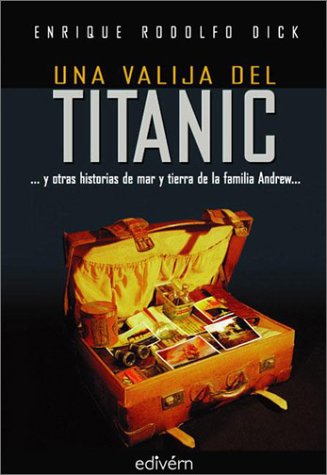
In 2002, he released to the readers two captivating books, "A suitcase from the Titanic," published by EDIVERN, and "Sails and Steam," published by the Argentine Naval Institute. In December 2003, he was promoted to Major General. In 2005, by request of CITEFA, General Dick completed a book on the his-tory of that institution, titled "CITEFA, Fifty Years of Involvement in (Argentine) Society and National Defense,"
In 2006, his dream of starting to publish a series of volumes on his natal town of Villa Belgrano became reality with "Vignettes of Villa General Belgrano."
Finally, he published in 2009 "El Corvo", A history of how General San Martin the Liberator of America obtained his Mameluke sword, called Shamshir in Persia, and the times and adventures he experienced between leaving Cadiz and arriving in Argentina.
Dick, Enrique Rodolfo (Argentina). Nació en Villa General Belgrano, Pcia. de Córdoba, en 1950.
Concurrió al colegio alemán de su pueblo natal y luego ingresó al Liceo Militar "General Paz" donde no sólo supo afianzar su vocación militar sino que plasmó con solidez su orientación a la literatura y la his-toria, disciplinas que habrían de jugar más tarde un papel trascendente en su camino como escritor.
En 1968 se incorpora al Colegio Militar de la Nación y egresa como subteniente de infantería en 1970. Destinado primero a unidades de paracaidistas, accede más tarde a la carrera de ingeniero. Como ingenie-ro militar en armamentos de la Escuela Superior Técnica del Ejército Argentino, es comisionado en 1984 a Francia a realizar una maestría en Aerodinámica, en la Escuela Nacional Superior de Aeronáutica y del Espacio. En 1986 regresa al país y es destacado al Instituto de Investigaciones Científicas y Técnicas de las Fuerzas Armadas (CITEFA), donde despliega diversos cargos. Allí, en contacto con científicos, in-vestigadores, desarrollistas y técnicos, lleva adelante profusa labor y tiene oportunidad de publicar traba-jos de su especialidad y dirigir proyectos para las Fuerzas Armadas.
Tras su paso por Fabricaciones Militares, asciende a General de Brigada en diciembre de 2003.
En el año 1989, como consecuencia de un impulso literario y en una suerte de necesidad de expresar sus inquietudes, hace y se hace una promesa de delinear la vida de su padre, antiguo tripulante del acorazado alemán Graf Spee, hundido en las marrones aguas del Plata en 1939.
Publica en 1995 Tras la estela del Graf Spee, libro de rotundo éxito y que habría de tener siete ediciones, la última en 2009.
Definitivamente volcado a las sagas familiares, compone Y cuando vuelva, hijo, que tenga juicio (1999), que resulta un vínculo con su tío abuelo, voluntario en la Francia de la primera guerra. Es, secretamente, su libro más querido... Allí, se muestra al escritor en toda su magnitud con el afecto por el país galo, donde sigue cultivando indisolubles amistades, como su querido amigo de ultramar, Miguel Gigante, quien siempre le supo abrir los archivos del pasado...
En 2002 lanza al público dos historias que atrapan: Una valija del Titanic (EDIVERN) y Velas y vapor (PUBLICACIONES NAVALES). Finalmente, CITEFA le encarga su historia, que se materializa en CITEFA, 50 años de compromiso con la sociedad y la defensa nacional (2005).
Para el año 2006 publica el libro Rasgos de Villa General Belgrano, Tomo I, donde recopila historias de su pueblo natal, en ocho capítulos, ilustrado con treinta fotografías de épocas pasadas.
En el año 2009 publica El Corvo (EDIVERN), la historia de la adquisición del sable del general San Martín en Londres en el período desde que el futuro libertador abandona Cádiz y llega a las tierras del Plata tras residir tres meses en la capital británica.
Actualmente prosigue un doctorado en Historia en la Universidad del Salvador (Argentina).
Popular items by Enrique Rodolfo Dick
View all offers-
Una Valija del Titanic - Y Otras Historias de Mar y Tierra de La Familia Andrew (Spanish Edition)
Unknown
Item prices starting from
View 1 offerUS$ 29.00
Also find
New -
El sable del general (Spanish Edition)
Enrique Rodolfo Dick
Item prices starting from
View 5 offersUS$ 59.34
Also find
New