James M. Doyle
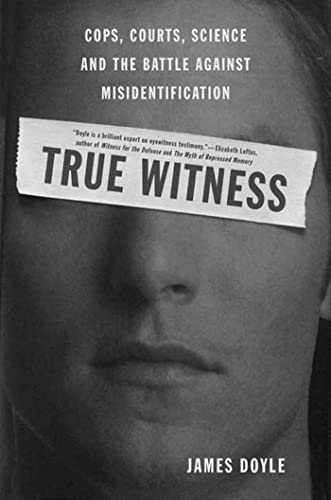
James M. Doyle is the author of the general audience historical narrative, True Witness: Cops, Courts, Science, and the Battle Against Misidentification, the story of scientific psychology’s 100 year battle to make its findings on eyewitness memory heard in the legal system, published by Palgrave MacMillan. A fourth edition of his treatise for lawyers, Eyewitness Testimony: Civil and Criminal (co-authored with Elizabeth Loftus and Jennifer Dysart) has just been issued. Mr. Doyle has published critical, scholarly, and practice-oriented articles on evidence, capital punishment, and race. He has written extensively for lawyers on the issue of eyewitness identification testimony in criminal cases.
He is also veteran litigator, whose experience has ranged from death row appeals to ground-breaking civil rights cases. Mr. Doyle has defended murder and other serious felony cases in the District of Columbia, freed death row inmates as a volunteer lawyer in in Georgia, and served as the head of the Public Defender Division of the statewide Committee for Public Counsel Services in Massachusetts. He has recently complete a term as the founding director of the newly launched Center for Modern Forensic practice at the John Jay College of Criminal Justice of the City University of New York, an innovative effort to bring scientists and practitioners together to confront justice system challenges. He divides his time between law reform and writing projects and his practice with the Boston law firm of Carney & Bassil (of counsel), where he focuses on trial and appellate advocacy in criminal and civil rights cases.
He graduated from Trinity College and Northwestern University School of Law. Following graduation from Northwestern he was awarded an E. Barrett Prettyman/LEAA Fellowship for an advanced course of study in criminal law and trial advocacy at the Georgetown University Law Center in Washington, D.C. After the completion of the Prettyman Program, Mr. Doyle was awarded an LL.M. degree with a Certificate in Trial Advocacy from Georgetown in 1979. He has appeared as a commentator on NPR, PBS, CNN, and Court-TV among other media outlets, and frequently lectures to lawyers and general audiences.
Popular items by James M. Doyle
View all offers-
True Witness: Cops, Courts, Science, and the Battle against Misidentification
Doyle, James M.
Item prices starting from
View 6 offersUS$ 6.99