Michael Baum
A Day in the life of ...Professor Michael Baum
Hampstead Garden Suburb News 2014
It takes a certain amount of courage and confidence to rebuke the Prince of Wales publicly. But that is what Professor Michael Baum had cause to do in 2004. He is not a man to mince his words:-
“The power of my authority comes with a knowledge built on 40 years of study and 25 years active involvement in cancer research. Your power and authority rests on an accident of birth”
Ever passionate about his areas of interest, Baum was deeply worried that the heir to the Throne had advocated alternative medicine as a treatment for cancer. Carrot juice and coffee enemas or the Gerson diet were no fit substitute for rigorous medical and scientific research and tried and proven remedies. Complementary therapy integrated within modern medicine: Yes. Alternative therapy: No. Homeopathy also came in for his broadsides as being “among the worst examples of faith-based medicine. These axioms are not only out of line with scientific facts but directly opposed to them. If homeopathy is correct much of physics, chemistry and pharmacology must be incorrect”. It is a “cruel deception”.
Professor Baum was more than qualified to make such comments. A leading British surgical oncologist and Emeritus Professor of Surgery and Visiting Professor of medical humanities at UCL and a Professor of Surgery at Kings college London and the Royal Marsden Hospital, he is more qualified than most.
His team were the first to demonstrate the effectiveness of Tamoxifen for early breast cancer treatment –a 30 % drop in mortality was recorded- and its use as a possible preventative treatment for women with high susceptibility. Later improvements were achieved through Anastrozole.
In 2009 he was nominated for the British Medical Journal Group Lifetime Achievement Award and the citation recorded “his contribution to improving health had extended far beyond his outstanding skills as a breast cancer surgeon” and that his new treatment strategies had improved survival rates and his innovative approaches cared for the whole person. He “challenged practices that lack evidence”. Adopting a heretical stance at the time he advanced limited surgery and radiotherapy rather than radical mastectomy.
He also criticised breast cancer screening methods complaining that most women were not giving informed consent and were unaware of the risks of the procedure. Over-diagnosis of “pseudo cancers” meant women often received unnecessary treatment including mastectomy, radiotherapy and even chemotherapy.
Married to Judy and with three children and nine grandchildren he is an intensely proud family man. Asked about his personal priorities Professor Baum carefully explains that his interests have included “identity stratification” especially amongst Jews. This process analyses the levels of personal identity and their importance. Using this analysis he places family at the top of the tree closely followed by a powerful association with Judaism. He is at pains to let his professional colleagues know that he is a proud secular Jew. However he uses the strict rigours of scientific analysis to probe and question issues which touch him. Thus his contributions to medical ethics are seen by regular membership of and addresses to the Local Hampstead Garden suburb Doctors Group and he used to advise Chief Rabbi Lord Jakobovits on acute medical ethical issues of the day.
As a child he joined in regular family debates over the Shabbat table and often ended up playing the role of “devil’s advocate”. While these and future debates would be conducted in a Talmudic way- considering both or all sides of an argument- he still prefers scientific discipline to shape the process.
What of current and future medical trends. Here he is clear if somewhat trenchant. Stem cell research opens new vistas of treatment with huge potential. As to his own field of cancer treatment and prevention he has long campaigned to reduce cancer screening. Why? Simply, he argues, it does not work and results in major over-diagnosis and over-treatment and a diversion of funding from other more pressing needs. He warms to his theme. Screening every three years misses the cancers that kill you but “catches” the cancers that are indolent are not programmed to shorten a woman’s life. Many of us have minor cancers with which we live for many years and then die from other causes. All major medical journals across the world now agree and the UK Governments are gradually accepting this reality but the public are kept in ignorance of this still.
He advocates spending scare resources on the unglamorous sectors such as the aged and dementia sufferers.
Lung cancer is still a major killer and he advocates the banning of cigarettes which should be graded as a Class A drug or Poison. They are highly addictive and a far greater killer than cocaine.
He has lived in the Suburb for 15 years and following formal retirement now spends his spare time writing and painting. He has published or delivered many essays during his life, many aimed at resolving the ethical medical dilemmas he identifies. These have just been complied and published on December 1st by NOVA N.Y.C.
The ballerina, Baum 2009
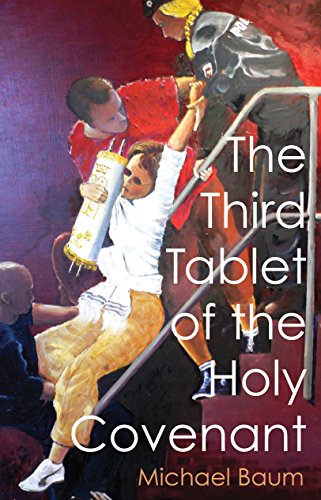
He has recently taken up writing novels the first of which – The Third Tablet of the Holy Covenant -was published in November 2013. Inspired by his experiences living in Israel and working on the archaeological excavation of Masada, he draws on his family history of breast cancer and his Ashkenazi heritage. He skilfully blends the molecular and biblical genealogy of the Jewish people with the fictitious search for an ancient relic to produce a gripping semi-autobiographical novel.
The story follows Martin Tanner, who grows up in a poor Jewish family in the East End of London during the Second World War. A brilliant student, he goes on to qualify as a surgeon at University College London, learning along the way that his family is cursed with the Ashkenazi mutation, a defect in the DNA coding that leads to an increased risk of cancer.
He immigrates to Israel in 1960 and serves as medical officer on the Masada dig in 1963 where he meets and falls in love with Sara, a nurse who suffers the same fate as his mother. The tragedy of Martins life is coupled with the discovery of the Eliezer Scroll on the dig, which provides evidence that a codicil to the Mosaic tablets of the holy covenant could exist. The translation of these scrolls reveals that twin sisters escaped from the sacking of Jerusalem in 70 CE, carrying with them holy relics from the Temple. This book combines the quest for a biblical relic from the second Temple in Jerusalem, with the biblical and genetic anthropology of the Jewish people.
Third Tablet of the Holy Covenant, Baum 2013
A sequel is in planning and concerns the fall of the Second Temple in 586 BCE, archaeological research of contemporary letters unearthed in the 1930’s (The Lachish letters), the mysterious death of the archaeologist who discovered these ostraca and a hornet’s nest Nazi eugenicists at University College London.
He has drawn and painted from an early age and while his father advised him to become a doctor and only then to paint in his spare time, he reflects that this was poor advice. The urge to paint is insistent, unrelenting and all consuming. His passion and ability are clear for all to see.
Popular items by Michael Baum
View all offers-
Breast Cancer: The Facts (Oxford Medical Publications)
Baum, Michael
Item prices starting from
View 3 offersUS$ 4.10
Also find
Used -
Breast Cancer Fast Facts
Baum, Michael; Schipper, Harvey
Item prices starting from
View 16 offersUS$ 4.15
Also find
Used -
Breast Beating: A Personal Odyssey in the Quesst for an Understanding of Breast Cancer, the Meaning of Life and Other Easy Questions
Baum, Michael
Item prices starting from
View 20 offersUS$ 5.21
-
A Philosopher Adrift in the Sea of Time
Baum, Michael
Item prices starting from
View 7 offersUS$ 13.39
Also find
New -
-
The Third Tablet of the Holy Covenant
Baum, Michael
Item prices starting from
View 2 offersUS$ 127.08
Also find
Used