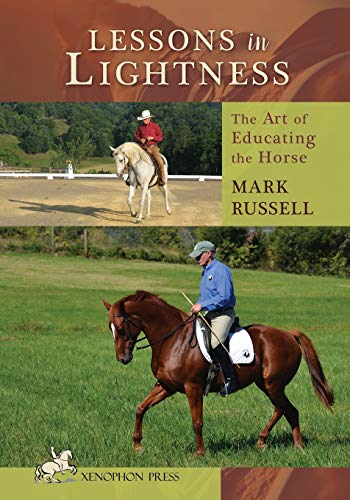
Mark Russell
Mark Russell was an author, clinician, teacher, educator of horses in the Art Form sense of riding. Mark had worked with horses across a variety of disciplines since his teen years, continuously building his knowledge base. Over the course of his early years Mark worked in various disciplines each leading him to believe that Classical Dressage benefited all horses. He found himself drawn to the dressage teachings of the old masters who promoted the benefits of suppleness and flexion in the horse. These included Francois Robichon de la Gueriniere, Francois Baucher, Gustav Steinbrecht, and General Decarpentry. While integrating these philosophies into his riding and training, Mark completed his transformation after traveling to Portugal in 1984 to study under world renowned Portugese classical horse trainer and rider Nuno Oliveira. What Mark experienced during that time had shifted his approach to training and riding to a truly partnership based relationship.
In the 1990s, Mark was introduced to Natural Horsemanship philosophies which he discovered had many commonalities with Art Form Riding/Dressage; specifically their shared approach towards the horse by keeping the horse’s needs at the forefront. He began studying the teachings of the Dorrances, Ray Hunt, Pat Parelli, and others. Mark felt that practice in both worlds enhanced the other. Mark wished to be clear however, that in practice there was also a strong distinction between the two; notably the emphasis on relaxation obtained through relaxation of the jaw and the surrounding structures attended to only through Art Form Riding.
In Art Form Riding the horse is developed in accordance with his parasympathetic nervous system - the system that creates relaxation in the horse (through first accessing the jaw). Additionaly there is a strong emphasis on developing the horses postural muscles and proprioception. This approach supports the development of the alignment of the spine, impulsion, engagement, and balance. Art Form Dressage gradually evolves into an effortless self carriage through the continued emphasis of relaxation throughout the entire horse. With attention to how the horse uses his body and by addressing each area where he may hold even the smallest amount of physical or emotional tension, the horse is able to find a comfort zone for learning balanced, healthy, movement.
Mark’s years of intense practice of Tai Chi and Chi Gong in his 20s and 30s and beyond, had opened his being to connecting to his own self and the world around him. For Mark, Tai Chi and Chi Gong had opened the door to the joy of discovery into the very nature of the horse: connecting, understanding, then communicating with the horse. Horses by nature were consistently drawn to Mark and his quiet connected energy. Mark believed that without mastery of our own selves, teaching the horse would become quite difficult if not impossible.
Attention to equine biomechanics, energy movement through the horse, and maintaining full relaxation of the horse has become a lost art. When these qualities are all bound together, the “whole is greater than the sum of its parts”. For Mark, each path deepened the understanding of the other. Mark was unique indeed; his quiet energy, demeanor, wealth of knowledge, all expressed while he taught both horse and rider made him a popular clinician.
“Maestro”, as many of Mark’s students fondly called him, was killed in a riding accident on June 12th, 2016. The accident occurred during a ‘perfect storm’ of variables that came to pass at that moment in time. Mark was known to those that are qualified to judge, as one of the world’s best horsemen. However Mark would consistently argue this point adding that he had much to learn on his journey.
Mark Russell’s credits include the training DVD “Lessons in Lightness: Building the Horse’s Foundation In Hand”, he is featured in the DVD “Riding with Chi: Your Pathway to Energy Mastery”, and he has been featured in a variety of equine journals.
Popular items by Mark Russell
View all offers-
Lessons in Lightness: The Art of Education the Horse
Russell, Mark
Item prices starting from
View 38 offersUS$ 6.49
-
Lessons in Lightness Expanded Edition
Russell, Mark; Kreinbring, Jillian
Item prices starting from
View 40 offersUS$ 27.13