Sherry Seethaler
I am a science writer and educator at the University of California, San Diego. For many years, I wrote the weekly science "Questions Answered" column for the San Diego Union-Tribune, in which I answered readers' questions spanning nearly every imaginable science topic from "Why do I sneeze when I look toward the sun?" to "Is a lightsaber possible?" to "Is one horsepower really equal to the power of one horse?" to "Why do lizards do push-ups" to "What causes out-of-body experiences?" That last question really does fall under the purview of science! You can read the answers to these and 345 other questions in my books, Curious Folks Ask: 162 Real answers on amazing inventions, fascinating products, and medical mysteries (FT Press Science) and Curious Folks Ask 2: 188 Real answers on our fellow creatures, our planet, and beyond (FT Press Science).
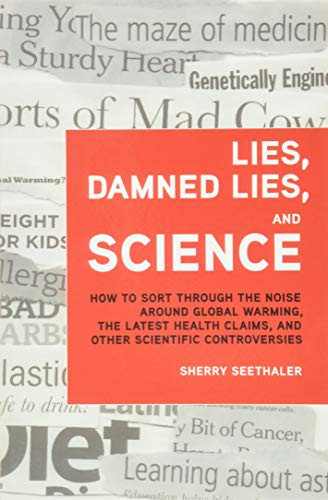
My passion is to help people rediscover the wonder about science that we all shared as children, before we had concluded that science meant facts to be memorized from a textbook. Back then science meant bugs and slugs, trees and seas, stars and scars, rocks and… (well, you get the picture). Science is also a way of approaching problems and a way of thinking about the world that we can each apply to making better reasoned health, political and consumer decisions. Unfortunately, precollege and even college science classes fail to teach us how to do this. To fill that gap, my book Lies, Damned Lies, and Science: How to sort through the noise around global warming, the latest health claims, and other scientific controversies (FT Press Science) is an empowering yet palatable set of tools for making sense of the health and science-related issues we encounter in our daily lives.
After publishing Lies, Damned Lies, and Science, I began working toward the complementary goal of teaching and writing about communication. Too often the blame for not understanding information or for not following recommendations is placed on the individual on the receiving end of the communication. Yet, the problem often lies with flawed assumptions about what constitutes effective communication, and the concomitant failure to communicate in a way that supports reasoning. My most recent book (University of Toronto Press, 2024) is a research-based guide to improve communication about science, health, the environment and more.
I earned a Bachelor of Science in biochemistry and chemistry from the University of Toronto, a Master of Science and a Master of Philosophy in biology from Yale University and a Doctor of Philosophy in science and mathematics education from the University of California, Berkeley, and I have published peer-reviewed articles in both science education and science communication. When I am not working (and sometimes even when I am), you will find me outdoors enjoying nature.
Popular items by Sherry Seethaler
View all offers-
Lies, Damned Lies, and Science: How to Sort Through the Noise Around Global Warming, the Latest Health Claims, and Other Scientific Controversies
Seethaler, Sherry
Item prices starting from
View 47 offersUS$ 4.41
-
Curious Folks Ask: 188 Real Answers on Our Fellow Creatures, Our Planet, and Beyond
Seethaler, Sherry
Item prices starting from
View 3 offersUS$ 8.95
-
Curious Folks Ask: 162 Real Answers on Amazing Inventions, Fascinating Products, and Medical Mysteries
Seethaler, Sherry
Item prices starting from
View 3 offersUS$ 10.73