Lois Ellen Olson
A BRIEF HISTOY OF MY WRITING EXPERIENCE
I was always enticed to put words on paper, stringing them together in such a way that they created pictures of people or events. When I attended elementary school in Kokomo, Indiana, my best friend was Kathy Dillahunt. We met in kindergarten and since we lived in the same neighborhood, we enjoyed playing together.
Her house had three stories plus a basement. The third floor had a large room with dormer windows to let in light and air. There was a big carpet, a table, and some old chairs and several lamps.
It was an awesome place to play. There were also some storage boxes up there and once we found one open. When we looked inside the box, I saw things that made it a treasure chest to me. It was filled with tablets of yellow-lined paper and sharpened yellow pencils. There were also pads of receipt books.
Kathy’s dad had a Firestone Tire Store and this stuff was part of his stash for business use. But, I was delighted to just be able to look inside the box and marvel at its contents.
Nothing excites me quite like tablets of paper, sharpened pencils, except maybe boxes of crayons and bottles of paint.
From an early age I had a small diary with a lock and key and a pink Richard Esterbrook Fountain Pen. I filled it with aqua ink by putting the nib in the inkbottle and raising a little lever on the barrel of the pen. I loved writing in my diary, confiding to Dear Diary. I recorded what I had done, said, felt, and hoped for on the colored pages inside the diary.
I probably didn’t need to use the key to keep my sister and brother out of it. My sister Sara would have had trouble deciphering the spelling and my brother Joe couldn’t read yet. But it was my first journal and none since have been more precious to me than that one was.
I had the usual composition instruction in school and usually did very well. I remember my senior English teacher, Mrs. Blickman. She was a forceful and erudite teacher who demanded the best from her students. I was excited because she was dedicated and wanted everyone to do well in her class. My final assignment pleased her so much she read it to the class. I was thrilled, as well as, embarrassed by the attention and praise, but no one seemed surprised. I was, after all, the editor of my high school yearbook.
After my fiancé, Tom Olson, graduated from The Ohio State University we married and he began teaching in Fairborn, Ohio. Nine years later and after having two children, Tom and I sold our house in Columbus, Ohio and moved to Stehekin, Washington, where he taught in a one-room log schoolhouse.
After we got settled in Stehekin, I ventured to take a creative writing class by mail from the University of Washington. Each night, after putting the girls to bed, and when our home became quiet, I read the lessons and completed the assignments. I was ecstatic when the instructor made this comment on one of the stories I wrote.
He wrote, “Before you send this out, you might want to…” I saw only that first part of the comment and rejoiced that he thought my story was worth sending out to a publisher. Later, on another story, he wrote, “When you decide what you want to write, you will be a good writer”. I could describe people, and their feelings, as well as, events, and scenes I had experienced. I could also do a fair job on dialogue that I had learned, but I was not confident at making up stories.
After we recovered from Amy’s head injury, caused when she ran in front of a boy swinging a bat at the Stehekin School, I wrote the story and sent it to Guidepost Magazine. They accepted it for publication, but wanted it rewritten into their preferred framework for publication in their magazine. They sent a woman to talk with me, and as she took profuse notes, I realized they had bought my story, but not my writing. It was not my story now; it was her version they published in their magazine and republished in their anthologies of Stories of Faith.
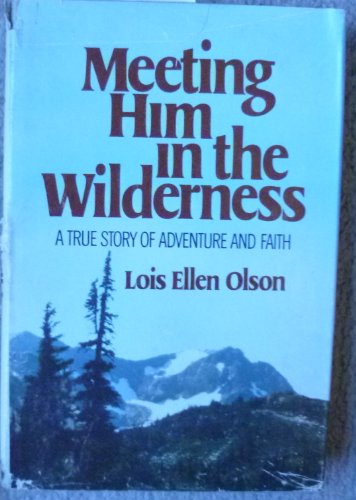
I began writing Meeting Him in the Wilderness: A True Story of Adventure and Faith when we lived in Richland, Washington, where Tom was the youth pastor at Central United Protestant Church. I felt ‘commissioned, by the Lord, to write the story of our four years in Stehekin, and Tom’s decision to go to seminary.
At last I knew what I wanted to write about and even though my writing teacher had said I would write well when I knew what to write, I was reluctant. It was one thing to write a story and another thing to write a book, or so I thought.
Believing I didn’t really know how to write a book and not being able to imagine myself working at it day after day, considering my commitments to my family and the church, the joy of the idea was fast becoming a burden, but, the Lord very clearly erased my doubts through the comments of people at church.
So I began. In the space of one morning, I wrote a complete outline and then, as time allowed, I began working my way through the story, chapter by chapter depending on the Lord to bring to my mind what I needed to tell and how to tell it. The work was, at the same time, easy and very difficult. It was written as a first person narrative and so I was forced to always have my own viewpoint; this meant I could not relate someone else’s thoughts and feelings, but could only describe what I saw and what that person did. I found myself actually reliving the story as I wrote it and since some of it was very emotional, I sometimes felt tears flowing down my face or heard myself laughing.
When the book was completed, I had no idea what to do with it. Tom had retyped it for me and it sat in a box on my desk. A few weeks later we were at family camp and as I walked into the cabin we shared with other clergy, one of the pastors’ wives was reading from a magazine to some people sitting at the kitchen table. She read: “Doubleday Publishing Company in New York is starting a new publishing section called Galilee Originals”. They are looking for manuscripts of personal faith stories”. It seemed to me it was a pretty clear direction of what to do with my book. When we got home from the camp, I went directly to the library, found the address of the company and mailed the book the next day.
Two weeks later we moved to Atlanta, Georgia, where Tom would be finishing seminary. It was a hectic move and took a while to find a place to live and obtain some furniture for our residents. Several members of the church where Tom was working as a youth minister loaned us some furniture for the time Tom would be attending Candler School of Theology at Emory University.
I wasn’t thinking much about the book, besides I had always heard it took weeks, even months to hear from publishers, but in the fifth week, after sending it out, I received a forwarded letter saying they wanted to publish my book under the condition that I expand it a hundred pages. It was awesome! We were having a difficult time adjusting to our new environment and this was a big bright spot of joy shining during that dismal time.
I went through the manuscript marking places where I could expand it, places where there was more to tell or something to add. In November, I took Thursday and Friday off from work and went to a friend’s summerhouse and wrote twelve hours a day. By Sunday afternoon, I was finished. When I counted the additional pages there were exactly one hundred pages.
Tom retyped it all and we sent it off to New York. We soon received a contract and an advance of $2,500. I was grateful for the money and used it to pay tuition for Sally and Amy to attend a private school. The public school, they were both attending, were horrendous and had caused both girls heartaches.
By the time the book was published, Tom had graduated from seminary and we moved back to Washington State where he was appointed by the Pacific Northwest Conference to pastor two small churches in Okanogan and Mallot.
I will always remember the day the book was published in February 1980. I received a telegram saying they were proud to publish my book and was sending me an advanced copy. I cried all day. I had thought I would be happy and hopping around, but I was grieving. I knew now that anyone in the world who read my book would know what I did and how I felt and what I thought. It was a breaking out of my protected life into a vulnerable transparent existence,
I received many requests for speaking engagements and leading retreats from Florida, Wisconsin, Minnesota, Tennessee and Washington, even from the Board of Discipleship of the United Methodist Church located in Nashville, Tennessee. I received a lot of mail from people who liked the book and who had questions, or expressed comments. It was an exciting and gratifying time.
Now I have finished writing a book of fiction, The Secret of Stonewall Farm, and given it to my husband Tom to publish. The idea for this book came to me while we were living in Stehekin, Washington, and germinated as we lived in Henry, Nebraska; Denver, Colorado; Richmond, Washington; Atlanta, Georgia; Okanogan, Washington; Temple City, California, and finally came to be a book while living in Plainsburg, California.
I am very pleased with this book and I hope many children and adults find it to be a delightful and entertaining mystery.
For the last year or so I have been gathering and writing stories for my memoir book as my health permits. I have given my husband those stories and my journals to go through if I should die before finishing it. I have asked him to organize the stories as he sees fit and to include other writings as he finds in my journals he wants to include. I’ve asked him to publish this book for my children, grandchildren, friends and me.
Lois Ellen Olson
June 2014
OBITUARY OF LOIS ELLEN (RAYL) OLSON
Lois Ellen Rayl Olson, 72, died at 1:17 a.m. on July 25, 2014, of metastases bone cancer at the Fresno Hospice House with her husband and her youngest daughter at her bedside. Lois was born on August 2, 1941, in Kokomo, Indiana, the daughter of Earl M. Rayl and Mildred E. Rayl. She is survived by her husband of 52 years, Thomas C. Olson, and two daughters, Sally A. Olson Evans, wife of Brian J. Evans of Livingston, CA.; and Amy C. Olson of Merced, CA; six grandsons, Brian R. Evans and his wife Jill of Fort Mitchell, AL; Bradley J. Evans of Atwater, CA; Brent L. Evans, Thomas S. Evans, Marshall T. Evans, and Adam G. Evans all at home; and two great granddaughters, Delilah and Maci Evans of Fort Mitchell, AL. She is also survived by her sister, Sara A. Dean and her brother Joseph H. Rayl both of Clearwater, FL. and numerous cousins, nieces and nephews in various U.S. locations.
In their 52 years together, Lois and her husband lived in seven U.S. states, in big cities like Columbus, Denver, Atlanta and Los Angeles; small towns like Henry, Nebraska and Okanogan, Washington as well as, Stehekin, a wilderness area in Washington state, reached only by a half hour seaplane trip or a four hour ferry ride. They also traveled to Canada, Italy and Israel together. Lois graduated from college and also attended Fuller Theological Seminary in Pasadena, CA.
Lois learned to read before going to school by sitting on her father’s lap while he read the Bible to her. She was a lifelong voracious reader reading as many as fifty books in a year. She kept a reading journal over the years making entries of her responses to many of the books. She also read Classical Latin, Greek and Hebrew texts, and knew French, Russian, & Spanish. She was a gifted teacher and taught many subjects as well as grade levels including assisting her husband in a one room log school in the North Cascade National Park in Stehekin.
Lois was an author of four books and many short stories and personal essays and was the speaker at many retreats and other occasions. She was also an artist, painting portraits of her family members as well as still life’s in oil and watercolor. Her artistry included quilting, needlework, and weaving on her floor loom. She made many beautiful things for her family and friends. She has left a stash of baby quilts intended for her great grandchildren.
Lois was gracious, fun loving, kind, courageous, diligent, and persevering. At the age of seven she was completely paralyzed with polio but with the help and grace of her parents, many people and God, she recovered to a near normal use of her body. However, through her lifetime she endured twenty surgical procedures and much pain. She said she had early on made friends with physical pain and continued to her death from bone cancer with only small amounts of pain medication. She attributed her tolerance of pain to the grace of God and to her many friends who prayed faithfully for her.
A memorial service was held in her home on Plainsburg Road on August 10, 2014, with her husband Tom conducting the service. Her husband Tom spread Lois’ ashes along the shores of the Pacific coast near Pigeon Point Lighthouse on August 20, 2014, in a private ceremony.
Popular items by Lois Ellen Olson
View all offers-
Meeting Him in the wilderness: A true story of adventure and faith
Lois Ellen Olson
Item prices starting from
View 34 offersUS$ 4.46
-
-
Memories, Like Burrs Caught on My Coat
Olson, Lois Ellen
Item prices starting from
View 1 offerUS$ 40.57
Also find
New