

Pravir Malik
The books that appear here correspond to different phases in my life.
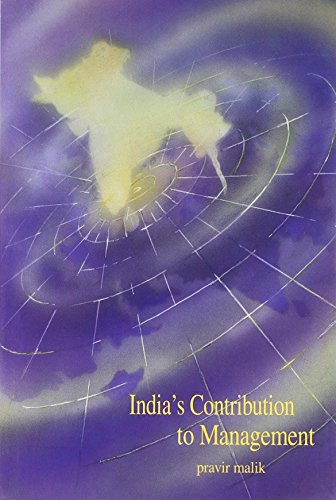
In the earlier stage I wrote 'The Flowering of Management' and 'India's Contribution to Management'. The impetus for both these books was similar in that they were reactions to the environment that I was placed in at the time. When I first began working in the corporate world the reality of the environment struck me as decidedly anachronistic. I had a different sense of what life could offer and wrote 'The Flowering of Management' to capture aspects of a vision I thought corporations and money existed for. Similarly, when I wrote 'India's Contribution to Management' it was the result of the dissatisfaction I experienced when confronted with the prevalent interpretation of India. This was precipitated by my working with a US-based company, A.T. Kearney, in India. I sought to reverse that interpretation with 'India's Contribution to Management' which aimed to capture my understanding of the essence and deeper capacity of synthesis of India.
The next phase was marked by a strong interest in fractals that primarily stemmed from my beginning to see similar patterns in seemingly distinct areas of life. I wrote 'Connecting Inner Power with Global Change: The Fractal Ladder' as a theoretical framework of fractals. The fractals that I envisioned included the added complexities of emotional and thought components. This was followed by 'Redesigning the Stock Market: A Fractal Approach' which was an application of the theoretical fractal framework to the then recent global financial crises of 2008. 'The Flower Chronicles' sought to make the gist of the ubiquitous fractal I had described in the previous two books easily graspable at the visceral level primarily through many practical examples spanning diverse walks of life. 'The Fractal Organization: Creating Enterprises of Tomorrow' was a comprehensive summary of the fractal framework that included the basic theory, the applications, and a practical field guide that had been developed while I was working at the Organizational Development group at Stanford University Medical Center.
The most recent phase has focused on creating a mathematical framework to take the previously developed fractal framework further. The development of such a mathematical framework that seeks to frame innovation in complex adaptive systems was also the focus of my doctoral work. This gave birth to an exciting period and will result in multiple series of books.
The first series, comprising of six books, extended my inquiry into mathematics and complex adaptive systems to an interesting limit culminating in the nature of Light and the Cosmos. The fractal mathematics I propose is at the heart of this series: Cosmology of Light.
The first book, 'A Story of Light: A Simple Exploration of the Creation and Dynamics of this Universe and Others' contains the main ideas in the mathematics, in non-mathematical terms, that are further explored mathematically in the remaining books in this series. The second book 'Oceans of Innovation: The Mathematical Heart of Complex Systems' describes my interpretation of the mathematical foundation of complex systems. The third book, 'Emergence: A Mathematical Journey from the Big Bang to Sustainable Global Civilization' applies the mathematics to several layers of matter and life. The fourth book, 'Quantum Certainty: A Mathematics of Natural and Sustainable Human History' describes a process culminating in space, time, energy, and gravity quantization by which history is made. The fifth book, 'Super-Matter: Functional Richness in an Expanding Universe' describes a process for the creation of super-matter-based on a need for continued functional-richness. A link is made between the resulting quantization of space and an expanding universe. The final book, 'Cosmology of Light: A Mathematical Integration of Matter, Life, History & Civilization, Universe, and Self' proposes an integrated mathematical framework that flows through all things, hence unifying matter, light, civilization, history, universe, and self.
The second series further explores the implications of "one mathematics flowing through all things". The first book in this series 'The Emperor's Quantum Computer: An Alternative Light-Centered Interpretation of Quanta, Superposition, Entanglement and the Computing that Arises from it' describes an alternative narrative for quantum computing to the one commonly expressed today. The second book in the series, ‘The Origin and Possibilities of Genetics: A Mathematical Exploration in a Cosmology of Light’ explores pre-genetic, genetic, and post-genetic possibilities in a cosmology of light. This book, ‘The Second Singularity: A Mathematical Exploration of AI-Based and Other Singularities in a Cosmology of Light’ explores the limits of AI-based singularities with respect to light-based singularities. This book, the final in this series explores transhumanism in a cosmology of light.
The third series, Artistic Interpretation of Cosmology of Light, is intended to make Cosmology of Light more accessible by interpreting it artistically. The first book in the series is ‘The Mandala Illustrated Story of Light’. The objective is to lead the reader through the story of light using mandalas as an aid in the journey. The second book ‘Musings on Light’ is a meditative book set to graphical illustrations. The illustrations focus on 50 key concepts derived from the ten-book joint Cosmology of Light series. The third book ‘The Illustrated Oceans of Innovation: The Mathematical Heart of Complex Systems Depicted in Indian Arts’ uses Indian Arts to illustrate the mathematical heart of complex systems. The fourth book 'Emergence Illustrated: A Mathematical Journey from the Big Bang to Sustainable Global Civilization Depicted with Indian Mythological Arts' uses Indian mythological arts to express the concepts of Emergence. Several additional books are envisioned and are currently under development.
Popular items by Pravir Malik
View all offers-
Connecting Inner Power with Global Change: The Fractal Ladder (Response Books)
Malik, Pravir
Item prices starting from
View 4 offersUS$ 8.00
-
-
Quantum Certainty: A Mathematics of Natural and Sustainable Human History (Cosmology of Light)
Malik, Pravir
Item prices starting from
View 1 offerUS$ 19.89
Also find
New -
A Story of Light: A Simple Exploration of the Creation and Dynamics of this Universe and Others (Cosmology of Light)
Malik, Pravir
Item prices starting from
View 8 offersUS$ 10.28
-
Emergence: A Mathematical Journey from the Big Bang to Sustainable Global Civilization (Cosmology of Light)
Malik, Pravir
Item prices starting from
View 1 offerUS$ 18.23
Also find
New -
Triumph of Love: A Mathematical Exploration of Being, Becoming, Life, and Transhumanism in a Cosmology of Light (Applications in Cosmology of Light)
Malik, Pravir
Item prices starting from
View 9 offersUS$ 27.92
-
Super-Matter: Functional Richness in an Expanding Universe (Cosmology of Light)
Malik, Pravir
Item prices starting from
View 1 offerUS$ 23.22
Also find
New -
Oceans of Innovation: The Mathematical Heart of Complex Systems (Cosmology of Light)
Malik, Pravir; Pretorius, Dr. Leon
Item prices starting from
View 1 offerUS$ 18.23
Also find
New



Showing 8 of 35 titles