

Bernard O'Connor
Bernard O’Connor taught Humanities and English in Hertfordshire, Cambridgeshire and Bedfordshire for four decades as well as four years in Taiwan, China and Western Australia. During this time he researched aspects of local geology, archaeology, history and natural history. When he discovered that an iguanodon had been dug up in Potton in 1866 he decided to locate the dinosaur. It sparked a decade of investigating the impact of the UK’s coprolite industry; thought by many at the time to be fossilised dinosaur droppings. He has written accounts of every parish where coprolites were found, had articles published in academic magazines and given talks and lectures across East Anglia. (www.lulu.com/spotlight/coprolite)
He has also researched RAF Tempsford, a TOP SECRET airfield used by 138 and 161 Squadrons to supply the resistance in occupied Europe. This included accounts of all the female agents infiltrated behind enemy lines by the Special Operations Executive during the Second World War; German saboteurs sent to Britain, He also researched Brickendonbury Manor, SOE's specialist sabotage training school, blackmail sabotage and accounts of SOE-trained saboteurs sent to Norway, Denmark, Netherlands, Belgium, France, Greece and, expecting a German invasion of Iberia, to Gibraltar. He also investigated Soviet agents who Britain infiltrated into Western Europe and liaised with a Russian historian to update his account using Comintern and captured Gestapo records. He researched SOE's role in Afghanistan and the story of Bhagat Ram, a quintuple spy; Spanish agents trained for an invasion of Iberia and Germans and Austrians sent on sabotage and subversion missions in Germany. There's also a two-volume account of Graf Spee sailors' internment, escape and repatriation in Argentina and Uruguay.
Work on other topics includes the story of St Neot; the Mawddach Estuary in North Wale; phosphate mining in France, Spain, Canada and the United States; the history of the guano (bird droppings) industry and the local history of Sandy, St Neots and Gamlingay, details of which can be found on his website (www.bernardoconnor.org.uk).
Since retiring to the Clee Hills in Shropshire, he has researched prehistoric hillforts, deserted medieval villages, the iron industry, air crashes, the Ditton Royal Naval Armaments Depot, the Peaton Shadow factory and SOE in the Marches (Shropshire and Herefordshire). He recommends checking out his author page - www.lulu.com/spotlight/coprolite
Popular items by Bernard O'Connor
View all offers-
Churchill's School for Saboteurs: Station 17
O'Connor, Bernard
Item prices starting from
View 6 offersUS$ 6.04
-
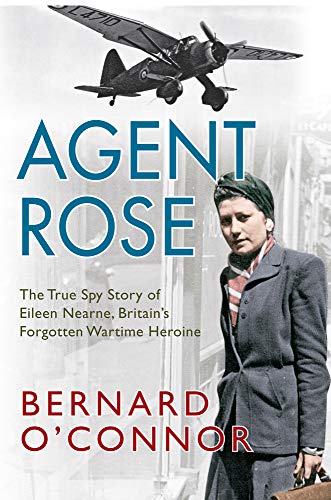
Agent Rose: The True Spy Story of Eileen Nearne, Britain's Forgotten Wartime Heroine
O'Connor, Bernard
Item prices starting from
View 11 offersUS$ 5.48
-
Agent Fifi and the Wartime Honeytrap Spies
O'Connor, Bernard
Item prices starting from
View 30 offersUS$ 4.21
-
Churchill's Angels: How Britain's Women Secret Agents Changed the Course of the Second World War
O'Connor, Bernard
Item prices starting from
View 15 offersUS$ 4.20
-
SOE Heroines: The Special Operations Executive's French Section and Free French Women Agents
O'Connor, Bernard
Item prices starting from
View 48 offersUS$ 5.46
-
RAF Tempsford: Churchill's Most Secret Airfield
O'Connor, Bernard
Item prices starting from
View 11 offersUS$ 12.50
-
Tempsford Academy: Churchill's and Roosevelt's Secret Airfield
O'Connor, Bernard
Item prices starting from
View 8 offersUS$ 13.94
-
Churchill's School For Saboteurs: Station 17
O'Connor, Bernard
Item prices starting from
View 20 offersUS$ 13.44



Showing 8 of 131 titles