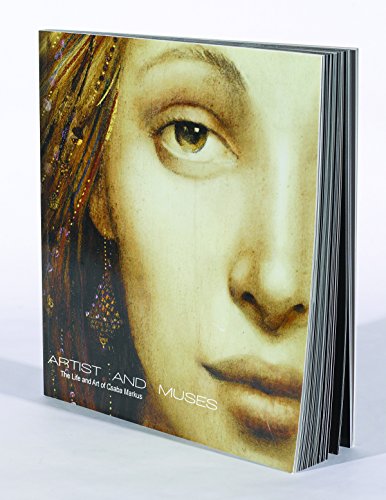
Csaba Markus
Csaba Markus(1953-) was born in Budapest, Hungary, grew up in Budapest, Hungary, and immigrated to America in 1978.
Author Csaba Markus, who self-publishes his works under the name of Csaba Markus Atelier, has expanded into the book publishing business with his new company, Dreaming Muse. Dreaming Muse will focus on producing art catalogs, books and calendars, starting with Markus' own fine-art books. Csaba Markus Atelier will still concentrate solely on the creation of fine-art prints, such as etchings, stone lithographs and serigraphs, according to Markus.
Budapest's rich history and strict communist regime contributed to his artistic style.
His television debut (1967 Budapest) also sparked another epiphany for the young man. "I could paint nice pictures and write poems for girls to show them that I was unique. After the live broadcast, I got my first girlfriend--my first success."
Early on, Markus' captivation with the Renaissance, Neo-Classical and Romantic periods dominated his work. Though classically trained, the Avant Garde and Abstraction began to make their way into Markus' work. He reflected on the rebirth of humanity after the Middle Ages, the transition from a spiritually and morally controlled world to one that encouraged individual thought. These ideas became strong themes in his art. He became increasingly frustrated with teachers and the confines of communism.
Stylistically, Renaissance art likewise reflected a mixture of tradition and innovation. It united the flatness and luminosity of medieval icons with the depth, volume, play of light and richness of the unparalleled artistic innovations of Giotto, Michelangelo and Leonardo da Vinci.
If any artist can do that for our times, it is Csaba Markus. His feminine figures evoke the stylized beauty of Botticelli's Venus: full, elongated bodies, elegant necks; expressive almond eyes, sensual mouths. Their bodies combine the flat, beautiful, ornamental iconography of the early Renaissance - found in the works of Giotto - with the volume and sensuality of the high Renaissance and Baroque - visible in the works of Botticelli, Leonardo da Vinci and Titian.
Nonetheless, Markus' painting, like that of the Pre-Raphaelites, does not merely reproduce Renaissance styles and themes. It is also a pastiche: a way of mixing art historical allusions to induce viewers to think about their times. As the works of the Pre-Raphaelites did for the Victorians, so Markus' art has the paradoxical capacity to make the Renaissance feel simultaneously distant and illegible and fresh, immediate, challenging and thought provoking for our times.
To date, Markus has participated in more than 200 U.S. exhibitions and is now an established artist with a solid base of collectors.
Popular items by Csaba Markus
View all offers-
-
-
Artist and Muses Silk Edition
Csaba Markus
Item prices starting from
View 1 offerUS$ 89.95
Also find
Used