Brian Powell
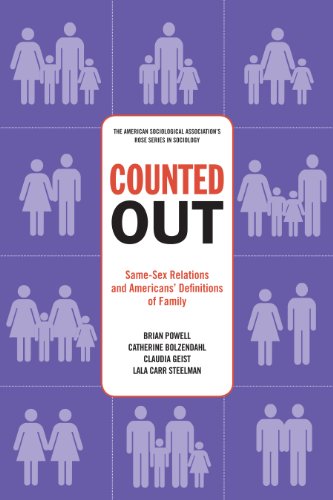
Brian Powell's COUNTED OUT: Same-Sex Relations and Americans' Definitions of Family (Russell Sage Foundation, September, 2010), coauthored with Catherine Bolzendahl, Claudia Geist and Lala Carr Steelman, moves beyond previous efforts to understand how Americans view their own families by examining the way Americans characterize the concept of family in general.
COUNTED OUT reports on and analyzes the results of the authors' Constructing the Family Surveys (2003 and 2006), which asked more than 1500 people to explain their stances on a broad range of issues, including gay marriage and adoption, single parenthood, the influence of biological and social factors in child development, religious ideology, and the legal rights of unmarried partners.
Brian Powell is the James H. Rudy Professor of Sociology at Indiana University. Much of his research has examined how families confer advantages (or disadvantages) to their children and how structural and compositional features of families (e.g., parental age, family size, birth order, one vs. two-parent households, inter-racial composition, adoptive vs. biological parents) influence parental social, intellectual and economic investments in children. He is especially interested in several increasingly visible groups of "atypical" family forms: families with older parents, bi/multiracial families, adoptive families and gay/lesbian families.
Other publications have examined:
* similarities and differences in the experiences of children who live with their same-sex parent and of their peers who live with an opposite sex parent (American Sociological Review, 1997);
* factors shaping children's perceptions and evaluations of parental roles (Social Psychology Quarterly, 1997);
* the applicability of recent claims about the effects of birth order on innovative thinking in the contemporary United States (American Sociological Review, 1999);
* the extent to which sociobiological explanations add to or detract from sociological understandings of parental investments (American Journal of Sociology, 1999);
* the role of political generations in shaping feminist self-identification (American Sociological Review, 2003);
* challenges that sociologists face when studying "atypical" families (Journal of Marriage and Family, 2005);
* the extent to which emotional management at work and at home is structurally and situationally determined (Social Psychology Quarterly, 2006);
* how parental age is linked to the conferral of advantages and disadvantages to children (Social Forces, 2006);
* whether biracial families differ from monoracial families in their investments in their children (American Journal of Sociology, 2007);
* the extent to which parental biological ties are (or are not) critical to children's wellbeing (American Sociological Review, 2007);
*the relative influence of schools and families on children's obesity (American Journal of Public Health, 2007);
*the emotional implications of fair and unfair division of domestic labor (Social Psychology Quarterly, 2010).
Popular items by Brian Powell
View all offers-
Counted Out: Same-Sex Relations and Americans' Definitions of Family (American Sociological Association's Rose Series)
Powell, Brian; Blozendahl, Catherine; Geist, Claudia; Steelman, Lala Carr
Item prices starting from
View 22 offersUS$ 5.10
-
Who Should Pay?: Higher Education, Responsibility, and the Public
Quadlin, Natasha; Powell, Brian
Item prices starting from
View 6 offersUS$ 18.21