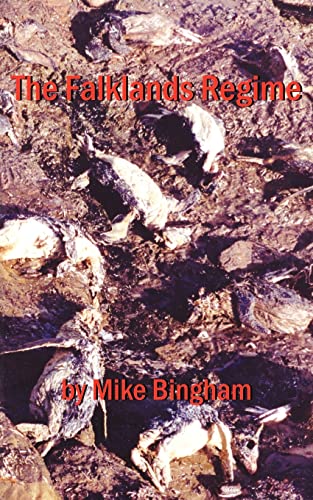
Mike Bingham
Mike Bingham began his career studying marine turtles and Hawaiian Geese for the US Government in the Hawaii Volcanoes National Park. In 1993 he took up the post of Conservation Officer for the Falkland Islands. As part of his work as Conservation Officer for the islands, Mike led an island-wide penguin census in 1995, which revealed an 85% decline in penguin numbers since the establishment of the Falklands fishing industry just 10 years earlier. The full details of this census, including maps showing the exact location of every penguin colony in South America, tables showing population counts for each colony, and detailed information on every species of penguin found in South America, can be found in Mike's book "Penguins of the Falkland Islands and South America".
The Falklands fishing industry generated an income of US$20,000 for every man,woman and child living in the islands, so the Falklands government asked Mike to keep his findings confidential. When he insisted that the Falklands government should protect the remaining penguins with a system of no-fishing zones around penguin colonies, Mike was removed from office. When Mike obtained independent funding to continue his research into the penguin declines, he suffered police harassment, false arrests, and death threats. Mike took the Governor, Attorney General and the entire Executive Council to the Supreme Court for human rights violations, and won his case, with the Supreme Court Judge declaring that human rights abuses perpetrated against Mike Bingham had been morally and legally indefensible. This story is told in great detail in Mike's books, The Falklands Regime (in English) and El Regimen de las Malvinas (in Spanish).
Following his removal as Conservation Officer for the Falkland Islands, the British government funded Mike to set up a penguin monitoring programme in neighbouring Chile and Argentina, to determine whether the massive decline of Falklands penguins was indeed being caused by commercial fishing, or by other factors. Studies in Chile and Argentina, where penguins are protected from commercial fishing by no-fishing zones, showed increasing penguin populations. This confirmed that the decline of penguins was indeed unique to the Falklands, and that it was being caused by the Falklands' refusal to introduce no-fishing zones around penguin colonies, like those used successfully in Chile and Argentina. These results were published in a peer-reviewed scientific article entitled "The decline of Falkland Islands Penguins in the presence of a Commercial Fishing Industry' (Revista Chilena de Historia Natural 75:805-818). Mike also presented these results to the International Penguin Conference, who responded by petitioning the Falklands government to instigate protection for Falklands penguins, which they declined to do.
Mike continues to work for the Organization for the Conservation of Penguins, supported by both the Chilean and Argentine governments. His research is now funded entirely by book sales, and income from an Adopt a Penguin programme www.seabirds.org/adopt.htm. Mike insists that whilst working closely with government is great, that financial independence from government is essential in order to remain objective, and to prevent a repeat of what occurred in the Falklands.
Popular items by Mike Bingham
View all offers-
-
Penguins of the Falkland Islands and South America
Bingham, Mike
Item prices starting from
View 19 offersUS$ 9.49
-
The Great Divide: An Autobiography by Dr. Mike Bingham
Bingham, Mike
Item prices starting from
View 1 offerUS$ 11.75
Also find
Used -
El Régimen De Las Malvinas (Spanish Edition)
Bingham, Mike
Item prices starting from
View 27 offersUS$ 23.62