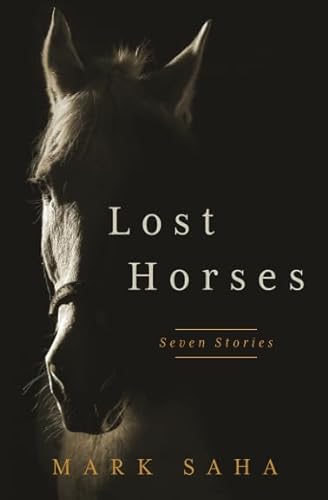
Mark Saha
Mark Saha grew up in cotton country along the Texas Gulf Coast, earned a BA at the University of Notre Dame, and attended film school at UCLA, where a collection of his short stories won a Samuel Goldwyn Creative Writing Award and led to many years of writing scripts for film and television. Growing up in Texas he worked on a doodlebug crew blowing shot lines across the Big Thicket, drove a tractor hauling trash wagons at a cotton gin near Fairchild, and worked cattle on foot on his father’s farm outside Sealy. He is a lifetime member of Writers Guild of America, w and lives in Santa Monica, California.
* * *
Goodreads invites authors to review their own work. My review of Lost Horses on that site may be found here:
https://www.goodreads.com/review/show/2673989066?book_show_action=true&from_review_page=1
* * *
Books that mattered to me...
If I had to pick one novel that left the deepest impression in my youth it would be War and Peace. Tolstoy's grasp of the range and depth of human experience, about which he wrote so intimately and well, made me realize how pitifully little I knew of life. He had served in the Crimean War and used that experience to convey, as Hemingway would later, a sense of absolute realty to the combat portions. (Hemingway in boasting of writers he had beat, grudgingly admitted “I didn’t beat the Russians.”) He wrote with equal ability of family; a personal favorite moment is young Natasha attending the opera in Moscow at sixteen. She is so dazzled that she shakes with excitement and flushes with embarrassment yet, Tolstoy writes, is unaware it is those very qualities that wins the hearts of Muscovites and make her the talk of the evening. We see her grow from a mischievous and intelligent child into an adult mother with thoroughly conventional views, which is a little sad. But it is this distance between war and peace and his ability to write of each with insight that impressed me.
I admire Scott Fitzgerald’s prose and notice (or imagine I do) how his experience in Hollywood affected it. His early works (e.g., “The Offshore Pirate”) seem to me a poet boldly writing in prose. The movies made him more of an empiricist, telling a story in more conventional terms of what we see and what people say. “Tender is the Night” frustrates me because it might have been his best work. but is clearly marred by his drinking and struggle with Zelda’s breakdown. There is a Hollywood screenwriter who claims to have written small portions of it, when Scott called him over in the middle of the night to try to make sense of passages that had become hopelessly confused. Scott’s “Basil and Josephine” stories won my heart shamelessly, and “The Pat Hobby Stories” are quite insightful about Hollywood under the studio system.
Somerset Maugham’s “Of Human Bondage” deeply affected me in undergraduate days as a study of how little we control when, how, and with whom we fall in love. I was disappointed by his attempt to depict young Philip as intellectual by having him study philosophy. It seemed obvious to me Maugham had merely consulted a few standard philosophy texts to extract “famous quotes” by “great philosophers”; there is nothing critical or original in Philip’s grappling with the subject to suggest his understanding is more than rote and superficial. Looking back, it was probably unfair of me to find this so annoying in a book that otherwise taught me much about life.
Charles Mackay’s “Extraordinary Popular Delusions and the Madness of Crowds” (1841) hugely influenced me in college, and persuaded me there is nothing so fantastic that someone somewhere will not believe it. In addition to the spectacular lunacies such as witchcraft and the Crusades, he explores mundane silliness like “the politics of hair and beard” and slang expressions that come and go in the cities -- in his day, “quoz” and “there he goes with his eye out.” This book is public domain so finding an unabridged copy can be a challenge. Many editions are edited to include only financial hysterias as a cautionary tale for investors, but do not warn the buyer of substantial omissions.
William Lecky’s “Rise of Rationalism in Europe” (1865) is a more scholarly companion to Mackay. Lecky concludes that once a hysteria takes off on a rip (e.g., the witch mania), it is immune to reason, but eventually burns out when people simply lose interest. He points out that the abundance of evidence for existence of witches has never been disproven -- authority of scripture, eye-witness accounts, signed confessions, transcripts of court testimony, etc. Today, Lecky writes, people simply no longer think such evidence worth considering.
Russell’s “History of Western Philosophy” influenced me because he does not simply treat the views of various philosophers in the abstract, but places each in his own time to expose ulterior motives that influenced his thinking. This originated as a series of lectures for art students at the Barnes Institute, and reads more like lectures in its presentation than material laid out for a book.
Popular items by Mark Saha
View all offers-
-
-
Mystery Manor: A Spooktacular 3-D Playset
Mark Saha
Item prices starting from
View 1 offerUS$ 29.99
Also find
Used