Thomas M. Armstrong
Thomas Madison Armstrong III is a veteran of the early 1960s civil rights movement in his native Mississippi, the heart of white resistance in the South.
He was at the forefront of early protests led by black Southerners for voting rights and equal public accommodations from 1958-1961. Such activism constituted criminal activity under the laws of segregation, and made participants targets for eager retaliation by white extremists. Their gut-wrenching courage in the beginning stages of protest offers up a contrast of the civil rights movement at its height. Armstrong and his family were threatened to such an extent; he was forced to leave Mississippi against his will.
The traumatic and painful separation would lead him to step out of the milieu of protest, and focus instead on working to advance his career and caring for his family, even as he struggled with what to do with his life.
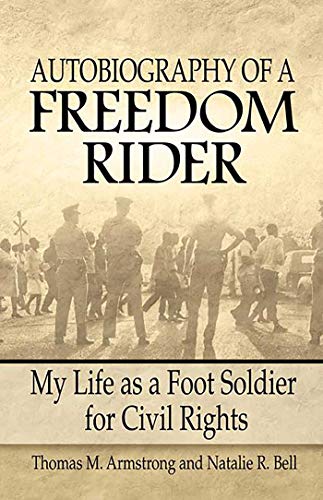
The author of the memoir AUTOBIOGRAPHY OF A FREEDOM RIDER; My life as a foot soldier for civil rights moved to the Chicago area in 1964.
He is a retired transportation contracts manager, having worked at the United States Postal Service for 37 years. These days he mostly spends time with his family, helping neighbors, and volunteering at the American Red Cross.
He did not speak publicly about his civil rights experiences for some 38 years. He has only broken his silence at the urging of family members, and out of his own concern that the history is being oversimplified to but a few names of icons.
He remains closely allied with other former Freedom Riders and civil rights workers around the country. Since he began responding to invitations to talk about his experiences in recent years, he has presented at several schools, and before professional and civic organizations, such as the African American Leadership Roundtable in Chicago.
He has been the subject of scholarly research by Maria Lowe, associate professor of sociology at Southwestern University, Georgetown, Texas, who continues to work on her book, Civil Rights, Agitation, and Freedom in the Ivory Tower: The Distinctive Roles of Tougaloo College and Millsaps College in the Mississippi Civil Rights Movement, 1954-1965.
His civil rights activism became the focus of the attached research paper, History of a Freedom Rider, 'No Threat or Harm Could Stop Us, written in 2007 by Maggie Morgan, a graduate student the University of Chicago (see Appendix). Morgan is a student of Raymond Arsenault, whose book on the 1961 Freedom Riders is detailed in the Competition section of the Overview. Before his book was completed, Arsenault invited Armstrong to share his experience in classes with his students.
Requests for media interviews are ongoing. On February 15th of this year, Chicago Tribune columnist Dawn Turner Trice featured Armstrong's story and photograph in her column about the 1961 Freedom Riders. (see Appendix).
Armstrong is pictured and quoted in the 2008 book Breach of Peace: Portraits of the 1961 Freedom Riders (Atlas) by writer and photographer Eric Etheridge. A police mug shot taken of him after his arrest for entering the white waiting room at a Jackson, Mississippi bus station is included, along with a recent picture, as part of a series of then-and-now portraits of freedom riders. Breach of Peace's portraits of Armstrong were also carried on the cover of the Fall 2008 issue of American Legacy, a magazine of African American history published by Forbes, Inc.
Armstrong wrote his memoir over the course of two years, completing it in 2009. He has also written a 200-page genealogical history of his family, which includes the names of his ancestors who were able to vote during Reconstruction.
Natalie R. Bell
Natalie Bell is a journalist based in New York. She has worked for more than 25 years, as a news reporter for broadcast and print news organizations in the Northeast, Midwest and Southern U.S. Her work has been carried by national and international news organizations, such as Dow Jones & Co. and National Public Radio. She is specialized in covering public affairs, in particular education. As a Fulbright-Hayes fellow, she covered political and cultural transition in post-apartheid South Africa. She was a delegate to the United Nations World Conference Against Racism in 2001. She has also taught journalism and media studies as an adjunct professor.
Bell has family roots in Prentiss, Mississippi, and met Armstrong while researching her family history. She is a native of Nashville, Tennessee, and has lived and worked as a television news reporter in Mississippi.
Popular items by Thomas M. Armstrong
View all offers-
Autobiography of a Freedom Rider: My Life as a Foot Soldier for Civil Rights
Armstrong, Thomas; Bell, Natalie
Item prices starting from
View 12 offersUS$ 7.44