Paul Ernst
I believed in God as a child. It was a source of comfort, especially after my mother died when I was ten. But I became more self-absorbed as I grew older, and my interests drifted away from faith. High school found me with two obsessions: motorcycles (the "in" thing) and science (the only subject I was good at).
Scientists of the day had celebrity status. They were the role models for what "smart people" did, and I admired them immensely. Add to that admiration a naive overlay of Ayn Rand's "Objectivist" philosophy, and I thought I had it all under control. I majored in chemistry, taught high school chemistry and physics, and worked as a pharmaceutical chemist. After a slight career change, I spent most of my professional life in financial services.
Although an atheist, I never held the kind of militant atheism we see today. Religion just seemed silly, and I wanted to be like the smart people. Besides, I saw no way to get at the truth of religious issues. How could anyone hope to investigate bizarre claims like, "Jesus physically rose from the dead?" I didn't see how religion could offer any benefit in this world or the next--so what was the point?
At age fifty, all that changed. I got approached by an attorney who had written a legal "brief" defending the divinity of Christ. Through reading his work, I realized that Christianity's major claims were open to ordinary methods of investigation. In other words, they rested on more than just "faith."
What followed was an eighteen month investigation of Christian beliefs. I worked through a swamp of arguments and counterarguments, every stage of which only strengthened my resolve to find the truth. I lived in turmoil as claim after claim muddied the waters. Finally, I decided to take stock of what I had found. The conclusion startled me: beyond all my expectations, the case for Christ held up to scrutiny. From fulfilled prophecy to the resurrection, the details of his story fit the evidence.
Yet if Christianity were true, then my journey couldn't end with a finding. The whole business was about much more than my head; I had to move from "believing that" to "trusting in." So I decided to reach for the Jesus behind the evidence. I say reach, but in actuality, he was the one reaching for me. He provided a community to help me through, and by his grace, I have been able to spend the last ten years delving further into the personal and intellectual aspects of my faith.
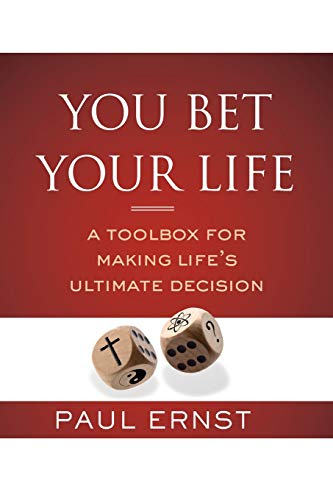
I am not a literary sort by nature, but a serious illness and a friend's urging convinced me to write something down. Throughout the process of writing You Bet Your Life, I have had access to some of the best minds in Christian thought. The book blends accessible forms of their arguments with my analysis and experience. I wrote it as a personal epistle to the skeptical and to the doubting, to those who feel their mortality closing in and to those who wonder why they should care. Simply put, this is my attempt to fill a missing space between objective evidence and our need for something greater than this life.
Popular items by Paul Ernst
View all offers-
You Bet Your Life: A Toolbox for Making Life's Ultimate Decision
Ernst, Paul
Item prices starting from
View 11 offersUS$ 6.48