Robert H Lengel
I am Bob Lengel, author of The Front Porch Revolution and president of LeaderWork Inc., a company I founded to serve as home for a revolution in how we think about the interdependence of personal and organizational leadership development and the quality of our conversations introduced in the book. My background includes two degrees in engineering, an MBA, a Ph.D. and work experience in the aerospace industry, financial services, industrial sales, environmental systems, and academics. For the last 34 years, I did research and taught at a business school in a major university. While there I founded an executive learning center, an innovative executive MBA program, a Leadership Challenge program for undergraduates and a university-wide student-run philanthropic organization providing emotional and financial support for families battling pediatric cancer. My center served as a front porch for the College of Business, where theory and practice came together in constructive dialogue. Through conversations on this porch, my research, my eclectic education and work experience and consulting, I developed a new level of thinking about leadership, communication, change and personal growth. This thinking shifts our attention away from leadership to what I call leader work.
I wrote The Front Porch Revolution because we are failing to accomplish our leader work and as a result, our nation, our organizations and our sense of humanity are in jeopardy. This book is an invitation to step out of your busyness, sit with me on my front porch and engage in a serious conversation of possibility. This conversation unfolds in the context of a personal first-person story that blends my evolution as a person with what I have learned about working together with others around complex topics where our diversity typically leads to acrimonious and uncivil discourse and gridlock. Today it seems like we have forgotten how to talk to each other, let every disagreement become personal and tend to retreat to the perceived safety of isolated tribal communities like “liberal” and “conservative” or “Trumpers” and “non-Trumpers”. We simply do not seem capable of dealing constructively with our differences. This is a frustrating and depressing state of affairs, but it is reversible.
I offer a path out of this downward spiral that begins with mustering the courage to change the stories we tell ourselves about who we are and what we want to be. These new stories have to be about leading our lives and not just managing them. We are a product of our world and our world is a product of us. Like everything I have to say, this idea is best illustrated in a story.
I grew up in a small town in the anthracite coal region of Pennsylvania. There were a collection of elementary schools in those days that fed eventually into a common junior high and high school. Each of the elementary schools had a basketball team and these teams formed a “biddy basketball” league. “Biddy” meant that we played with baskets that were only 8.5 feet high as opposed to the standard 10 feet.
At the end of the season when I was in the fifth grade, the league held a celebration dinner for all the players, coaches and parents. Trophies were handed out to the winning team members and other individuals for things like scoring and sportsmanship. In those days not everyone was entitled to a trophy. As I think about the work that I have done and presented in The Front Porch Revolution, I am reminded of a story that the keynote speaker at that event told. I cannot remember who that speaker was, but I will never forget what he said.
He wanted to make a point about the importance of participating in challenging activities like basketball in the development of young boys. Here is the story as I remember it —
A few months ago I had to take my five-year-old son Ben to the dentist. The waiting room was crowded and my son was anxious and hyperactive. In frustration, I picked up a magazine and started to page through it. I found a page with a picture of a world map and had an idea. I tore that page out and ripped it into pieces. I put those pieces on the floor in front of my son and told him it was a puzzle. He was only five and probably had no real sense of what the world looked like, but I challenged him to put that world puzzle together. I was sure this would keep him occupied until the dentist could see us, but to my surprise, it only took him about five minutes to complete the task.
Ben, how on earth did you do that? He replied, dad, it was easy. I was not sure what the world looked like, but on the other side of that world map page, there was a picture of a little boy. I found that by putting that little boy together all right, the world came out OKAY.
In many ways, our nation, our communities, our lives and the complex challenges we face are constantly being torn into pieces that are set before us like the world map puzzle that was set before Ben. If we do not know what the pictures of the solutions we seek look like, perhaps there is a picture we do know on the other side of those solutions. I think that picture is us. The downward spiral in communications and the gridlock around issues we all care about is, in large part, the result of this picture not being clear.
The Front Porch Revolution challenges us to reclaim the time and space to slow down, talk to each other and lead our lives in an over-managed world. Creating this time and space opens a path home to our best individual and collective possibilities in whatever we face. This path is illuminated by a new level of thinking that appreciates the interdependent relationship between the personal and more public sides of the puzzles we face. The first step and I believe the missing step, on this path is to realize that any sustainable and life-affirming solution to our leadership challenges must simultaneously put together both sides of the puzzle. This is our leader work, but we cannot do this work alone.
We need the help of others to see ourselves clearly. Only through our conversations can we make visible different parts of our potential. This requires us to meet in new ways that offer the time and space necessary to put our personal puzzles together as context for the external problems or issues we face. Without this context we are trapped in the downward communication spiral that denies us full presence with our potential and the possibilities it invites. Such meetings are more likely to happen on front porches as opposed to in conference rooms, classrooms or on the floor of Congress. The Front Porch Revolution and our leader work is about coming together in front-porch-like meetings to help each other put together our pictures of what an individual and collective life of possibility looks like and then turning that picture over to see what our world and our solutions to our most perplexing problems need to be to live that life.
Popular items by Robert H Lengel
View all offers-
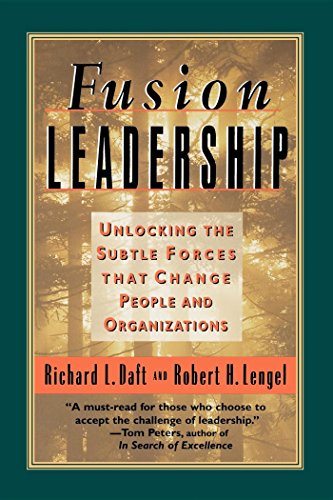
Fusion Leadership (Tr)
Daft, Richard L; Lengel, Robert H
Item prices starting from
View 36 offersUS$ 3.94
-
The Front Porch Revolution: Reclaiming the Time and Space to Slow Down, Talk to Each Other and Lead in an Over-Managed World
Lengel, Robert H
Item prices starting from
View 29 offersUS$ 15.26
-
A Place for T: Giving Voice to the Tortoise in Our Hare-Brained World
Lengel, Robert H
Item prices starting from
View 28 offersUS$ 29.60