Order Total (1 Item Items):
Shipping Destination:

Japanese Internment (18 results)
Skip to main search results
Search filters
Product Type
- All Product Types
- Books (17)
- Magazines & Periodicals (No further results match this refinement)
- Comics (No further results match this refinement)
- Sheet Music (No further results match this refinement)
- Art, Prints & Posters (1)
- Photographs (No further results match this refinement)
- Maps (No further results match this refinement)
- Manuscripts & Paper Collectibles (No further results match this refinement)
Condition Learn more
- New (1)
- As New, Fine or Near Fine (3)
- Very Good or Good (7)
- Fair or Poor (No further results match this refinement)
- As Described (7)
Binding
Collectible Attributes
Language (2)
Price
- Any Price
- Under US$ 25 (No further results match this refinement)
- US$ 25 to US$ 50
- Over US$ 50
Free Shipping
Seller Location
Seller Rating
-
-
JAPANESE INTERNMENT Two Scarce 1945 Philadelphia RESETTLEMENT PAMPHLETS
Language: English
Published by Philadelphia District Office of the War Relocation Authority / Philadelphia Nisei Council and the International Institute, Philadelphia, Pennsylvania, 1945
Seller: Blank Verso Books, ABAA, Mill Valley, CA, U.S.A.
Seller rating 5 out of 5 stars

First Edition
Soft cover. Condition: Very Good. 1st Edition. Two original pamphlets encouraging Japanese Nisei, recently released from West Coast internment camps, to relocate to Philadelphia: Wanted, A Friendly Community For Family Resettlement, Found The City For Family Relocation, Philadelphia / Philadelphia ?. Why? We The Relocatees Speak To You In Our Own Words Because We Are Sincerely Interested In You ?. Published by the Philadelphia District Office of the War Relocation Authority. With contributions from numerous evacuees relating their experiences and which Internment camp they left from. Illustrated by Masao Yabuki. 1945 first edition, illustrated wraps, 10.5" x 8", 13 numbered pages, mimeographed sheets, staple bound. VERY GOOD Condition: some age toning and light wear to the covers, spine fold split at the ends, staples are oxidized and no longer holding inner pages, internally light signs of age and use, otherwise bright, clean and unmarked. Scarce. Philadelphia 1945 Young Penn Meets Nisei?Plant'g Friendship Hiroshi Uyehara, Editor. Published under the auspices of the Philadelphia Nisei Council and the International Institute. From the introduction: "If Philadelphia be your choice, this booklet that we have compiled out of our actual experiences and up-to-date facts may be of help in introducing you to the 'ins and outs' of this city that we have come to love and has become home to us." Cover illustration by Masao Yabuki. 1945 first edition. Illustrated wraps, 8.5" x 5.5", 24 pages including covers, mimeographed sheets, staple bound, map frontispiece, b&w drawings throughout, last 4 pages in Japanese. VERY GOOD Condition: staples oxidized and light signs of age otherwise thighs, bright, clean and unmarked. Scarce. The Philadelphia Nisei Council was a grassroots organization established in May 1945 to support and encourage Japanese Americans to resettle in the Philadelphia region after leaving World War II internment camps. The Council acted as a vital relocation social network, publishing and distributing informational pamphlets offering practical advice on finding employment, local housing, hostels, schools, food, fun and general help navigating the post war Philadelphia community. Philadelphia earned its moniker as the "City of Brotherly Love" at key moments in national history. The establishment of a community for recently imprisoned Japanese Americans during World War II was one such moment. After the Pearl Harbor attacks, President Franklin D. Roosevelt ordered the removal of 120,000 Japanese Americans from their homes on the West Coast to prison camps inland. This violated Japanese Americans' right to due process, stripped many families of wealth, and caused generational hardship. After the east coast was opened to resettlement (January 1944) The Philadelphia War Relocation program helped find new homes and employment for thousands of Japanese American evacuees who had nothing to return home to on the West Coast.
-

A child in prison camp.
Published by William Morrow & Co.,, New York:, 1974
Seller: Zephyr Used & Rare Books, Vancouver, WA, U.S.A.
Association Member: ABAA CBA ESA ILAB
Seller rating 5 out of 5 stars
First Edition
4to. 63, [1] pp. With colour plates, 1 map. Gold library cloth publisher's binding, black lettering on spine (scuffing, and offsetting from jacket Brodart being glued securely originally to pastedowns, ex-lib markings on endpapers), w/ d.j. cover art by Takashima (minor edgewear, slight creasing, partially removed spine label for "Library Edition"), still a G/VG copy. First U.S. edition of this searing and poignant illustrated memoir of the artist's experiences being stripped of their Canadian Civil Rights, herded into railcars, and shipped to New Denver Internment Camp on Slocam Lake, Canada for over 3 years during World War II. Her watercolour paintings earned a Gold Medal from the Canadian Association of Children's Librarians, and was the first major publication to examine the Japanese-Canadian experience of illegal internment by a Japanese-Canadian writer. Takashima (1928-2005) studied at the Ontario College of Art following the War, later taught there from 1976 to retirement in 1994, and also spent extensive time traveling in Mexico, India, New York, and Japan.
-

THE STORY OF JAPANESE-AMERICAN STUDENT RELOCATION
Published by World Student Service Fund, New York, 1943
Seller: johnson rare books & archives, ABAA, Covina, CA, U.S.A.
Association Member: ABAA ESA ILAB
Seller rating 5 out of 5 stars
Four-panel brochure (5 1/2" x 8 1/2"), printed in blue on white stock. The front panel features a photographic illustration of three Japanese-American students at the University of Nebraska. Previous owner's pencil signature to the top of the front panel; otherwise very good. Scarce, OCLC locates only two holdings, at the Bancroft and the Presbyterian Historical Society. Outlines plans to assist Japanese-American students whose university studies were interrupted by the attack on Pearl Harbor and Executive Order 9066, which set into motion the removal and imprisonment of 110,000 Japanese Americans living on the West Coast. It describes the success as of January 1943 at finding institutions in the interior, outside the evacuation zone, willing to accept these students as transfers and makes a plea for donations to continue the program: "A great deal is at stake in this job of relocating our Nisei students. Their belief in American democracy, which they have been taught as American citizens, and in good faith of the nation of which they are part, is at stake." Offered together with: HOW TO HELP JAPANESE AMERICAN STUDENT RELOCATION. Philadelphia: National Japanese American Student Relocation Council, 1943. Pamphlet (4" x 8 3/4"): 8 p. Printed in black on cream stock and bound with a staple. A crisp and clean example. OCLC locates four holdings: Emory, Stanford, UC Irvine, and Wisconsin Historical Society. Frames the effort as a common task for church and college, touching on the rise of anti-Japanese discrimination in the United States and the financial commitment required to assist students displaced by the war. Includes a statement from a Nisei student: "Consider us as you would any other American student on campus. Within and without the classroom help us to become one of your group." The final two panels are dedicated to an annotated bibliography of suggested references.
-
Japanese Internment Heart Mountain War Relocation Center Materials Documenting WRA Governance, Camp Administration, and Community Activities Inside the Camp, 1944
Publication Date: 1944
Seller: Max Rambod Inc, Woodland Hills, CA, U.S.A.
Association Member: ABAA ILAB PADA
Seller rating 5 out of 5 stars
Signed
[Japanese Internment] Heart Mountain War Relocation Center materials documenting administrative theory alongside camp level cultural practice. The War Relocation Authority's political administration and daily life inside Japanese American incarceration during World War II, including a copy of Community Government in War Relocation Centers signed "Rachel Sady," likely the anthropologist Rachel Reese Sady of the War Relocation Authority's Community Analysis Section, paired with a 1944 recital program naming Heart Mountain residents and a camp letterhead sheet. The booklet analyzes block organization, temporary councils, organizing commissions, the crises at Poston and Manzanar, registration, and the extension of representation to Issei, while the recital program shows community activities operating within Heart Mountain's own block and barracks geography. Heart Mountain opened in Wyoming in August 1942 under the War Relocation Authority, held more than 10,000 Japanese Americans behind barbed wire and guard towers, and differed from most WRA camps in relying on a Temporary Council of Block Chairmen rather than a standard elected community council, making this grouping a sharp document of how federal control and inmate social life intersected within one confinement site. 1944-1946, Heart Mountain, Wyoming, with one Washington, D.C., War Relocation Authority publication. Archive of 3 items: 1 typed recital program, 1 Heart Mountain War Relocation Project letterhead sheet, and 1 printed WRA booklet. [1] United States. War Relocation Authority. Community Government in War Relocation Centers. Washington, D.C.: U.S. Government Printing Office, [1946]. Printed wrappers, upper cover signed "Rachel Sady." Prepared by Solon T. Kimball, head of the Section of Community Government, the 103-page volume examines the War Relocation Authority's effort to construct political administration within the camps through legal policy, block organization, temporary community councils, organizing commissions, and debates over representation, with sections on the Poston strike, the Manzanar riot, registration, and the extension of representation to the Issei. Its closing pages turn from camp governance to the consequences of removal itself, recommending "special governmental agencies or units" to provide "resettlement aid (grants)" and "loans" to former inmates, and stating in a "statement of facts" that "mental suffering has been caused by the forced mass evictions" and that there had been "almost a complete destruction of financial foundations built during over half a century." The signature matches the name of anthropologist Rachel Reese Sady, a University of Chicago trained researcher who worked for the WRA's Community Analysis Section during the war and later wrote on labor relations, race relations, and rumors in the camps; without further provenance, the inscription is best treated as a probable but unconfirmed identification. [2] The Community Activities of Heart Mountain invites you to a Pupils Piano Recital of Julia Kuwahara. Heart Mountain, Wyoming: Community Activities of Heart Mountain, May 29, 1944. Typed program for a recital held Monday evening at 8:00 p.m. in "Y Lounge, 23-25-N." The program names Heart Mountain residents and performers including Nobuko Kato, Lillian Kumagai, Helen Kato, Fumiko Fukuda, Kiyoko Nomura, Linda Ito, Matsuko Iizuka, Taneko Okauchi, Frances Okazaki, and Kiku Hori, with repertoire by Mozart, Mendelssohn, Chopin, Tchaikovsky, Rachmaninoff, and others. In documentary terms, this is the strongest item in the group: it anchors camp cultural life to a precise date and place while preserving a roster of named individuals living inside Heart Mountain's internal address system. [3] Heart Mountain War Relocation Project letterhead. Heart Mountain, Wyoming: War Relocation Authority, circa 1944-1945. Single sheet with printed Heart Mountain vignette and the designation "Heart Mountain War Relocation Project / Heart Mountain, Signed.
-
Outcasts! The Story of America's Treatment of Her Japanese-American Minority
Published by Fellowship of Reconciliation, New York, 1944
Seller: Auger Down Books, ABAA/ILAB, Marlboro, VT, U.S.A.
Association Member: ABAA ESA ILAB
Seller rating 5 out of 5 stars
Condition: Near Fine. A booklet published by the Quaker anti-war group Fellowship of Reconciliation concerning the evacuation and resettlement of west-coast Japanese Americans. The booklet was written from federal prison by conscientious objector Caleb Foote, who would later become a leading scholar of criminal justice reform; with a foreword by prominent anti-internment activist Galen Fisher. Fisher describes its contents: "[I]t strikes a body blow to keep the Constitution valid for all, and takes square issue with those who would expurgate it for persons of Japanese descent. It is not an appeal for sympathy for the evacuees, but an argument for justice, and that is what the evacuees themselves want. Facts are arrayed about the whole gamut of evacuation and resettlement, but the emphasis on the deeper issues affecting our American democracy is at the core of the booklet." The booklet is illustrated with photographs of Japanese internment taken by Dorothea Lange, Clem Albers, Francis Stewart, Joe McClelland, and Tom Parker. Lange, Albers, Stewart, and Parker worked for the War Relocation Authority; and McLelland worked at the Granada camp in Colorado, where his wife was a teacher. Lange is best known for her Depression-era photos; much of her documentation of the evacuation and internment of Japanese Americans was impounded by the US government until after the war. Though fairly common institutionally, no other copies are offered for sale at the time of listing. Illustrated with photographs by Dorothea Lange, Clem Albers, Francis Stewart, Joe McLelland and Tom Parker.
-
HEADQUARTERS WESTERN DEFENSE COMMAND AND FOURTH ARMY PRESIDIO OF SAN FRANCISCO, CALIFORNIA. PUBLIC PROCLAMATION NO. 6 [caption title].
Published by San Francisco. June 2, 1942., 1942
Seller: William Reese Company, New York, NY, U.S.A.
Association Member: ABAA ESA ILAB SNEAB
Seller rating 5 out of 5 stars
First Edition
Public Proclamation No. 6, signed in type by John L. DeWitt of the notorious Western Defense Command during World War II, setting a curfew for all persons of Japanese ancestry in the California exclusion zones and setting the groundwork for the imminent incarceration of all such persons in that area. The proclamation's seven articles require that: "all alien Japanese and persons of Japanese ancestry who are within the said California portion of Military Area No. 2, be and they are hereby prohibited from leaving that area for any purpose"; "No person of Japanese ancestry, whether alien or non-alien, who is now outside of Military Area No. 1 or outside of the said California portion of Military Area No. 2, shall enter either of said areas unless expressly authorized to do so by this headquarters"; and that "The hours between 8p.m. and 6a.m. are hereby designated as the hours of curfew.All persons of Japanese ancestry, both alien and non-alien.shall, during the hours of curfew, be within their places of residence.At all times other than during the hours of curfewall such persons shall be not more than 10 miles from their place of residence." Articles 4 and 5 exempt hospital patients, orphans, and the deaf or blind from the preceding orders, and permit persons of Japanese ancestry to visit post offices or courts which are more than ten miles from their homes. Should any hope of relief have remained among California residents, the sixth article of this proclamation squelches them: "All alien Japanese and all persons of Japanese ancestry will be excluded from said California portion of Military Area No. 2 by future orders or proclamations of this Headquarters." The National Park Service's official report on the Manzanar Relocation Center describes this proclamation and its aftermath as follows: "On June 2, 1942, a second stage of the government's Japanese evacuation program began when, by Public Proclamation No. 6, DeWitt ordered the exclusion of Japanese aliens and American citizens of Japanese ancestry from the California portion of Military Area No. 2 on the grounds of military necessity.The first civilian exclusion order [No. 100] for this area was issued on June 27, and by August 8 all persons of Japanese ancestry had been removed from the eastern part of California. "Analysis of this second exclusion decision belies the lame military rationale on which it was presumably based. The eastern boundary of California lies more than 100 miles east of Military Area No. 1 at the Oregon border. If there had been a general decision to exclude the ethnic Japanese from forests and mountains, why had they been allowed to resettle in Military Area No. 2? Morton Grodzins, an authority on the Japanese evacuation has concluded that this second exclusion decision was another example of the Western Defense Command's adoption of an unsound military rationale to carry out the program of politicians, agriculturalists, and agitators in eastern California who were determined to remove all ethnic Japanese from the state. "Whatever the motivation, this second exclusion decision had two principal results. The voluntary evacuees who had resettled in eastern California were uprooted a second time, and, by August 8, 1942, everyone of Japanese descent had been expelled from the entire state of California except for those under guard at the Manzanar and Tule Lake relocation centers and a small handful under constant supervision in hospitals and prisons. The anti-Japanese forces in California had finally triumphed in their historic crusade." This proclamation was followed by No. 7 on June 8, and "With the implementation of Public Proclamations Nos. 6 and 7, the compulsory evacuation of Japanese Americans from the west coast was completed" (Unrau). One of the most important official steps in the forced relocation of Japanese Americans from California, and evidence of the harsh restrictions which were enforced even prior to incarceration. Harlan D. Unrau, The Evacuation and Relocation of Persons of Japanese Ancestry During World War II: A Historical Study of the Manzanar War Relocation Center (National Parks Service, 1996) pp.64-66. Single bifolium. Outer leaves tanned. Very good plus.
-
[Japanese Internment Camp Yearbook] The Minidoka Interlude. September, 1942 - October, 1943
Published by Residents of Minidoka Relocation Center, Hunt, ID, 1943
Seller: Burnside Rare Books, ABAA, Portland, OR, U.S.A.
Association Member: ABAA CBA ILAB
Seller rating 5 out of 5 stars
Condition: Near Fine. An annual yearbook documenting the residents at the Minidoka War Relocation Center in Hunt Idaho. Bound in the original dark blue cloth stamped in blind. Near Fine with rubbing to extremities, light soiling to rear. Former detainee/owner's name on front pastedown "Margaret [Masako] Tomoguchi 38-12 Hunt, Idaho", and several instances of red underlining throughout. Depicted in this yearbook are various employment divisions and recreational activities including ikebana flower arranging and cheerful Christmas celebrations. Included are black of white photos of each block and barrack members by name, including Tomoguchi's. Tomoguchi was ten years old when she and her parents, Tomoji & Ayako, were initially sent to Camp Harmony at the Puyallup Assembly Center and then later relocated to Minidoka.
-
THAT YOU MAY KNOW. A FEW FACTS ABOUT THE "JAPANESE PROBLEM" IN THE UNITED STATES.
Published by [N.p., but Pasadena? 1943]., 1943
Seller: William Reese Company, New York, NY, U.S.A.
Association Member: ABAA ESA ILAB SNEAB
Seller rating 5 out of 5 stars
An intriguing and likely unique draft for an apparently unpublished pamphlet in opposition to the forced evacuation of Japanese Americans from the West Coast during World War II. Titled "THAT YOU MAY KNOW," this "pamphlet" was written by "citizens of the State of California" and aims to present "A Few Facts about the 'Japanese Problem' in the United States." Motivated by deep concern for the rights of Japanese Americans as well as the dire consequences of such horrific government overreach, the otherwise unidentified authors lay out their purpose early on in the document: "This little pamphlet was written in the state where exists some of the most deep-seated prejudice against the Oriental.The authors of this pamphlet are citizens of the State of California. They believe that most of the Japanese in our country are loyal; they believe that attempts at disfranchisement and deportations of American citizens are essentially un-American and dangerous to the future peace and security of our nation; they believe in the integrity of our American Government and that our Government, if left free to carry out its own intentions, will safeguard the future of the citizens of Japanese descent. But, if the pressure groups have their way, the future for us all will be fraught with turmoil, and domestic disaster." They point out that that "At the time of the evacuation there were approximately 127,000 'Japanese' in the United States. This is less than one tenth [^of 1% (1000th)] of our total population," and blame "the dramatic reporting in the American Press of gross sabotage and espionage committed by members of the local Japanese community in Hawaii" for the way things have turned out. To make their case, they reprint pages eleven and twelve of the fourth interim report of the U.S. House of Representatives' Tolan Committee in full, which found that they "cannot doubt and everyone agreed that the majority of Japanese citizens and aliens are loyal to this country." In order to disprove the claims of the media, the authors also quote from affidavits and testimonials collected by the Tolan Committee as to the loyalty of Japanese Americans. These include a statement by J. Edgar Hoover himself, who states that "there was no sabotage committed [in Hawaii] prior to December 7, on December 7, or subsequent to that time." The authors supplement the work of the Tolan Committee with a statement from Dr. Philip S. Platt, who resided in Hawaii as director of the charitable Palama Settlement at the time of the Pearl Harbor attack, and include the text of an advertisement run in the Hawaiian Advertiser in February of 1943, congratulating Japanese Americans on earning the right to enter the armed forces. While the authors of this pamphlet are never identified, given the subject and tenor of the text and the fact that they refer to themselves as "the Committee," it seems a strong possibility that this was an unrealized project of the American Friends Service Committee. Founded in 1917 to aid conscientious objectors during the First World War, during the 1920s period the AFSC became increasingly involved with race relations in the United States. The California branches focused particularly on the so-called "Japanese Problem," and dedicated themselves to support for incarcerated Japanese Americans beginning in 1943. Their efforts included matching Japanese students with universities, establishing hostels to help resettle inmates, supporting legal efforts which opposed the internment program (including the famous Gordon Hirabayashi case), and, of course, printing and distributing literature. A unique and ephemeral artifact in opposition to America's unprecedented Japanese Internment program during the Second World War, likely penned by one of the leading advocate groups for Japanese Americans in the early 20th century. Light edge wear and chipping, else very good.
-
[Japanese Internment Camp Yearbook] The Minidoka Interlude. September, 1942 - October, 1943
Published by Residents of Minidoka Relocation Center, Hunt, ID, 1943
Seller: Burnside Rare Books, ABAA, Portland, OR, U.S.A.
Association Member: ABAA CBA ILAB
Seller rating 5 out of 5 stars
Condition: Very Good. Original dark blue/black cloth stamped in blind. Very Good. Old tape with holograph Japanese characters on paper to spine and rear cover; tape reinforcements to inner hinges. Owner name (Frank M. Tomori) and family number to verso of front free endpaper, several holograph markings at rear section, several newsclippings taped to rear page, and Tomori's 1973 markings to rear free endpaper. An annual yearbook documenting the residents at the Minidoka War Relocation Center in Idaho, showing each block, and various employment divisions and recreational activities.
-
[Japanese Internment] Japanese Students Under Fire (Original Silver Gelatin Press Photograph)
Published by Acme Newspictures, 1942
Seller: Burnside Rare Books, ABAA, Portland, OR, U.S.A.
Association Member: ABAA CBA ILAB
Seller rating 5 out of 5 stars
Condition: Very Good. Original silver gelatin press photograph. 7"x9". Captioned on back on mounted label, "Parkville, Mo., American-born Japanese students at Park College, Parkville, Mo., take part in flag-raising ceremony and calmly continue studies there despite protests of citizens of Platte County, Mo., who believe they should be interned. [.]" The college president is shown raising the flag as six students named on the back look on. Very Good with a small amount of label adhesion to the bottom the image.
-
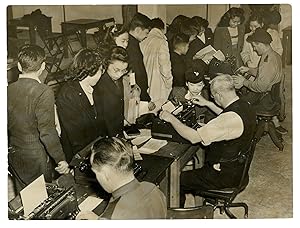
Japanese Americans Anxious to Establish Their Status as United States Citizens in December, 1941 (Japanese Internment Press Image)
Published by The Oregonian, Portland, OR, 1941
Seller: Burnside Rare Books, ABAA, Portland, OR, U.S.A.
Association Member: ABAA CBA ILAB
Seller rating 5 out of 5 stars
Condition: Very Good. Original silver gelatin press image, 9.25" x 7. A very early image of Japanese Americans responding to the attack on Pearl Harbor and the rising anti-Japanese sentiment in the Untied States, with the date of "Dec 15 1941" rubber-stamped to verso. In the days immediately after Japan's December 7, 1941 attack, local defense councils on the West Coast implemented new identification paper requirements for Japanese Americans. Clipping glues to verso of image reads" Anxious to establish their status as United States citizens and escape the laws restricting Japanese nationals, many American-born Japanese Sunday flocked to the Multnomah County courthouse, there they received special identification papers. A portion of the crowd which applied for recognition is shown above answering questions and being fingerprinted by the city and county officers. County officials estimated that 1000 were eligible for papers in Portland." Very Good.
-
[Japanese Internment] Off on a New Adventure (Original Silver Gelatin Press Photograph)
Published by Acme Newspictures, Los Angeles, 1942
Seller: Burnside Rare Books, ABAA, Portland, OR, U.S.A.
Association Member: ABAA CBA ILAB
Seller rating 5 out of 5 stars
Condition: Very Good. Original silver gelatin press photograph. 8.5" x 6.75". Among the most chilling images of propaganda, casting the forced detention and relocation of Japanese Americans as a fun trip to summer camp. Press caption on reverse reading "These young Japanese are ready to leave homes in Los Angeles for new homes and new adventure in Manzanar Alien Reception Center, Owens Valley, California. Here the government is providing farm land and living quarters for those having to evacuate strategic defense areas in and near Los Angeles. These young folks will help make way for the thousands that will follow in the next few months." Very Good with some waviness to the image from the caption label glued to the rear, light general wear.
-
Collection of 9 typed and manuscript letters and original documents, most relating to the internment during World War II of Eitaro Aida originally of Cumberland, B.C.
Published by vp: 1911-1951., 1951
Seller: D & E LAKE LTD. (ABAC/ILAB), Toronto, ON, Canada
Seller rating 2 out of 5 stars

[ff. 24]. Aida was born in Japan in 1880 and first came to Canada in 1907, living in Cumberland, Vancouver, and again in Cumberland where he owned four properties including a tailor shop, until he was evacuated in April, 1942. He stayed at Hastings Park for five months before being moved the interior housing centre of New Denver in the Kootenays. There he remained in detention for four years until he was released and able to relocate to Toronto. Aida was one of some 21,000 Japanese Canadians living in British Columbia detained and dispossessed under the War Measures Act following the attack on Pearl Harbour. The papers document the seizure and forced sale of Aida's properties and personal possessions at auction, all itemized with prices realized, in four typed letters, dating from 1945 to 1948, from the Canadian Department Of The Secretary of State, Office of the Custodian, Japanese Evacuation Section in Vancouver, B.C. Also included here are Aida's 1911 Japanese Passport, his 1947 request for compensation, his 1949 application for naturalization papers, and his 1951 Certificate of Canadian Citizenship.
-
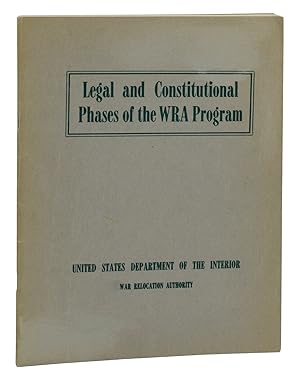
Legal and Constitutional Phases of the WRA Program
Published by U.S. Government Printing Office, Washington, D.C., 1946
Seller: Burnside Rare Books, ABAA, Portland, OR, U.S.A.
Association Member: ABAA CBA ILAB
Seller rating 5 out of 5 stars
First Edition
Condition: Very Good+. First Edition. First edition. [iv], 59 pp. Gray stapled wraps. Very Good+ with light wear, crease to final page. A rare legal history of the War Relocation Authority, which managed the forced confinement of people of Japanese ancestry in America during World War II, as well as their return to civilian life with the commencement of the war. It outlines the government response to the Korematsu case as well as the entire program's overall claims to constitutionality.
-
Administrative Highlights of the WRA Program
Published by U.S. Government Printing Office, Washington, D.C., 1946
Seller: Burnside Rare Books, ABAA, Portland, OR, U.S.A.
Association Member: ABAA CBA ILAB
Seller rating 5 out of 5 stars
First Edition
Condition: Good. First Edition. First edition. [iv], 82 pp. Gray stapled wraps. Good with closed tear to top of front wrap and first page, very slightly to following page; wraps toned and lightly worn; former owner's name written on front cover. A rare history of the War Relocation Authority, which managed the forced confinement of people of Japanese ancestry in America during World War II, as well as their return to civilian life with the commencement of the war.
-
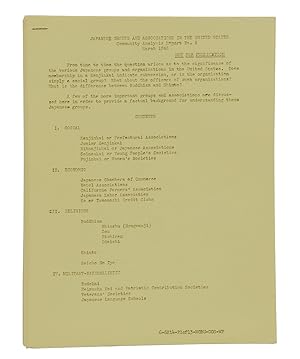
Japanese Groups and Associations in the United States Community Analysis Report No. 3, March 1943
Published by [War Relocation Authority], [Washington, D.C], 1943
Seller: Burnside Rare Books, ABAA, Portland, OR, U.S.A.
Association Member: ABAA CBA ILAB
Seller rating 5 out of 5 stars
First Edition
Condition: Fine. First Edition. First edition. 7 pp. single-sided. Yellow sheets, corner staple bound. A Fine copy with faint rusting to staple and typical faint offsetting around mimeographed text. A very rare document in excellent condition. A list of the different types of groups and associations people of Japanese descent might belong to, compiled for the War Relocation Authority to aid in their internment of Japanese-Americans living on the West Coast.
-
Japanese Internment Documentary Film Flyer, Unfinished Business, by Academy Award Winner Okazaki
Publication Date: 1984
Seller: Max Rambod Inc, Woodland Hills, CA, U.S.A.
Association Member: ABAA ILAB PADA
Seller rating 5 out of 5 stars
Art / Print / Poster
Unfinished Business: The Japanese American Internment Cases. San Francisco: Asian Law Caucus & Committee to Reverse the Wartime Internment Cases, 1984. Broadside. 8.5" x 14". Original 1984 benefit screening poster for Unfinished Business, a landmark documentary film by Oscar-winning director Steven Okazaki, exploring the wrongful internment of Japanese Americans during World War II and the legal redress efforts that followed. Hosted at San Francisco's Palace of Fine Arts and sponsored by the Asian Law Caucus and the Committee to Reverse the Wartime Internment Cases, the poster announces a special premiere event featuring three men who famously challenged the legality of their incarceration: Gordon Hirabayashi, Fred Korematsu, and Minoru Yasui. The stark black-and-white illustration by artist Nancy Yoshihara depicts a barbed wire-encircled Japanese American family, a haunting symbol of collective trauma. Above, a powerful endorsement by Studs Terkel reads: "Unfinished Business is more than a deeply moving film. It is more than a recounting of our country's most shameful moment. It is a powerful warning that hysteria, bigotry, ignorance and moral cowardice demeans us all." Below, the event details highlight the film's focus on the decades-long legal battle waged by these civil rights pioneers, whose wartime convictions were eventually overturned. Some horizontal fold lines, with some light creasing, overall very good condition. An exceptionally scarce piece of Asian American civil rights ephemera marking the emergence of public reckoning with Japanese American incarceration in the prelude to the 1988 Civil Liberties Act. Scarce.


![Seller image for HEADQUARTERS WESTERN DEFENSE COMMAND AND FOURTH ARMY PRESIDIO OF SAN FRANCISCO, CALIFORNIA. PUBLIC PROCLAMATION NO. 6 [caption title]. for sale by William Reese Company](https://pictures.abebooks.com/inventory/md/md32359932052.jpg)
![Seller image for [Japanese Internment Camp Yearbook] The Minidoka Interlude. September, 1942 - October, 1943 for sale by Burnside Rare Books, ABAA](https://pictures.abebooks.com/inventory/md/md32352191064.jpg)

![Seller image for [Japanese Internment Camp Yearbook] The Minidoka Interlude. September, 1942 - October, 1943 for sale by Burnside Rare Books, ABAA](https://pictures.abebooks.com/inventory/md/md31656195925.jpg)
![Seller image for [Japanese Internment] Japanese Students Under Fire (Original Silver Gelatin Press Photograph) for sale by Burnside Rare Books, ABAA](https://pictures.abebooks.com/inventory/md/md31141662512.jpg)
![Seller image for [Japanese Internment] Off on a New Adventure (Original Silver Gelatin Press Photograph) for sale by Burnside Rare Books, ABAA](https://pictures.abebooks.com/inventory/md/md31141652383.jpg)