

Order Total (1 Item Items):
Shipping Destination:

Miller, Richard Kendall (31 results)
Skip to main search results
Search filters
Product Type
- All Product Types
- Books (31)
- Magazines & Periodicals (No further results match this refinement)
- Comics (No further results match this refinement)
- Sheet Music (No further results match this refinement)
- Art, Prints & Posters (No further results match this refinement)
- Photographs (No further results match this refinement)
- Maps (No further results match this refinement)
- Manuscripts & Paper Collectibles (No further results match this refinement)
Condition Learn more
- New (19)
- As New, Fine or Near Fine (5)
- Very Good or Good (4)
- Fair or Poor (No further results match this refinement)
- As Described (3)
Binding
Collectible Attributes
- First Edition (1)
- Signed (No further results match this refinement)
- Dust Jacket (2)
- Seller-Supplied Images (7)
- Not Print on Demand (28)
Language (2)
Free Shipping
Seller Location
Seller Rating
-

PSYCHOLOGY
Language: English
Published by Macmillan Publishing Company, New York, 1986
ISBN 10: 0023698802 ISBN 13: 9780023698804
Seller: Paraphernalia Books 'N' Stuff, Belleville, ON, Canada
Seller rating 5 out of 5 stars

Hardcover. Condition: Very Good. No Jacket. Later Edition. Large heavyset hardcover, may require extra postage; A college textbook but text is unmarked inside and book is sound and free of any marks or writing; 710 pages with index;
-

Condition: As New. Unread book in perfect condition.
-

Artificial Intelligence Applications in Sensors and Instrumentation
Language: English
Published by S E A I Technical Publications, 1988
ISBN 10: 0881730653 ISBN 13: 9780881730654
Condition: Used. pp. 197.
-
-
-
-

Fifth Generation Computers
Language: English
Published by Fairmont Press, Incorporated, 1987
ISBN 10: 0881730505 ISBN 13: 9780881730500
Condition: New. pp. 220.
-
Fifth Generation Computers
Language: English
Published by Fairmont Press, Incorporated, 1987
ISBN 10: 0881730505 ISBN 13: 9780881730500
Condition: New. pp. 220.
-
-
Artificial Intelligence Applications in Sensors and Instrumentation
Language: English
Published by S E A I Technical Publications, 1988
ISBN 10: 0881730653 ISBN 13: 9780881730654
Condition: Used. pp. 197 Illus.
-
Fifth Generation Computers
Language: English
Published by Fairmont Press, Incorporated, 1987
ISBN 10: 0881730505 ISBN 13: 9780881730500
Condition: New. pp. 220.
-

Automated Inspection and Quality Assurance
Book 11 of 21: Quality and ReliabilitySeller: GreatBookPricesUK, Woodford Green, United Kingdom
Seller rating 5 out of 5 stars
US$ 63.92
US$ 20.12 shipping
Ships from United Kingdom to U.S.A.Quantity: Over 20 available
Add to basketCondition: As New. Unread book in perfect condition.
-

Automated Inspection and Quality Assurance
Book 11 of 21: Quality and ReliabilitySeller: GreatBookPricesUK, Woodford Green, United Kingdom
Seller rating 5 out of 5 stars
US$ 69.24
US$ 20.12 shipping
Ships from United Kingdom to U.S.A.Quantity: Over 20 available
Add to basketCondition: New.
-
Automated Inspection and Quality Assurance (Quality and Reliability)
Book 11 of 21: Quality and ReliabilitySeller: Ria Christie Collections, Uxbridge, United Kingdom
Seller rating 5 out of 5 stars
US$ 73.37
US$ 16.07 shipping
Ships from United Kingdom to U.S.A.Quantity: Over 20 available
Add to basketCondition: New. In.
-
Automated Inspection and Quality Assurance (Quality and Reliability)
Book 11 of 21: Quality and ReliabilityUS$ 107.79
US$ 33.54 shipping
Ships from United Kingdom to U.S.A.Quantity: 1 available
Add to basketPaperback. Condition: New. NEW. SHIPS FROM MULTIPLE LOCATIONS. book.
-

Condition: New. This is a Brand-new US Edition. This Item may be shipped from US or any other country as we have multiple locations worldwide.
-

Automated Inspection and Quality Assurance
Book 11 of 21: Quality and ReliabilitySeller: GreatBookPricesUK, Woodford Green, United Kingdom
Seller rating 5 out of 5 stars
US$ 181.01
US$ 20.12 shipping
Ships from United Kingdom to U.S.A.Quantity: Over 20 available
Add to basketCondition: As New. Unread book in perfect condition.
-

Automated Inspection and Quality Assurance
Book 11 of 21: Quality and ReliabilitySeller: GreatBookPricesUK, Woodford Green, United Kingdom
Seller rating 5 out of 5 stars
US$ 181.68
US$ 20.12 shipping
Ships from United Kingdom to U.S.A.Quantity: Over 20 available
Add to basketCondition: New.
-
-
Automated Inspection and Quality Assurance (Quality and Reliability)
Book 11 of 21: Quality and ReliabilityUS$ 169.97
US$ 33.54 shipping
Ships from United Kingdom to U.S.A.Quantity: 1 available
Add to basketHardcover. Condition: Like New. Like New. book.
-
Condition: As New. Unread book in perfect condition.
-
Automated Inspection and Quality Assurance (Quality and Reliability)
Book 11 of 21: Quality and ReliabilitySeller: Ria Christie Collections, Uxbridge, United Kingdom
Seller rating 5 out of 5 stars
US$ 229.41
US$ 16.07 shipping
Ships from United Kingdom to U.S.A.Quantity: Over 20 available
Add to basketCondition: New. In.
-
US$ 286.68
US$ 16.77 shipping
Ships from United Kingdom to U.S.A.Quantity: 2 available
Add to basketHardcover. Condition: Brand New. 1st edition. 272 pages. 9.50x6.25x0.75 inches. In Stock.
-
Condition: New. Satisfaction Guaranteed or your money back.
-

Condition: Gut. Zustand: Gut | Sprache: Englisch | Produktart: Bücher | Keine Beschreibung verfügbar.
-

US$ 298.49
US$ 33.54 shipping
Ships from United Kingdom to U.S.A.Quantity: 1 available
Add to basketpaperback. Condition: Good. Good. Dust Jacket NOT present. CD WILL BE MISSING. . SHIPS FROM MULTIPLE LOCATIONS. book.
-
US$ 762.80
US$ 33.54 shipping
Ships from United Kingdom to U.S.A.Quantity: 1 available
Add to basketpaperback. Condition: Good. Good. Dust Jacket NOT present. CD WILL BE MISSING. . SHIPS FROM MULTIPLE LOCATIONS. book.
-
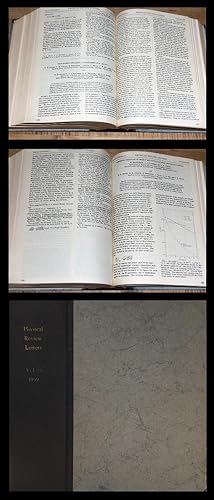
High-Energy Inelastic e-p Scattering at 6(deg) and 10(deg) (Bloom et al., pp. 930-934) WITH Observed Behavior of Highly Inelastic Electron-Proton Scattering (Friedman et al., pp. 935-939) in Physical Review Letters 23, 1969
Published by The American Physical Society, New York, 1969
First Edition
1st Edition. FULL VOLUME 1969 FIRST EDITION OF TWO PAPERS PRESENTING THE FIRST EMPIRICAL EVIDENCE OF THE EXISTENCE OF QUARKS WITHIN THE ATOMIC NUCLEUS. Quarks had been predicted in 1964 by Murray Gell-Mann but until these experiments, no one had produced convincing experimental evidence for the existence of quarks inside the proton or neutron ("Friedman, Kendall and Taylor Win Nobel Prize for First Quark Evidence", Physics Today, Vol. 44, 1, pp. 17). In demonstrating that quarks are real particles, the lead scientists on these two papers, Jerome Friedman, Henry Kendall, and Richard Taylor confirmed Murray Gell-Mann's hypothesis of their existence and for their discovery, the trio were awarded the 1990 Nobel Prize in Physics. Taylor passed away in early 2018 a further note about his import appears below. The first paper, "High-Energy Inelastic e-p Scattering at 6(deg) and 10(deg)" "describes the experiment that identified the point-like centers within protons that were later identified as quarks" (The History of Science: Wenner Collection). The second, "Observed Behavior of Highly Inelastic Electron-Proton Scattering" "explains the significance of the experiment in terms of theory" (ibid). Gell-Mann's seminal 1964 work positing the 'idea' of quarks was based on the assumption that strongly interacting particles he classified (called hadrons) were all "built up from more elementary constituents" that he famously called 'quarks' (Levinovitz, The Nobel Prize, 44). Few people, however, "believed that quarks were real particles. Despite many searches in accelerators and in cosmic rays, no one had found an isolated quark. As Gell-Mann himself said: 'Such particles [quarks] presumably are not real but we may use them in our field theory anyway'" (Alan Lightman, The Discoveries, pp. 457). In the late 1960s while at the new two-mile electron linear accelerator, the Stanford Linear Accelerator Center (SLAC), Friedman, Kendall, and Taylor proved the existence of quarks by using "high-energy electrons from the then new accelerator, and [showed] that they bounced back in an unexpected way from the protons and neutrons in a gas target" (Quinn, The Mystery of the Missing Antimatter, 97). High-energy collisions â?? such as those enabled by SLAC â?? "disrupt the target, and the ensuing scattering is called inelastic. When high-energy electrons are used for this purpose, their wavelengths are small enough to probe within protons and neutrons inside the nucleusâ??that is, deep within the nucleus (the â??deep' within â??deep inelastic scattering'). In 1969, American theoretical physicist James Bjorken (born 1934) used a form of mathematics called current algebra to predict behavior in deep inelastic scattering (now called "Bjorken scaling") and proposed an experiment to test the theory of hadrons being comprised of smaller, point-like particles" (Wenner). Friedman, Kendall, and Taylor then "conducted the Bjorken scaling experiment using liquid hydrogen as the target the Bjorken scaling experiment using liquid hydrogen as the target" (ibid). "Friedman's group was startled. to observe that the scattering pattern suggested not that the positive charge of the proton was uniformly spread out, but rather that charges were confined to point-like centers within the protons. As the Nobel Prize Committee's presentation speech makes clear, Friedman, Kendall, and Taylor had not anticipated anything fundamentally new: "similar experiments, albeit at lower energies, had found that the proton behaved like a soft gelatinous sphere with many excited states, similar to those of atoms and nuclei. Nevertheless, the Laureates decided to go one step further and study the proton under extreme conditions. They looked for the electron undergoing a large deflection, and where the proton, rather than keeping its identity, seized a lot of the collision energy and broke up into a shower of new particles. This so called "deep inelastic scattering" had generally been considered to be too rare to be worth investigating. But the experiment showed otherwise: deep inelastic scattering was far more frequent than expected, displaying a totally new facet of proton behavior. This result was at first skeptically received: perhaps the moving electron gave off undetected light. But this year's Prizewinners had been thorough and their findings were subsequently confirmed by other experiments. A new rung on the ladder of creation had revealed itself and a new epoch in the history of physics had begun" (Nobel Prize Award Ceremony, 1990). Richard E. Taylor passed away in late February of 2018. Dr. Taylor saw himself, matter-of-factly, as an experimentalist in physics, not a theoretician. "My job was to measure things and to make sure that the measurements were right," he said in the 2008 Nobel interview (NYT Obituary, March 1, 2018). "There were 20 of us named on that experiment. referring to their work on deep inelastic scattering [these papers]. There were, like, 40 of us who built that apparatus, backed up by another 40 engineers and technicians, using an accelerator that is built by a thousand people" (ibid). For all his humility, the work of Taylor's life "set the stage for what is now known as the Standard Model in Physics" â?? the classification system for all fundamental particles and forces (Stanford News, February 22, 2018). Note that we also separately offer Physical Review Letters 23 Issue 16, October 20, 1969 â?? inclusive of these two papers â?? in original wraps. CONDITION & DETAILS: New York: The American Physical Society. Full volume. (10.5 x 9 inches; 263 x 225mm). Fine condition inside and out.
-
Condition: New. PRINT ON DEMAND pp. 272.
-

Condition: New. Dieser Artikel ist ein Print on Demand Artikel und wird nach Ihrer Bestellung fuer Sie gedruckt. Robinson, Stanley L. Miller, Richard KendallNew concepts for gaging, inspection, checking, machine vision, and robotic testing. Includes guidelines for installing complex electronic and computerized systems and a directory of commercially availalbe.

