
After Hodges (12 results)
 More images
Language: English
Published by E. M. Diemar., London. 1783
- First Edition
- Art Print
Seller: Colophon Books (UK), Leek, STAFF, United KingdomColophon Books (UK)
Contact seller5-star sellerCondition: Used - Good
US$ 41.10
US$ 34.91 shippingShips from United Kingdom to U.S.A.Quantity: 1 available
No Binding. Condition: Good. 1st Edition. 18th century oval aquatint engraved by the Italian artist/engraver Francesco Bartolozzi, the print is unframed and is laid onto the backing card, some light colouring with flesh tones and blue, some browning and a few light age spots, the actual image is clear the age wear is in the surr…ounds and margins, Measures approx 10 x 7.5 ins to the plate line and 12.5 x 10 inches edge to edge, Genuine and original. NOT a modern copy. dated Sept 8th 1783 and that is Guaranteed. F. Bartolozzi (illustrator).

Published by [London]: 1777. 1777
- Art Print
Seller: Wittenborn Art Books, San Francisco, CA, U.S.A.Wittenborn Art Books
Contact seller4-star sellerCondition: Used - Good
US$ 75.00
US$ 10.00 shippingShips within U.S.A.Quantity: 2 available
Condition: Good. 1 black and white engraving. 8x10". Light signs of wear. Very Good.From the collection of the late Frederick G.Ruffner, Jr., founder of Gale Research, Detroit.
Published by London : Strahan 1777
- First Edition
- Art Print
Seller: Joseph Burridge Books, Dagenham, United KingdomJoseph Burridge Books
Contact seller5-star sellerCondition: Used - Very good
US$ 68.49
US$ 30.59 shippingShips from United Kingdom to U.S.A.Quantity: 1 available
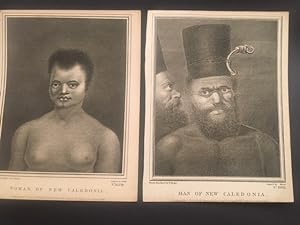
No Binding. Condition: Very Good. 1st Edition. Man of New Caledonia, Woman of New Caledonia. Two engravings 27 x 121cm, cropped close. After William Hodges, official artist on Captain to Cook's Second Voyage, London published by Strahan 1777.
 More images
Published by Hogg, Alexander, London 1772
Seller: Rob Zanger Rare Books LLC, Middletown, NY, U.S.A.Rob Zanger Rare Books LLC
Contact seller5-star sellerEngraving on cream laid paper, 9 1/4 x 15 (235 x 382 mm), evenly trimmed margins, thread to wide. In good condition with uniform toning, and scattered edge wear with a few minor nicks. A rich, well-inked impression. From George William Anderson's work, A New, Authentic, and Complete Account of Voyages Round the World, published…c1784. The location is Resolution Bay (now known as Vaitahu Bay) on the island of Tahuata (historically called Santa Cristina) in the Marquesas Islands. The bay was named after Captain James Cook's ship, the HMS Resolution, which you can see anchored in the distance. In the foreground are traditional Marquesan outrigger canoes with their distinct triangular sails and carved prows. Hodge's composition captures the first European contact with the Marquesas since the Spanish visited almost 200 years prior. Cook arrived there in April 1774 to take on fresh water and food, but stayed only four days. Doomed from the start, The Resolution was almost driven into the rocks during a violent squall as they tried to anchor. Finding that the Marquesans were shrewd traders who knew the value of their food and fresh water, peaceful trading quickly spiraled into tense negotiations that ended in bloodshed. An officer on The Resolution shot and killed a Marquesan man who was accused of stealing a piece of deck hardware, and the incident cast a shadow over Cook's remaining time there. Having loaded the ship with enough water and livestock to continue on, Cook set sail for Tahiti. Five years later Cook was murdered as he attempted to kidnap Kalani??pu?u, the ruling chief (ali?i nui) on the island of Hawaii. Ironically, Cook was stabbed with an iron dagger that the British had traded to the Hawaiians.
Published by Paris c. 1785
- Art Print
Seller: Shapero Rare Books, London, United KingdomShapero Rare Books
Contact seller5-star sellerCondition: Used
US$ 2,054.85
US$ 19.95 shippingShips from United Kingdom to U.S.A.Quantity: 1 available
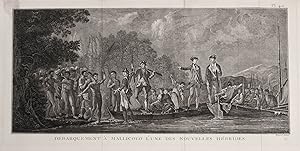
Fine engraving, 235 x 485mm (plate size), with vertical folds, mounted. After plate 60 in the official account of Cook's Second Voyage: The Landing at Mallicolo, one of the New Hebrides published 1st February 1777. The voyage's official artist Hodges here records Cook's arrival on the second largest island in the New Hebrides, w…hich they surveyed during their time in Vanuatu (4 June to 13 September 1774). Cook records that two boats were despatched to gather wood, only to be confronted by four or five hundred local people when they landed. Cook, with his feet in the water, hands his musket to a Marine on the boat, and with an outstretched hand is ready to take the palm frond being offered by the local man. Whilst the clothing for each group matches records of the encounter the poses are particularly formal and classical â" the local people being tall and dignified, contrary to the unflattering description given by Cook.

Published by London 1777
Seller: Antipodean Books, Maps & Prints, ABAA, Garrison, NY, U.S.A.Antipodean Books, Maps & Prints, ABAA
Contact seller4-star sellerCondition: Used - Very good
US$ 825.00
US$ 10.00 shippingShips within U.S.A.Quantity: 1 available
Condition: Very good condition. Portrait of Captain Cook as a young man. Engraved by J. Basire 1777. Copper engraving, 8 1/2 x 11 1/4" plus margins, wove paper. Frontispiece to Cook's 2nd Voyage around the World. With the full old border; at some point in the distant past an extra border almost one half inch around has been adde…d. There are no details at the bottom where the publishing details should be. In lovely condition, very nice overall.
Seller: Antiquariaat Arine van der Steur / ILAB, Den Haag, , NetherlandsAntiquariaat Arine van der Steur / ILAB
Contact seller4-star sellerCondition: Used
US$ 78.88
US$ 34.52 shippingShips from Netherlands to U.S.A.Quantity: 1 available
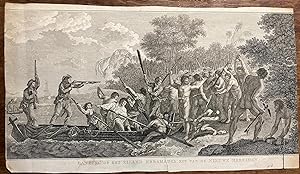
Original engraving on laid paper, 235 x 410 mm. With tears in the plate and narrow margins left and right.Captain James Cook (1728-1779) made three separate voyages to the Pacific (with the ships Endeavour, Resolution, Adventure, and Discovery) and did more than any other voyager to explore the Pacific and Southern Ocean. Cook n…ot only encountered Pacific cultures for the first time, but also assembled the first large-scale collections of Pacific objects to be brought back to Europe. He was killed in Hawaii in 1779.William Hodges (1744 - 1797) joined Cook's second expedition to the South Pacific as a draughtsman 1772-75 and was employed by the Admiralty in finishing his drawings.Cook reached Eromanga on August 4, 1774. As recorded in Hawkesworth's account: "Here Cook met the most unpleasant encounter he had experienced with islanders on the voyage. Hodges made no known portraits of the people of the island, and conditions were such that none were possible; but later, with Cipriani's assistance, he prepared a painting of the encounter for the engraver. The actual arrangement entered into between the two artists is not known, but it was very much in the order of things. Both Hodges and Cipriani are known to have worked in this way with other artists. Cipriani's drawing predictably presents the Melanesians in classical poses but also depicts the tight girdle that the men wore, reported by Cook and others. But it is an ill-coordinated drawing and depicts only a part of the action. Hodges, presumably, was responsible for the figure of Cook (in the action of firing at the 'treacherous' chieftain) and of Cook's companion."This engraving was severly criticized by Georges Forster. Hodges had invented it and it was, he inferred, misleading. William Wales leapt to the artist's defence. He had discussed the criticism with him, and his defence throws an interesting light on Hodges's practice. The artist had copied the account of the affray at Eromanga from Cook's own journal a few days after Cook had written it in order to compose an illustration of the affair. This indicates that both Cook and Hodges had the illustration of significant events of the voyage for the official published account well in mind long before the Resolution returned to England. Since it was not possible at Eromanga to make drawings of the inhabitants, 'the manners and person of the natives were copied chiefly from those at Tanna, as they were exactly alike'. The engraving was not intended, Wales added, ' to identify particular persons, or to give the exact positions of employment of everyone who were present; but it appears very possible, that he might draw a general representation of the action from a description given to him by any person of veracity, equally as well as if he had been on the spot and seen it with his own eyes.' (From: www.rmg.co.uk)[NL] Originele gravure van de landing op eiland Erramanga door Kapitein Cook (Afgebeeld met geweer in de aanslag). Naar de tekening door Hodges. Erramanga, ook wel Erromange is een eiland in Vanuatu, vallend onder provincie Tafea, Grote Oceaan. James Cook was de eerste Europeaan die op 4 augustus 1774 op Erromango landde. Het eerste contact leidde tot een schermutseling waarbij bemanningsleden van Cook gewond raakten en een paar bewoners het leven kostte.

Portrait (mezzotint) of Wierd Adels. Stuurman op het Hollandsch Kof Schip De Bloeyende Blom, die zig van dezen bodem, na dat dezelve door de Franschen genomen, met veel bravoure meester gemaakt en den 6 Augustus te Hellervoer opgebracht heeft.
ADELS,WIERD. Hodges,Charles Howard [London 1764 - 1837 Amsterdam] after Jacobus Perkois [Middelburg 1756-1804].
Seller: Rob Kok Old Books & Prints, Loosdrecht, NH, NetherlandsRob Kok Old Books & Prints
Contact seller4-star sellerCondition: Used
US$ 207.41
US$ 29.92 shippingShips from Netherlands to U.S.A.Quantity: 1 available
c.1795. 30 x 22 cm. Fine impression with margins all around. [24028].
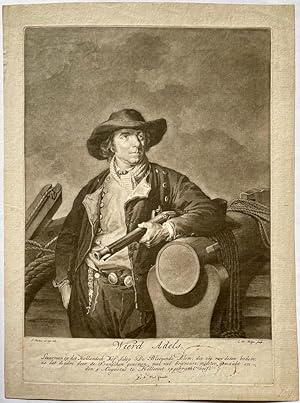
[Antique print, mezzotint] Portrait of Wiert (Wierd) Adels, published 1796, 1 p.
Charles Howard Hodges (1764-1837), after Jacob Perkois (1756-1804)
Seller: Antiquariaat Arine van der Steur / ILAB, Den Haag, , NetherlandsAntiquariaat Arine van der Steur / ILAB
Contact seller4-star sellerCondition: Used
US$ 430.22
US$ 34.52 shippingShips from Netherlands to U.S.A.Quantity: 1 available
Portrait of Wiert Adels helmsman on the kofship 'De Bloeyende Blom'; three-quarters length standing looking away to right, on his ship, leaning with his back against the side, holding a gun in his left hand and resting the elbow on a cannon, his right hand in his pocket, wearing informal naval uniform, his coat open, with a stri…ped cravat and wide-brimmed hat; ropes and tackle behind to left.The Bloeyende Blom was hijacked by the French in August 1794. Adels recaptured the ship and brought it into Hellevoetsluis on 5 August.Signed below, with the address of the publisher: 'J. Perkois ad viv. del. // C.H. Hodges sculp. // W.A. Keel Excudit'. Charles Howard Hodges (1764-1837) was an English painter and engraver, het worked in Amsterdam and was a famous portret painter around 1800. His mezzotint engraving is of very high quality. W. Keel worked in Middelburg.On verso collector's mark of Pim van Eekelen (L. 5101). Mezzotint on paper, with wide margins; total: 343 x 255 mm; some dirt and rubbing due to handling, some in traces on the textual portion; traces of previous mounting on verso, otherwise in good condition. Van der Feltz, 1982: Charles Howard Hodges 1764-1837, nr 626.
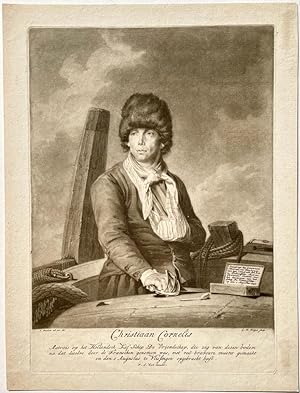
Antique print, mezzotint | Portrait of Christiaan Cornelis (Van Kinsbergen) on the ship De Vriendschap, published 1795, 1 p.
Charles Howard Hodges (1764-1837), after Jacob Perkois (1756-1804)
Seller: Antiquariaat Arine van der Steur / ILAB, Den Haag, , NetherlandsAntiquariaat Arine van der Steur / ILAB
Contact seller4-star sellerCondition: Used
US$ 430.22
US$ 34.52 shippingShips from Netherlands to U.S.A.Quantity: 1 available
Portrait of Christiaan Cornelis, three-quarter length standing, looking away to left, his left arm in a sling, his right resting on a wooden board in front of him, holding a sword, wearing a fur hat.On July 31, 1794, Cornelis recaptured the ship De Vrienschap (The Friendship) taken by the French on which he had served as a sailo…r. After Cornelis had returned the ship, he was rewarded by Admiral van Kinsbergen with a silver tobacco box. Below the image is a caption related to his heroic act: 'Matroos op het Hollandsch Kof De Vriendschap . 1 Augustus te Vlissingen opgebracht heeft.'On the board beside him is a pipe and a box inscribed 'Present van den Lieutenant / Admiraal van Kinsbergen. / aan zyn Cameraad, den bra / ve Hollandsche Matroos, / Christiaan Cornelis, voor / het hernemen van het / Schip De Vriendshap / op den 1 Augustus 1794.'Signed below, with the address of the publisher: 'J. Perkois ad viv. del. // C.H. Hodges sculp. // W.A. Keel Excudit'. Willem Alexander Keel is from Middelburg. Charles Howard Hodges (1764-1837) was an English painter and engraver, het worked in Amsterdam and was a famous portret painter around 1800. His mezzotint engraving is of very high quality.[NL] Christiaan Cornelis staat op een schip. Hij heeft zijn linkerarm in een mitella, in zijn andere een zwaard. Cornelis heroverde op 31 juli 1794 een door de Fransen ingenomen kofschip waarop hij als matroos gediend had. Nadat Cornelis het schip had teruggebracht werd hij door admiraal van Kinsbergen met een zilveren tabaksdoos beloond. Onder de afbeelding een onderschrift met betrekking tot zijn heldendaad. Mezzotint on paper, with wide margins; total: 344 x 260 mm; some rubbing due to handling, traces of previous mounting on verso, otherwise in very good condition. Van der Feltz, 1982: Charles Howard Hodges 1764-1837, nr 649.
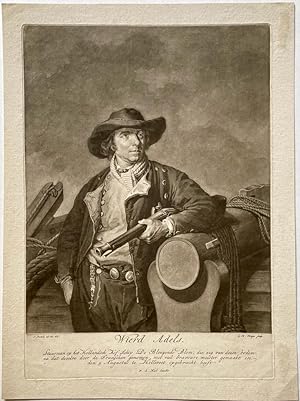
Antique print, mezzotint Batavian Republic | Portrait of Wiert (Wierd) Adels on his ship, published 1796, 1 p.
Charles Howard Hodges (1764-1837), after Jacob Perkois (1756-1804)
Seller: Antiquariaat Arine van der Steur / ILAB, Den Haag, , NetherlandsAntiquariaat Arine van der Steur / ILAB
Contact seller4-star sellerCondition: Used
US$ 430.22
US$ 34.52 shippingShips from Netherlands to U.S.A.Quantity: 1 available
Portrait of Wiert Adels helmsman on the kofship 'De Bloeyende Blom'; three-quarters length standing looking away to right, on his ship, leaning with his back against the side, holding a gun in his left hand and resting the elbow on a cannon, his right hand in his pocket, wearing informal naval uniform, his coat open, with a stri…ped cravat and wide-brimmed hat; ropes and tackle behind to left.The Bloeyende Blom was hijacked by the French in August 1794. Adels recaptured the ship and brought it into Hellevoetsluis on 5 August.Signed below, with the address of the publisher: 'J. Perkois ad viv. del. // C.H. Hodges sculp. // W.A. Keel Excudit'. Charles Howard Hodges (1764-1837) was an English painter and engraver, het worked in Amsterdam and was a famous portret painter around 1800. His mezzotint engraving is of very high quality. W. Keel worked in Middelburg.[NL] Wiert Adels, stuurman op het kofschip 'De Bloeyende Blom'. Hij draagt zeemanskleding en houdt een geweer in de hand. Zijn arm rust op een stuk geschut. De Bloeyende Blom werd in augustus 1794 door de Fransen gekaapt. Adels heroverde het schip en bracht het op 5 augustus binnen te Hellevoetsluis. Aanloop naar de Bataafse Republiek. Mezzotint on paper, with wide margins; total: 344 x 259 mm; some rubbing due to handling, traces of previous mounting on verso, otherwise in very good condition. Van der Feltz, 1982: Charles Howard Hodges 1764-1837, nr 626.
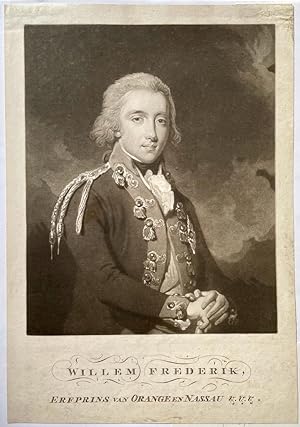
Antique print, mezzotint | Portrait of Willem George Frederik van Oranje-Nassau, published 1794, 1 p.
Charles Howard Hodges (1764-1837), after Johann Friedrich August Tischbein (1750-1812)
Seller: Antiquariaat Arine van der Steur / ILAB, Den Haag, , NetherlandsAntiquariaat Arine van der Steur / ILAB
Contact seller4-star sellerCondition: Used
US$ 537.77
US$ 34.52 shippingShips from Netherlands to U.S.A.Quantity: 1 available
Portrait of Willem George Frederik van Oranje-Nassau (1774-1799), prins van Oranje-Nassau, half-length to right, looking towards the viewer, hands clasped on the hilt of his sword in front of him, wearing a military uniform with a sash, frilled cravat and powdered hair.Titled below: 'Willem Frederik Erfprins van Orange en Nassau… &. &. &.' Made by Charles Howard Hodges (1764-1837), an English painter and engraver. He worked in Amsterdam and was a famous portret painter around 1800. His mezzotint engraving is of very high quality.On verso collector's mark: Bernard Houthakker (L.1272).[NL] Willem George Frederik, prins van Oranje-Nassau gekleed in een uniform, met de handen over elkaar. Mezzotint on paper, with margins; total: 400 x 278 mm; some dirt and rubbing due to handling, especially on the margins, otherwise in good condition. Van der Feltz, 1982: Charles Howard Hodges 1764-1837, nr 696, Van Someren 878*.


