

Order Total (1 Item Items):
Shipping Destination:

Andrew Ottens (20 results)
Skip to main search results
Search filters
Product Type
- All Product Types
- Books (20)
- Magazines & Periodicals (No further results match this refinement)
- Comics (No further results match this refinement)
- Sheet Music (No further results match this refinement)
- Art, Prints & Posters (No further results match this refinement)
- Photographs (No further results match this refinement)
- Maps (No further results match this refinement)
- Manuscripts & Paper Collectibles (No further results match this refinement)
Condition Learn more
- New (16)
- As New, Fine or Near Fine (3)
- Very Good or Good (1)
- Fair or Poor (No further results match this refinement)
- As Described (No further results match this refinement)
Binding
Collectible Attributes
- First Edition (No further results match this refinement)
- Signed (No further results match this refinement)
- Dust Jacket (No further results match this refinement)
- Seller-Supplied Images (9)
- Not Print on Demand (8)
Language (1)
Free Shipping
- Free Shipping to U.S.A. (No further results match this refinement)
Seller Location
Seller Rating
-
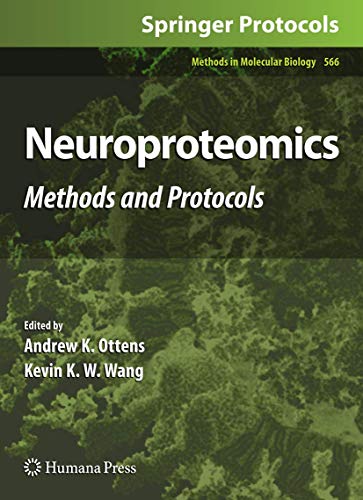
Neuroproteomics. Methods and Protocols
Language: English
Published by Humana Press, New York, 2009
ISBN 10: 1934115843 ISBN 13: 9781934115848
Hardback. Condition: Very Good. xi + 321 pp. Methods in Molecular Biology, 566. Rubber-stamped on front free endpaper. book.
-

-

Neuroproteomics: Methods and Protocols (Methods in Molecular Biology, 566)
Seller: Ria Christie Collections, Uxbridge, United Kingdom
Seller rating 5 out of 5 stars

US$ 143.51
US$ 16.00 shipping
Ships from United Kingdom to U.S.A.Quantity: Over 20 available
Add to basketCondition: New. In.
-
US$ 54.50 10% off
US$ 49.05
US$ 121.16 shipping
Ships from Germany to U.S.A.Quantity: 1 available
Add to basketCondition: Sehr gut. Zustand: Sehr gut | Seiten: 336 | Sprache: Englisch | Produktart: Bücher | Neuroproteomics: Methods and Protocols presents experimental details for applying proteomics to the study of the central nervous system (CNS) and its dysfunction through trauma and disease. The target audience includes clinical or basic scientists who look to apply proteomics to the neurosciences. Often researchers hear of proteomics without an adequate explanation of the methodology and inherent limitations. This volume conveys where proteomic methodology is in its application to CNS research and what results can be expected. We also address clinical translation of neuroproteomics, specifically in the area of biomarker research. The inception of neuroproteomics capitalized on rapid progress in large-molecule mass spectrometry over the last decade. Two seminal advances have spurred research ¿ development of reliable polypeptide ionization processes and bioinformatics to rapidly process tandem mass spectra for peptide identification and quantification. What has followed is the exponential application of mass spectrometry to proteome characteri- tion across biological and biomedical disciplines. Arguably, the most elaborate proteomic implementation is in studying the CNS, the most enigmatic and complex animal system. Neuroscience is characterized by grandiose questions ¿ what is consciousness, how does thought or memory work. Neuroproteomics researchers, however, have pri- rily involved themselves dysfunction, based on a pressing need (and invariably funding), in answering questions on CNS dysfunction, based on a pressing need (and invariably funding), and because such questions hold more accessible answers. Dysfunction is readily contrasted against normal function and presumably produces a lasting differential protein signature.
-
US$ 197.89
US$ 16.70 shipping
Ships from United Kingdom to U.S.A.Quantity: 2 available
Add to basketPaperback. Condition: Brand New. 2009 edition. 322 pages. 10.24x7.60x1.55 inches. In Stock.
-
US$ 231.15
US$ 33.40 shipping
Ships from United Kingdom to U.S.A.Quantity: 1 available
Add to basketPaperback. Condition: Like New. LIKE NEW. SHIPS FROM MULTIPLE LOCATIONS. book.
-

Neuroproteomics
Language: English
Published by Humana Press, Humana Press Aug 2009, 2009
ISBN 10: 1934115843 ISBN 13: 9781934115848
Seller: buchversandmimpf2000, Emtmannsberg, BAYE, Germany
Seller rating 5 out of 5 stars
Buch. Condition: Neu. Neuware -Neuroproteomics: Methods and Protocols presents experimental details for applying proteomics to the study of the central nervous system (CNS) and its dysfunction through trauma and disease. The target audience includes clinical or basic scientists who look to apply proteomics to the neurosciences. Often researchers hear of proteomics without an adequate explanation of the methodology and inherent limitations. This volume conveys where proteomic methodology is in its application to CNS research and what results can be expected. We also address clinical translation of neuroproteomics, specifically in the area of biomarker research. The inception of neuroproteomics capitalized on rapid progress in large-molecule mass spectrometry over the last decade. Two seminal advances have spurred research ¿ development of reliable polypeptide ionization processes and bioinformatics to rapidly process tandem mass spectra for peptide identification and quantification. What has followed is the exponential application of mass spectrometry to proteome characteri- tion across biological and biomedical disciplines. Arguably, the most elaborate proteomic implementation is in studying the CNS, the most enigmatic and complex animal system. Neuroscience is characterized by grandiose questions ¿ what is consciousness, how does thought or memory work. Neuroproteomics researchers, however, have pri- rily involved themselves dysfunction, based on a pressing need (and invariably funding), in answering questions on CNS dysfunction, based on a pressing need (and invariably funding), and because such questions hold more accessible answers. Dysfunction is readily contrasted against normal function and presumably produces a lasting differential protein signature.Humana Press in Springer Science + Business Media, Heidelberger Platz 3, 14197 Berlin 336 pp. Englisch.
-
US$ 316.45
US$ 33.40 shipping
Ships from United Kingdom to U.S.A.Quantity: 1 available
Add to basketHardcover. Condition: Like New. LIKE NEW. SHIPS FROM MULTIPLE LOCATIONS. book.
-
Condition: New. Print on Demand pp. 22.
-
Condition: new. Questo è un articolo print on demand.
-
Quadrupole Ion Trap Mass Spectrometry for Space Shuttle Ground Support
Seller: THE SAINT BOOKSTORE, Southport, United Kingdom
Seller rating 5 out of 5 stars
US$ 112.32
US$ 15.55 shipping
Ships from United Kingdom to U.S.A.Quantity: Over 20 available
Add to basketPaperback / softback. Condition: New. This item is printed on demand. New copy - Usually dispatched within 5-9 working days 89.
-
Condition: new. Questo è un articolo print on demand.
-
Neuroproteomics
Language: English
Published by Humana Press Jul 2012, 2012
ISBN 10: 1617797545 ISBN 13: 9781617797545
Seller: BuchWeltWeit Ludwig Meier e.K., Bergisch Gladbach, Germany
Seller rating 5 out of 5 stars
Taschenbuch. Condition: Neu. This item is printed on demand - it takes 3-4 days longer - Neuware -Neuroproteomics: Methods and Protocols presents experimental details for applying proteomics to the study of the central nervous system (CNS) and its dysfunction through trauma and disease. The target audience includes clinical or basic scientists who look to apply proteomics to the neurosciences. Often researchers hear of proteomics without an adequate explanation of the methodology and inherent limitations. This volume conveys where proteomic methodology is in its application to CNS research and what results can be expected. We also address clinical translation of neuroproteomics, specifically in the area of biomarker research. The inception of neuroproteomics capitalized on rapid progress in large-molecule mass spectrometry over the last decade. Two seminal advances have spurred research - development of reliable polypeptide ionization processes and bioinformatics to rapidly process tandem mass spectra for peptide identification and quantification. What has followed is the exponential application of mass spectrometry to proteome characteri- tion across biological and biomedical disciplines. Arguably, the most elaborate proteomic implementation is in studying the CNS, the most enigmatic and complex animal system. Neuroscience is characterized by grandiose questions - what is consciousness, how does thought or memory work. Neuroproteomics researchers, however, have pri- rily involved themselves dysfunction, based on a pressing need (and invariably funding), in answering questions on CNS dysfunction, based on a pressing need (and invariably funding), and because such questions hold more accessible answers. Dysfunction is readily contrasted against normal function and presumably produces a lasting differential protein signature. 336 pp. Englisch.
-

US$ 117.12
US$ 56.53 shipping
Ships from Germany to U.S.A.Quantity: Over 20 available
Add to basketKartoniert / Broschiert. Condition: New. Dieser Artikel ist ein Print on Demand Artikel und wird nach Ihrer Bestellung fuer Sie gedruckt. Presents a modular approach to experimental design, covering neurodegenerative models, subproteome selection technologies, quantitative and qualitative mass spectrometry, data analysis and clinical translation of resultsDetailed guide to developin.
-

Neuroproteomics
Language: English
Published by Humana Press, Humana Press Jul 2012, 2012
ISBN 10: 1617797545 ISBN 13: 9781617797545
Seller: buchversandmimpf2000, Emtmannsberg, BAYE, Germany
Seller rating 5 out of 5 stars
Taschenbuch. Condition: Neu. This item is printed on demand - Print on Demand Titel. Neuware -Neuroproteomics: Methods and Protocols presents experimental details for applying proteomics to the study of the central nervous system (CNS) and its dysfunction through trauma and disease. The target audience includes clinical or basic scientists who look to apply proteomics to the neurosciences. Often researchers hear of proteomics without an adequate explanation of the methodology and inherent limitations. This volume conveys where proteomic methodology is in its application to CNS research and what results can be expected. We also address clinical translation of neuroproteomics, specifically in the area of biomarker research. The inception of neuroproteomics capitalized on rapid progress in large-molecule mass spectrometry over the last decade. Two seminal advances have spurred research ¿ development of reliable polypeptide ionization processes and bioinformatics to rapidly process tandem mass spectra for peptide identification and quantification. What has followed is the exponential application of mass spectrometry to proteome characteri- tion across biological and biomedical disciplines. Arguably, the most elaborate proteomic implementation is in studying the CNS, the most enigmatic and complex animal system. Neuroscience is characterized by grandiose questions ¿ what is consciousness, how does thought or memory work. Neuroproteomics researchers, however, have pri- rily involved themselves dysfunction, based on a pressing need (and invariably funding), in answering questions on CNS dysfunction, based on a pressing need (and invariably funding), and because such questions hold more accessible answers. Dysfunction is readily contrasted against normal function and presumably produces a lasting differential protein signature.Humana Press in Springer Science + Business Media, Heidelberger Platz 3, 14197 Berlin 336 pp. Englisch.
-
Neuroproteomics : Methods and Protocols
Language: English
Published by Humana Press, Humana Press, 2012
ISBN 10: 1617797545 ISBN 13: 9781617797545
Taschenbuch. Condition: Neu. nach der Bestellung gedruckt Neuware - Printed after ordering - Neuroproteomics: Methods and Protocols presents experimental details for applying proteomics to the study of the central nervous system (CNS) and its dysfunction through trauma and disease. The target audience includes clinical or basic scientists who look to apply proteomics to the neurosciences. Often researchers hear of proteomics without an adequate explanation of the methodology and inherent limitations. This volume conveys where proteomic methodology is in its application to CNS research and what results can be expected. We also address clinical translation of neuroproteomics, specifically in the area of biomarker research. The inception of neuroproteomics capitalized on rapid progress in large-molecule mass spectrometry over the last decade. Two seminal advances have spurred research - development of reliable polypeptide ionization processes and bioinformatics to rapidly process tandem mass spectra for peptide identification and quantification. What has followed is the exponential application of mass spectrometry to proteome characteri- tion across biological and biomedical disciplines. Arguably, the most elaborate proteomic implementation is in studying the CNS, the most enigmatic and complex animal system. Neuroscience is characterized by grandiose questions - what is consciousness, how does thought or memory work. Neuroproteomics researchers, however, have pri- rily involved themselves dysfunction, based on a pressing need (and invariably funding), in answering questions on CNS dysfunction, based on a pressing need (and invariably funding), and because such questions hold more accessible answers. Dysfunction is readily contrasted against normal function and presumably produces a lasting differential protein signature.
-

Buch. Condition: Neu. Neuroproteomics | Methods and Protocols | Andrew K. Ottens (u. a.) | Buch | xi | Englisch | 2009 | Humana | EAN 9781934115848 | Verantwortliche Person für die EU: Humana Press in Springer Science + Business Media, Heidelberger Platz 3, 14197 Berlin, juergen[dot]hartmann[at]springer[dot]com | Anbieter: preigu Print on Demand.
-

US$ 157.78
US$ 56.53 shipping
Ships from Germany to U.S.A.Quantity: Over 20 available
Add to basketCondition: New. Dieser Artikel ist ein Print on Demand Artikel und wird nach Ihrer Bestellung fuer Sie gedruckt. Presents a modular approach to experimental design, covering neurodegenerative models, subproteome selection technologies, quantitative and qualitative mass spectrometry, data analysis and clinical translation of resultsDetailed guide to developin.
-

Neuroproteomics
Language: English
Published by Humana Press Aug 2009, 2009
ISBN 10: 1934115843 ISBN 13: 9781934115848
Seller: BuchWeltWeit Ludwig Meier e.K., Bergisch Gladbach, Germany
Seller rating 5 out of 5 stars
Buch. Condition: Neu. This item is printed on demand - it takes 3-4 days longer - Neuware -Neuroproteomics: Methods and Protocols presents experimental details for applying proteomics to the study of the central nervous system (CNS) and its dysfunction through trauma and disease. The target audience includes clinical or basic scientists who look to apply proteomics to the neurosciences. Often researchers hear of proteomics without an adequate explanation of the methodology and inherent limitations. This volume conveys where proteomic methodology is in its application to CNS research and what results can be expected. We also address clinical translation of neuroproteomics, specifically in the area of biomarker research. The inception of neuroproteomics capitalized on rapid progress in large-molecule mass spectrometry over the last decade. Two seminal advances have spurred research - development of reliable polypeptide ionization processes and bioinformatics to rapidly process tandem mass spectra for peptide identification and quantification. What has followed is the exponential application of mass spectrometry to proteome characteri- tion across biological and biomedical disciplines. Arguably, the most elaborate proteomic implementation is in studying the CNS, the most enigmatic and complex animal system. Neuroscience is characterized by grandiose questions - what is consciousness, how does thought or memory work. Neuroproteomics researchers, however, have pri- rily involved themselves dysfunction, based on a pressing need (and invariably funding), in answering questions on CNS dysfunction, based on a pressing need (and invariably funding), and because such questions hold more accessible answers. Dysfunction is readily contrasted against normal function and presumably produces a lasting differential protein signature. 336 pp. Englisch.
-

Buch. Condition: Neu. nach der Bestellung gedruckt Neuware - Printed after ordering - Neuroproteomics: Methods and Protocols presents experimental details for applying proteomics to the study of the central nervous system (CNS) and its dysfunction through trauma and disease. The target audience includes clinical or basic scientists who look to apply proteomics to the neurosciences. Often researchers hear of proteomics without an adequate explanation of the methodology and inherent limitations. This volume conveys where proteomic methodology is in its application to CNS research and what results can be expected. We also address clinical translation of neuroproteomics, specifically in the area of biomarker research. The inception of neuroproteomics capitalized on rapid progress in large-molecule mass spectrometry over the last decade. Two seminal advances have spurred research - development of reliable polypeptide ionization processes and bioinformatics to rapidly process tandem mass spectra for peptide identification and quantification. What has followed is the exponential application of mass spectrometry to proteome characteri- tion across biological and biomedical disciplines. Arguably, the most elaborate proteomic implementation is in studying the CNS, the most enigmatic and complex animal system. Neuroscience is characterized by grandiose questions - what is consciousness, how does thought or memory work. Neuroproteomics researchers, however, have pri- rily involved themselves dysfunction, based on a pressing need (and invariably funding), in answering questions on CNS dysfunction, based on a pressing need (and invariably funding), and because such questions hold more accessible answers. Dysfunction is readily contrasted against normal function and presumably produces a lasting differential protein signature.

