
Besnard Albert: Signed (10 results)
 More images
Language: French
Published by Jardin de la France, Blois
- Hardcover
- First Edition
- Signed
Seller: L'ENCRIVORE (SLAM-ILAB), VENDOME, , FranceL'ENCRIVORE (SLAM-ILAB)
Contact seller5-star sellerCondition: Used - Fine
US$ 59.79
US$ 75.47 shippingShips from France to U.S.A.Quantity: 1 available
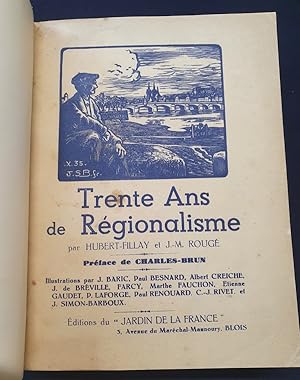
Demi-cuir. Condition: Très bon. Edition originale. In8 - belle demi basane - dos à nerfs - titres dorés - couvertures et dos conservés - 224 pages - un des 50 exemplaires sur Vélin Bibliophile numéroté 39 et signé par les deux auteurs - nombreuses illustrations. Baric Paul Besnard Albert Creiche J. de Bréville Farcy Marthe Fauch…on Etienne Gaudet P. Laforge Paul Renouard C-J Rivet J. Simon Bardoux (illustrator). Signé par l'auteur.

Language: French
Published by Emile-Paul Frères, Paris 1930
- Softcover
- First Edition
- Signed
Seller: Librairie Guimard, Nantes, , FranceLibrairie Guimard
Contact seller4-star sellerCondition: Used
US$ 143.50
US$ 34.83 shippingShips from France to U.S.A.Quantity: 1 available
Condition: en bon état. besnard Paris Emile-Paul Frères 1930 -in-8 broché un volume, broché (paperback) grand in-octavo carré Editeur, dos (spine) crème - brunissure en haut du dos (burnish mark in head of the spine), première de couverture rempliée illustrée (front cover illustrated), non rogné (edges no smooth), envoi autograp…he manuscrit de l'Auteur à l'encre brune sur la page de faux-titre (author's autograph on the half title page), tirage limité tiré à 1650 exemplaires sur papier vélin Lafuma (limited edition - 1650 copies were printed), illustrations : frontispice de l'auteur (frontispiece) + 1 front-de-chapitre (headpiece)+ 1 lettrine (dropped initial) et 1 cul-de-lampe hors-texte in-fine (tailpiece), 101 pages, 1930 à Paris Editions Emile-Paul Frères, en bon état pièce jointe (piece enclosure) : 1 carte de visite de l'auteur (autographe manuscrite) collée en-dessous de l'envoi (author's visiting card) - Collection "Portrait de la France" . EDITION ORIGINALE (first printing) . RARE . en bon état (very good condition).

Published by Paris 1929
- Signed
- Manuscript
Seller: Librairie Seigneur, VOINGT, , FranceLibrairie Seigneur
Contact seller4-star sellerCondition: Used - Fine
US$ 17.94
US$ 45.86 shippingShips from France to U.S.A.Quantity: 1 available
En feuille avec enveloppe. Condition: Très bon. Carte de visite autographe signée: il annoce qu'il écrira bientôt une petite rédaction sur Loti. Cette "rédaction" paraîtra dans le Mercure de Flandres de 1931.
Published by Emile Lechevalier, Paris 1899
- First Edition
- Signed
Seller: Bonnefoi Livres Anciens, Paris, FranceBonnefoi Livres Anciens
Contact seller4-star sellerCondition: Used
US$ 150.67
US$ 46.44 shippingShips from France to U.S.A.Quantity: 1 available
In-4 de V-168-CXIV-60 pp., demi-basane marbrée à coins, dos à nerfs, couverture conservée (reliure de l'époque). Édition originale tirée à 260 exemplaires. Histoire de l'église, son architecture, l'abbaye et pièces justificatives et annexes par l'architecte Albert Besnard (1849-1934). Frontispice gravé à l'eau-forte, 11 planches… hors texte dont 2 en couleurs et 2 repliées nombreuses illustrations dans le texte, certaines à pleine page. Envoi autographe signé de l'auteur A Monsieur Lalanne architecte, hommage de respectueuse confraternité A. Besnard. Dos épidermé et insolé.

Published by [Paris: Les Lettres et Les Arts]. 1888
- Signed
- Art Print
Seller: Wittenborn Art Books, San Francisco, CA, U.S.A.Wittenborn Art Books
Contact seller5-star sellerCondition: Used - Good
US$ 200.00
US$ 10.00 shippingShips within U.S.A.Quantity: 1 available
Condition: Good. Etching and aquatint on wove paper. 33 x 25 cm (sheet). Signed and dated in the plate. Very Good, toning along sheet edges, right side of sheet folded over 1/2 inch.Literature: Godefroy 79.

- Hardcover
- Signed
Seller: Babel Librairie, PERIGUEUX, , FranceBabel Librairie
Contact seller4-star sellerCondition: Used
US$ 538.12
US$ 45.28 shippingShips from France to U.S.A.Quantity: 1 available
Paris, Eugène Fasquelle, 1899. Un vol. au format in-4 (303 x 223 mm) de 1 f. bl., 2 ff. n.fol., 1 frontispice gravé n.fol., 99 pp., 1 f. n.fol. et 1 f. bl. Reliure de l'époque de plein cartonnage doré recouvert d'un important décor gauffré à motif floral, dos lisse, tête mouchetée. (Martial Dasset). Edition parue à la date de l'…originale et première édition illustrée. Exemplaire sous reliure du temps signée de Martial Dasset. ''Edition de luxe, au tirage limité à 160 exemplaires seulement. Celui-ci comptant parmi les 150 numérotés du tirage sur vélin de cuve (second papier après seulement 10 de tête sur Japon). Il s'agrémente - et est complet - des quatre superbes eaux-fortes inédites d'Albert Besnard. ''199 eaux-fortes et pointes-sèches ainsi que 3 lithographies constituent l'ensemble de l'oeuvre gravé de Besnard. Il a pu accuser dans ses planches d'une certaine modernité, nous rappelant qu'il connaissait Degas ; avant de parvenir à l'expression d'un certain symbolisme littéraire, recourant au thème macabre''. (in Bailly-Herzberg). ''Versailles a toujours, et dès mon enfance, fortement agi sur mon intellect et sur mon coeur. Aussi m'étonnais-je, presque ''au milieu du chemin de ma vie'' de n'avoir consacré à la Ville Royale que strophes détachées et réflexions éparses. Un désir me vint de ma rapprocher du Palais, plus qu'un désir, l'instinctive nécessité de me soumettre au contact direct, à l'immédiate effluve du Passé, afin d'en subir l'inspiration et la dictée. Je m'installai donc à proximité du Palais, et écrivis alors Les Perles rouges''. Proust d'estimer ''ses vers ontd'indestructibles fondements, des racines mystérieuses et profondes dans ce sol sacré, dans sa nature et son histoire''. Bailly-Herzberg, Dictionnaire de l'estampe en France, p. 31 - Bénézit I, Dictionnaire des peintres, p. 710. Angles élimés. Manques superficiels affectant principalement dos, coupes et mors de la reliure. Très belle condition intérieure.
- First Edition
- Signed
- Manuscript
Seller: Librairie Le Feu Follet, Paris, , FranceLibrairie Le Feu Follet
Contact seller5-star sellerCondition: Used
US$ 275.04
US$ 34.83 shippingShips from France to U.S.A.Quantity: 1 available
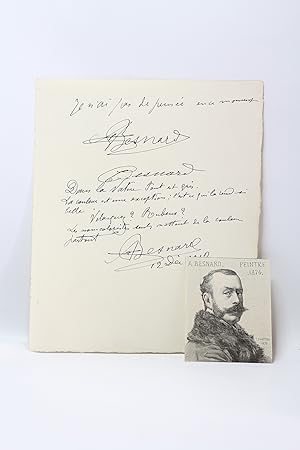
Pas de couverture. 12 décembre 1912 | 17.50 x 21 cm | une feuille | Billet autographe signée du peintre Albert Besnard, un an avant sa nomination à la tête de l'Académie de France à Rome. Une feuille, deux portraits du peintre issus de coupures de presse joints. "Je n'ai pas de pensée en ce moment [.] Dans la Nature tout est gri…s. La couleur est une exception : c'est ce qui la rend si belle. Vélasquez ? Rubens ? Les non-coloristes seuls mettent de la couleur partout A Besnard 12 déc 1912" | [ENGLISH DESCRIPTION FOLLOWS] Autograph letter signed by the painter Albert Besnard, one year before his appointment as head of the French Academy in Rome. One sheet, two portraits of the painter from press clippings enclosed. "I have no thoughts at this moment [.] In Nature everything is grey. Color is an exception: that is what makes it so beautiful. Velázquez? Rubens? Only non-colorists put color everywhere A Besnard 12 Dec 1912" *.

- Signed
Seller: Traces Ecrites, Paris, , FranceTraces Ecrites
Contact seller5-star sellerCondition: Used
US$ 538.12
US$ 17.42 shippingShips from France to U.S.A.Quantity: 1 available
1 lettre autographe signée 5 In-8 09/12/1909 Avec son enveloppe. Feuillets à son adresse du 17 rue Guillaume-Tell. bon Longue lettre de 5 pages d'Albert Besnard à la comtesse Greffulhe au sujet d'un projet de tableausur Saint-François de Salles et Sainte Jeanne de Chantal. Il revient à Paris après un périple dans la cité de Fran…çois de Salles [Annecy]. "Nous avons enfin quitté notre lac dont les charmes, d'ailleurs, se refroidissaient de jour en jour et sommes revenus dans la poussière et l'obscurité de la rue Guillaume Tell. Nous avons aussi quitté le voisinage de notre grand St François de Salles et de sa mystique campagne. J'ai le remord de ne vous avoir pas dit encore que j'étais allé voir la jeune mère de ce vieux couvent de la Visitation, qui est, comme vous me l'avez dit, charmante. Ce jour de parloir l'éclairait comme un ancien portrait et son voile dont elle se faisait de temps en temps un abri pour ses yeux noirs, ne pouvait empêcher de voir que son teint est lumineux et ses yeux brillants en dépit des austérités coutumières et quotidiennes [.]. J'ai trouvé cette jeune femme très enthousiaste de vous et préparée à une grande obéissance [.]. Aussi, ai-je beau faire, je ne vois jamais St François de Salles et St Jeanne de Chantal, que flottant dans une clarté divine qui laisse deviner le Paradis et ses saints peuplant l'Espace infini dont le centre est le trône du Très Haut, et ouvrant les bras, dans un geste d'adoration. Car la beauté de ces deux âmes est toute intérieure, et leur exaltation va directement vers Dieu. Je n'oublie pas les malheureux lépreux dont la sainte baisait dévotement les plaies, les découragés dont elle refit le courage, les pauvres enfin qu'elle secourut de sa bourse. Ils auront leur place à eux dans la composition de la Coupole. Quand à St François ce modèle des hommes du monde, cet amateur sublime de Dieu, il faudra l'étudier beaucoup, car il est difficile à composer, mais j'espère y arriver. Je suis en ce moment tout au placement de mes quatre peintures au Dôme du Petit-Palais, après quoi le plafond de la Comédie ira prendre sa place rue Richelieu, et je reviendrai calme et reposé, et enfin digne de St François je me mettrai avec joie à penser à lui [.]". Peintre, graveur et décorateur, il signe le plafond de la Comédie-Française. Elu à l'Académie française en 1924.

- Signed
Seller: Biblion Antiquariat, Zürich, ZH, SwitzerlandBiblion Antiquariat
Contact seller5-star sellerCondition: Used
US$ 956.67
US$ 29.03 shippingShips from Switzerland to U.S.A.Quantity: 1 available
Bildgrösse: 40,5x29 cm - Blattgrösse: 50x38,5 cm. Unten rechts signiert, links nummeriert "Tiré à 75". In Glas-Wechselrahmen. Gute Erhaltung. Hinten mit Besitzernachweis: Coppier 57. Lit: Hans W. Singer, Die moderne Graphik, S. 487. Verg. Camille Mauclair: Albert Besnard. L'homme et l'oeuvre, Paris 1914, S. 135: "Une des plus co…nnues est encore dans cette manière noire, une femme du peuple, accroupie devant un feu qui donne à son visage un aspect spectral.".
- Signed
Seller: Edward T. Pollack, ABAA, Portland, ME, U.S.A.Edward T. Pollack, ABAA
Contact seller1-star sellerBesnard, Albert. DEJEUNER. D.50. Etching and Drypoint, 1886. Edition of 100. 12 3/8 x 9 5/8 inches, 315 x 243 mm., with small margins (probably trimmed). Signed in pencil and annotated "Tiree a 100" (in pencil over an erasure). A fine impression in excellent condition. Besnard, Albert (illustrator).


