Order Total (1 Item Items):
Shipping Destination:

Blaeu Joan, Signed (3 results)
Skip to main search results
Search filters
Product Type
- All Product Types
- Books (3)
- Magazines & Periodicals (No further results match this refinement)
- Comics (No further results match this refinement)
- Sheet Music (No further results match this refinement)
- Art, Prints & Posters (No further results match this refinement)
- Photographs (No further results match this refinement)
- Maps (No further results match this refinement)
- Manuscripts & Paper Collectibles (No further results match this refinement)
Condition Learn more
- New (No further results match this refinement)
- As New, Fine or Near Fine (No further results match this refinement)
- Very Good or Good (3)
- Fair or Poor (No further results match this refinement)
- As Described (No further results match this refinement)
Binding
- All Bindings
- Hardcover (3)
- Softcover (No further results match this refinement)
Collectible Attributes
- First Edition (No further results match this refinement)
- Signed (3)
- Dust Jacket (1)
- Seller-Supplied Images (3)
- Not Print on Demand (3)
Language (2)
Price
- Any Price
- Under US$ 25 (No further results match this refinement)
- US$ 25 to US$ 50 (No further results match this refinement)
- Over US$ 50
Free Shipping
Seller Location
Seller Rating
-

US$ 69.29
US$ 26.91 shipping
Ships from United Kingdom to U.S.A.Quantity: 1 available
Add to basketHardcover. Condition: Very Good. Dust Jacket Condition: Very Good. H/B copy in Very Good Condition. The book is clean & Tightly bound throughout. D/J is in Very Good Condition there are no rips or tears evident. Free Postage within the UK. Signed by Author(s).
-
Seste deel van de nieuwe atlas oft Toonneel des Aerdrijcx, Uytgegeven door Joan Blaeu. Novus atlas sinensis a Martino Martinio Soc. Iefu descriptus et serenissimo archiduci Leopoldo Guilielmo Austriaco dedicatus
Published by Joan and Willem Blaeu, Amsterdam, 1655
Signed
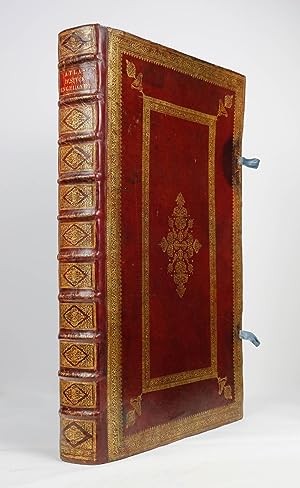
Hardcover. Condition: Very Good. First edition in Dutch. Amsterdam: Joan and Willem Blaeu. 1655. First and only edition in Dutch. Folio (21" x 13 3/8", 533mm x 337mm): [Full collation available upon request]. 148 leaves, pp. [6] (title, blank, 2pp. dedication to the Dutch East India Company, 2pp. copyright) 1-213 [19] (19pp. register) i ii-xviii 21-40. With an engraved title page and 17 hand-colored double-page engraved maps. Bound in Dutch paneled vellum with yapp edges and green ribbon closures. All edges of the text-block gilt, top and bottom edge partially gauffered. Boards scuffed with wear to the extremities. Loss to the fore-edge of the rear board and the ribbon closures. Leaves mounted to stubs. Foxing throughout, primarily to the text leaves. Worming to the fore-edge, most notably from ?1 to E1 (12 leaves); wormholes affecting 1 map and the engraved title page. Collated complete against Van der Krogt/Koeman, "(p. j-xviij; 2a-2d2 2e1)." Father Martino Martini (1616-1661) was a Jesuit missionary who worked extensively in (and on) China. Martini had arrived in China at the very end of the Ming dynasty. When the Qing Dynasty rose and Manchu forces came to the town where Martini was staying, he was asked to pledge his loyalty to the new rule. Upon agreement, his head was shaved in the Manchu manner and he adopted Qizhuang, the Manchu-style of dress. Compliance with the new Dynasty and the Jesuit mission's imperial cartographic approval gave Martini unprecedented access to Chinese sources (notably a Ming re-working of the Yü t'u from the Yuan period), to which he added his own observations. While returning to Rome to address the Chinese Rites Controversy (concerning, among many things, the right of Chinese Christians to worship their ancestors), Martini was able to offer his cartographic material to Dutch publishers. Joan Blaeu (1596-1673), official cartographer to the Dutch East India Company (VOC), scored rather a coup in securing the Italian Jesuit's material, and published it as the sixth part of his Atlas novus, also known as the Theatrum. It was the first European atlas devoted to Asia, and inspired many followers (notably d'Anville's work of the same title). Interestingly, the present example is signed through to "Hhh" and restarts with "b," a variation not listed in Van der Krogt-Koeman, where signatures for the body text end at "Ggg" and the register begins with "a." Koeman I.Bl 52; Van der Krogt-Koeman Atlantes Nederlandici II 2:521A. Cataloged by G.R. Murdock.
-
Vierde Stuck der Aerdrycks-Beschryving, welck vervat Engelandt
Published by Iohannes Blaeu, Amsterdam, 1648
Signed
Hardcover. Condition: Very good. Second. Second Dutch edition. Amsterdam: Apud Iohannem Blaeu, 1648. Folio (22 3/16" x 14 1/8", 564mm x 360mm): ?1 *2 **1 A-4S2 5K2 4V-6O2 [$1 signed; -*1]. Pp. [8] (title (engraved with letterpress), blank, Blaeu to the reader, 4pp. Camden to the reader, poem), 1-364, [2] (register, blank), with 58 double-page hand-colored and gilded engraved maps, sometimes integral to the foliation, sometimes additional. Bound in seventeenth-century ribbon-bound red morocco (attributed to the workshop of Albert Magnus). On the boards, an elaborate gilt scrollwork-and-bird border surrounding four gilt corner-ornaments with an inner gilt scrollwork-and-bird border surrounding a gilt central ornament. On the spine, ten raised bands with a gilt roll. In the panels, gilt scrollwork surrounding a gilt scrollwork lozenge. Title (ATLAS/IV.STVCK/ENGELANDT) gilt to the second panel. On the edges of the boards, gilt roll. Four blue silk ribbon ties at the fore-edge. All edges of the text-block gilt. An exceptional binding, which has at various stages had some repairs, most of which are quite subtle. Some scuffs and patches of darkening. Internally, a mild dampstain at the spine, sometimes causing pigment bleed and offset. 4T (2pp. text and map of Cheshire) has been swapped for the analogous sheet from the Spanish edition, on a slightly smaller (352mm tall) sheet. Several pages remargined, or otherwise repaired. Gilt armorial bookplate of Alexander Lawson Duncan to the rear paste-down. Joan Blaeu (1596-1673) was, along with his father Willem and brother Cornelis, the great Dutch cartographer of the Golden Age. He was made official cartographer of the Dutch East India Company after his father's death. The joint family project was the Theatrum Orbis Terrarum (first issued 1635), and after the death of the patriarch in 1638 the Theatrum was gradually expanded into the so-called Atlas Maior (Greater Atlas). The England volume (the fourth part of the Theatrum) draws on Speed's maps and Camden's text from earlier in the XVIIc. Blaeu's mastery of engraving and mise-en-page give the work power and beauty. The bibliography of the work is highly variable. This is van der Krogt/Koeman 2:322K, the second Dutch edition, with aspects of both the a and b issues (no priority; vdK/K has not seen any copies thus). Made with a view toward the longstanding Atlas Maior (of which it would eventually be part 5), it is given the designation (M). Dr. Truusje Goedings, the scholar of polychromy in this period, has studied the book via high-resolution photos. The coloring has been attributed to Dirk Janszoon Van Santen, and the binding to the workshop of Albert Magnus; this combination is the very finest pedigree for a Blaeu atlas. Van Santen was lavish with his use of ultramarine (ground lapis lazuli, found only in Afghanistan) and gilt, and his coloring is noted for its expressiveness and depth. Alexander Lawson Duncan (1859-1924) of Jordanstone (Perthshire, Scotland) amassed a large library at Jordanstone House (of which many items, though not the present one, were disbursed by Lyon & Turnbull after the death of Lady Duncan). His son, Sir James, was a major benefactor of the arts (setting up the Duncan of Jordanstone College of Art in Dundee (now a faculty of the University). Van der Krogt/Koeman Atlantes Nederlandici 2:322K[a-]b(M).