
Bothe Becker (6 results)
 More images
Published by Julius Springer, 1932., In: Zeitschrift fur physik, Vol. 76, 1932. Berlin: 1932
- Hardcover
- First Edition
Seller: Jeff Weber Rare Books, Neuchatel, NEUCH, SwitzerlandJeff Weber Rare Books
Contact seller4-star sellerCondition: Used
US$ 150.00
US$ 28.93 shippingShips from Switzerland to U.S.A.Quantity: 1 available
232 x 157 mm. 8vo. Pages 421-429. [Entire volume: vii, [1 blank], 856 pp.] 8 figs., 5 tables. Navy cloth, gilt spine. Blind-stamps of the Carnegie Institution of Washington, Mount Wilson Observatory. FINE. FIRST EDITION. Beginning in 1926, Walther Bothe investigated the transmutation of elements that occurs when their atomic nuc…lei are bombarded by alpha particles. In 1930 Bothe and Becker detected a highly penetrative radiation from beryllium bombarded by alpha particles, and they assumed that it was gamma radiation. Bothe estimated the photon energy from the degree of absorption of the secondary electrons. When physicists studied this "beryllium radiation," estimating its energy constituted a problem, for it varied greatly according to the substance used as absorber. Chadwick later suggested that the radiation was particulate and consisted of a new particle, the neutron. Walther Bothe shared the Nobel Prize for Physics with Max Born "for the coincidence method and his discoveries made therewith." Wasson, Nobel Prize winners, pp. 125-128. - DSB, II, pp. 337-339.
Published by Springer, Berlin 1930
- First Edition
Seller: Atticus Rare Books, West Branch, IA, U.S.A.Atticus Rare Books
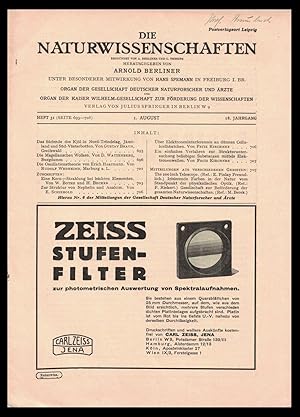
Contact seller5-star seller1st Edition. FIRST EDITION IN ORIGINAL WRAPS OF BOTHE & BECKER'S INFLUENTIAL 1930 ANNOUNCEMENT & DESCRIPTION OF THE PRODUCTION OF NEUTRAL PENETRATING RADIATION; while not the gamma radiation they believed it to be, within two years their work would lead directly to Chadwick's discovery of the neutron. Walther Bothe and Herbert B…ecker believed they had observed gamma radiation -- -rays (very energetic photons) being emitted from a beryllium target bombarded by -particles; in reality they had seen neutrons. By 1932, James Chadwick had correctly interpreted Bothe and Becker's research and discovered the neutron. Bothe won the Nobel Prize in Physics in 1954 for his work on the wave-particle duality of radiation, but the prize committee also specifically mentioned the work offered here. Note that later in this same year, 1930, Bothe and Becker published a fuller discussion of their findings in Zeitschrift für Physik 66, 1930. We offer that work separately. Chadwick's seminal discovery was built directly on two other sets of experiments, each unimaginable without the next. The first was the work of Bothe and Becker offered here."In 1927, Bothe began to study the transformation of light weight elements by bombardment of the nucleus with alpha particles. In 1930, after moving to the University of Giessen, Bothe and assistant H. Becker made a startling and perplexing new discovery while investigating such reactions. They observed for the first time the emission of an entirely new form of high energy radiation that was even more penetrating than the hardest known gamma rays" (Nobel Prize Committee). The second came in 1931 when Irène and Frédéric Joliot-Curie performed experiments using the radiation Bothe and Becker found and demonstrated that when it touched paraffin or any other hydrogen-containing compound, it ejected protons with very high energy from that substance. Still, they couldn't replicate Bothe and Becker's work and they too "fell short of a satisfactory explanation of the phenomenon" (ibid). Upon hearing of the Curie's experiments, James Chadwick "immediately understood that the ejections reported by the Curies required energy too high to have been produced by gamma rays. [He believed] and argued that the reaction must be caused by a new massive particle" (History of Physics: The Wenner Collection). Chadwick designed an experimental test confirming the Curie's results, but then went further. After accurately measuring the energy of the ejected nuclei, Chadwick saw that the "ultra penetrating radiation" could not be a gamma ray but had to be composed of particle of mass 1 and of electric charge 0: this, then, had to be the neutron. Chadwick won the 1935 Nobel Prize for his discovery, but even at that time, the prize committee acknowledge the centrality of Bothe and Becker's research to Chadwick's accomplishment. CONDITION & DETAILS: Complete issue. Original wraps. 4to. Provenance: Bearing the ownership signature of Christian Füchtbauer (1877-1959), a German experimental physicist & professor who published in AdP & ZfP. No institutional markings. Bright & clean. Fine condition.
Published by Springer, Berlin 1930
- First Edition
Seller: Atticus Rare Books, West Branch, IA, U.S.A.Atticus Rare Books
Contact seller5-star seller1st Edition. FULL VOLUME FIRST EDITION OF BOTHE & BECKER'S INFLUENTIAL 1930 EXTENDED DESCRIPTION OF THE PRODUCTION OF NEUTRAL PENETRATING RADIATION; while not the gamma radiation they believed it to be, within two years their work would lead directly to Chadwick's discovery of the neutron. Note that earlier in this same year, 19…30, Bothe and Becker published an initial announcement and a brief discussion of their findings in Die Naturwissenschaften 18, 1930. We offer that work separately. Walther Bothe and Herbert Becker believed they had observed gamma radiation -- -rays (very energetic photons) being emitted from a beryllium target bombarded by -particles; in reality they had seen neutrons. By 1932, James Chadwick had correctly interpreted Bothe and Becker's research and discovered the neutron. Bothe won the Nobel Prize in Physics in 1954 for his work on the wave-particle duality of radiation, but the prize committee also specifically mentioned the work offered here. Chadwick's seminal discovery was built directly on two other sets of experiments, each unimaginable without the next. The first was the work of Bothe and Becker offered here. "In 1927, Bothe began to study the transformation of light weight elements by bombardment of the nucleus with alpha particles. In 1930, after moving to the University of Giessen, Bothe and assistant H. Becker made a startling and perplexing new discovery while investigating such reactions. They observed for the first time the emission of an entirely new form of high energy radiation that was even more penetrating than the hardest known gamma rays" (Nobel Prize Committee). The second came in 1931 when Irène and Frédéric Joliot-Curie performed experiments using the radiation Bothe and Becker found and demonstrated that when it touched paraffin or any other hydrogen-containing compound, it ejected protons with very high energy from that substance. Still, they couldn't replicate Bothe and Becker's work and they too "fell short of a satisfactory explanation of the phenomenon" (ibid). Upon hearing of the Curie's experiments, James Chadwick "immediately understood that the ejections reported by the Curies required energy too high to have been produced by gamma rays. [He believed] and argued that the reaction must be caused by a new massive particle" (History of Physics: The Wenner Collection). Chadwick designed an experimental test confirming the Curie's results, but then went further. After accurately measuring the energy of the ejected nuclei, Chadwick saw that the "ultra penetrating radiation" could not be a gamma ray but had to be composed of particle of mass 1 and of electric charge 0: this, then, had to be the neutron. Chadwick won the 1935 Nobel Prize for his discovery, but even at that time, the prize committee acknowledge the centrality of Bothe and Becker's research to Chadwick's accomplishment. ALSO INCLUDED: Jordan and Fock's paper "Neue Unbestimmtheiteigenshaften des Electromagnetis- chen Feldes" (pp. 206-209) obtaining what they called â??new uncertainty characteristics of the electromagnetic field'. CONDITION & DETAILS: Complete volume. 8vo. No institutional markings. Tightly bound in blue cloth, gilt-lettered at the spine. Very occasional minor toning within. Near fine.

- Hardcover
Seller: Herman H. J. Lynge & Søn ILAB-ABF, Copenhagen, , DenmarkHerman H. J. Lynge & Søn ILAB-ABF
Contact seller4-star sellerCondition: Used
US$ 398.57
US$ 48.60 shippingShips from Denmark to U.S.A.Quantity: 1 available
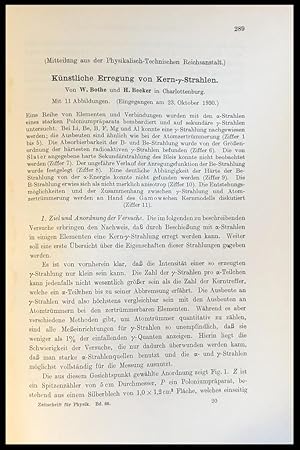
Berlin, Springer, 1930. 8vo. In contemporary halv cloth with gilt lettering to spine. In "Zeitschrift für Physik", Bd. 66, 1930. Entire volume offered. Stamp to front free end-paper, otherwise fine and clean. Pp. 289-310. [Entire volume: VIII, 863 pp.]. First appearance of Bothe and Becker's seminal paper in which they found tha…t if the very energetic alpha particles emitted from polonium fell on certain light elements, an unusually penetrating radiation was produced. Two years later this led directly to Chadwick's discovery of the neutron. "In 1930 Bothe and Becker detected a highly penetrative radiation from beryllium bombarded by alpha particles, and they assumed that it was gamma radiation. Bothe estimated the photon energy from the degree of absorption of the secondary electrons. When physicists studied this "beryllium radiation," estimating its energy constituted a problem, for it varied greatly according to the substance used as absorber. Chadwick later suggested that the radiation was particulate and consisted of a new particle, the neutron.".
Language: German
Published by Berlin Springer 1930
- First Edition
Seller: Antiquariat Gerhard Gruber, Heilbronn, , GermanyAntiquariat Gerhard Gruber
Contact seller4-star sellerCondition: Used
US$ 340.89
US$ 46.29 shippingShips from Germany to U.S.A.Quantity: 1 available
(23 x 15 cm). VIII, 863 S. Mit 369 Abbildungen. Halbleinwandband der Zeit. Erste Ausgabe. - Bothe und Becker beobachten bei der weiteren Erforschung der Kernumwandlung eine besonders energiereiche Strahlung, die sie als Gamma-Strahlung deuten und deren nähere Untersuchung zur Entdeckung des Neutrons durch Chadwick 1932 führt. -…Stempel auf Vorsatz und Titel. Titel mit senkrechtem Knick, sonst gut erhalten.
Seller: Antiq. F.-D. Söhn - Medicusbooks.Com, Marburg, , GermanyAntiq. F.-D. Söhn - Medicusbooks.Com
Contact seller5-star sellerCondition: Used
US$ 882.02
US$ 42.18 shippingShips from Germany to U.S.A.Quantity: 1 available
Z. Physik, 66/5-6. - Berlin, Verlag von Julius Springer, 1930, 8°, pp.289-306, 11 Fig.; 307-310, 1 Abb., 2 orig. Broschuren. VORWEGNAHME DER ENTDECKUNG DES NEUTRONS Seltener Sonderdruck! "Eine Reihe von Elementen und Verbindungen wurden mit den a-Strahlen eines starken Poloniumpräparats bombardiert und auf sekundäre y-Strahlen u…ntersucht. Bei Li, Be, B, E, Mg und Al konnte eine y-Strahlung nachgewiesen werden; die Ausbeuten sind ähnlich wie bei der Atomzertrümrnerung (Ziffer 1 bis 5). Die Absorbierbarkeit der B- und Be-Strahlung wurde von der Größenordnung der härtesten radioaktiven y-Strahlen befunden (Ziffer 6). Die von Slater angegebene harte Sekundantrahlung des Bleis konnte nicht beobachtet werden (Ziffer 7). Der ungefähre Verlauf der Anregungsfunktion der Be-Strahlung wurde festgelegt (Ziffer 8). Eine deutliche Abhängigkeit der Härte der Be-Strahlung von der a-Energie konnte nicht gefunden werden (Ziffer 9). Die B-Strahlung erwies sich als nicht merklich anisotrop (Ziffer 10). Die Entstehungsmöglichkeiten und der Zusammenhang zwischen y-Strahlung und Atomzertrümmerung werden an Hand des Gamowschen Kemmodells diskutiert (Ziffer 11)." Zusammenfassung Erstes Erscheinen der bahnbrechenden Arbeit von Bothe und Becker, in der sie feststellten, dass beim Auftreffen der sehr energiereichen Alphateilchen von Polonium auf bestimmte leichte Elemente eine ungewöhnlich durchdringende Strahlung erzeugt wird. Zwei Jahre später führte dies direkt zu Chadwicks Entdeckung des Neutrons. 1930 entdeckten Bothe und Becker eine sehr durchdringende Strahlung von Beryllium, das mit Alphateilchen beschossen wurde, und sie vermuteten, dass es sich dabei um Gammastrahlung handelte. Bothe schätzte die Photonenenergie anhand des Absorptionsgrades der Sekundärelektronen. Als die Physiker diese "Beryllium-Strahlung" untersuchten, stellte die Schätzung ihrer Energie ein Problem dar, da sie je nach der als Absorber verwendeten Substanz stark variierte. Chadwick schlug später vor, dass die Strahlung teilchenförmig war und aus einem neuen Teilchen, dem Neutron, bestand. Walther Wilhelm Georg Bothe (1891-1957) Physiker. Seine Arbeiten waren ein wichtiger Beitrag zur Begründung der modernen Kernphysik. Für die Entwicklung der Koinzidenzmessung und der damit gemachten Entdeckungen erhielt er im Jahr 1954 den Nobelpreis für Physik.


