

Order Total (1 Item Items):
Shipping Destination:

Boudreaux Benjamin (7 results)
Skip to main search results
Search filters
Product Type
- All Product Types
- Books (7)
- Magazines & Periodicals (No further results match this refinement)
- Comics (No further results match this refinement)
- Sheet Music (No further results match this refinement)
- Art, Prints & Posters (No further results match this refinement)
- Photographs (No further results match this refinement)
- Maps (No further results match this refinement)
- Manuscripts & Paper Collectibles (No further results match this refinement)
Condition Learn more
- New (3)
- As New, Fine or Near Fine (No further results match this refinement)
- Very Good or Good (4)
- Fair or Poor (No further results match this refinement)
- As Described (No further results match this refinement)
Binding
Collectible Attributes
- First Edition (No further results match this refinement)
- Signed (No further results match this refinement)
- Dust Jacket (No further results match this refinement)
- Seller-Supplied Images (2)
- Not Print on Demand (7)
Language (1)
Free Shipping
Seller Location
Seller Rating
-

Condition: Very Good. Shipped within 24 hours from our UK warehouse. Clean, undamaged book with no damage to pages and minimal wear to the cover. Spine still tight, in very good condition. Remember if you are not happy, you are covered by our 100% money back guarantee.
-
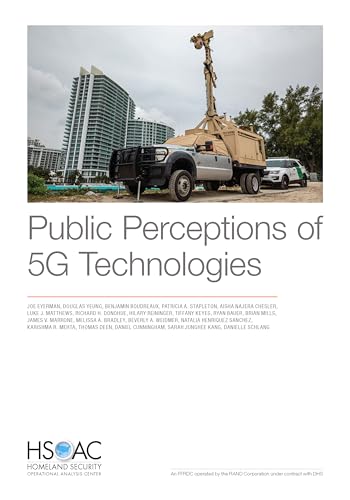
paperback. Condition: Very Good. Public Perceptions of 5G Technologies This book is in very good condition and will be shipped within 24 hours of ordering. The cover may have some limited signs of wear but the pages are clean, intact and the spine remains undamaged. This book has clearly been well maintained and looked after thus far. Money back guarantee if you are not satisfied. See all our books here, order more than 1 book and get discounted shipping. .
-
paperback. Condition: Very Good. Shipped within 24 hours from our UK warehouse. Clean, undamaged book with no damage to pages and minimal wear to the cover. Spine still tight, in very good condition. Remember if you are not happy, you are covered by our 100% money back guarantee.
-

paperback. Condition: Good. Connecting readers with great books since 1972! Used textbooks may not include companion materials such as access codes, etc. May have some wear or writing/highlighting. We ship orders daily and Customer Service is our top priority!
-

US$ 54.20
US$ 13.41 shipping
Ships from United Kingdom to U.S.A.Quantity: 1 available
Add to basketPaperback. Condition: Brand New. 154 pages. 9.00x6.00x0.50 inches. In Stock.
-

Human Dignity and the Future of Global Institutions
Language: English
Published by Georgetown University Press, US, 2014
ISBN 10: 1626161194 ISBN 13: 9781626161191
Seller: Rarewaves.com USA, London, LONDO, United Kingdom
Seller rating 5 out of 5 stars

US$ 157.91
Free Shipping
Ships from United Kingdom to U.S.A.Quantity: Over 20 available
Add to basketHardback. Condition: New. What does human dignity mean and what role should it play in guiding the mission of international institutions? In recent decades, global institutions have proliferated -- from intergovernmental organizations to hybrid partnerships. The specific missions of these institutions are varied, but is there a common animating principle to inform their goals? Presented as an integrated, thematic analysis that transcends individual contributions, Human Dignity and the Future of Global Institutions argues that the concept of human dignity can serve as this principle. Human dignity consists of the agency of individuals to apply their gifts to thrive, and requires social recognition of each person's inherent value and claim to equal access to opportunity. Contributors examine how traditional and emerging institutions are already advancing human dignity, and then identify strategies to make human dignity more central to the work of global institutions. They explore traditional state-created entities, as well as emergent, hybrid institutions and faith-based organizations.Concluding with a final section that lays out a path for a cross-cultural dialogue on human dignity, the book offers a framework to successfully achieve the transformation of global politics into service of the individual.
-

Human Dignity and the Future of Global Institutions
Language: English
Published by Georgetown University Press, US, 2014
ISBN 10: 1626161194 ISBN 13: 9781626161191
US$ 152.28
US$ 87.14 shipping
Ships from United Kingdom to U.S.A.Quantity: Over 20 available
Add to basketHardback. Condition: New. What does human dignity mean and what role should it play in guiding the mission of international institutions? In recent decades, global institutions have proliferated -- from intergovernmental organizations to hybrid partnerships. The specific missions of these institutions are varied, but is there a common animating principle to inform their goals? Presented as an integrated, thematic analysis that transcends individual contributions, Human Dignity and the Future of Global Institutions argues that the concept of human dignity can serve as this principle. Human dignity consists of the agency of individuals to apply their gifts to thrive, and requires social recognition of each person's inherent value and claim to equal access to opportunity. Contributors examine how traditional and emerging institutions are already advancing human dignity, and then identify strategies to make human dignity more central to the work of global institutions. They explore traditional state-created entities, as well as emergent, hybrid institutions and faith-based organizations.Concluding with a final section that lays out a path for a cross-cultural dialogue on human dignity, the book offers a framework to successfully achieve the transformation of global politics into service of the individual.

