
Brickweede (1 results)
 More images
Published by The American Physical Society, Minneapolis, Minnesota 1932
- Softcover
- First Edition
Seller: Kuenzig Books ( ABAA / ILAB ), Topsfield, MA, U.S.A.Kuenzig Books ( ABAA / ILAB )
Contact seller5-star sellerCondition: Used - Very good
US$ 440.00
US$ 5.99 shippingShips within U.S.A.Quantity: 1 available
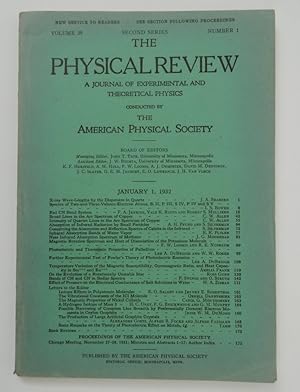
Wraps. Condition: Very Good. First Edition. First Edition. 191, [1 blank], 8 pages. 7 x 10 inches. The entire issue of the Physical Review, Vol. 39 #1 (Second Series) January 1, 1932 offered. Publisher's original green printed wrappers. A nice copy with minor browning to the covers at the extremities and some creasing to the rea…r wrapper. Upper spine corner lightly bumped. Rear wrapper and last nine leaves with closed tear at top edge. Wraps. The article offered here, "A Hydrogen Isotope of Mass 2" is found on page 164-5. It announces the discovery of the deuteron, which we now know as deuterium. "Deuterium (symbol D or 2H, also known as heavy hydrogen) is one of two stable isotopes of hydrogen. The nucleus of deuterium, called a deuteron, contains one proton and one neutron, whereas the far more common hydrogen isotope, protium, has no neutron in the nucleus. Deuterium has a natural abundance in Earth's oceans of about one atom in 6420 of hydrogen." (wiki) Deuterium has important applications in nuclear reactors, NMR Spectroscopy, geology, and a myriad of other areas. A further article was published in the April issue which addressed in considerably more detail the concentration of the newly discovered isotope and why that worked. "Soon after deuterium's discovery, Urey and others produced samples of "heavy water" in which the deuterium had been highly concentrated." "Harold Clayton Urey (April 29, 1893 January 5, 1981) was an American physical chemist whose pioneering work on isotopes earned him the Nobel Prize in Chemistry in 1934 for the discovery of deuterium. He played a significant role in the development of the atom bomb, but may be most prominent for his contribution to theories on the development of organic life from non-living matter.At Johns Hopkins, Urey and Arthur Ruark wrote Atoms, Quanta and Molecules (1930), one of the first English texts on quantum mechanics and its applications to atomic and molecular systems." (wiki) Most often found in bound ex-library volumes, we offer here the original issue of the Physical Review as it was published. See Ezhela, et al, pp 64-65, (Urey 1932) which identifies the article as providing "Evidence for the deuteron".
