

Order Total (1 Item Items):
Shipping Destination:

Bruce Tabashnik (13 results)
Skip to main search results
Search filters
Product Type
- All Product Types
- Books (13)
- Magazines & Periodicals (No further results match this refinement)
- Comics (No further results match this refinement)
- Sheet Music (No further results match this refinement)
- Art, Prints & Posters (No further results match this refinement)
- Photographs (No further results match this refinement)
- Maps (No further results match this refinement)
- Manuscripts & Paper Collectibles (No further results match this refinement)
Condition Learn more
- New (9)
- As New, Fine or Near Fine (1)
- Very Good or Good (2)
- Fair or Poor (No further results match this refinement)
- As Described (1)
Binding
Collectible Attributes
- First Edition (No further results match this refinement)
- Signed (No further results match this refinement)
- Dust Jacket (3)
- Seller-Supplied Images (7)
- Not Print on Demand (9)
Language (2)
Free Shipping
- Free Shipping to U.S.A. (No further results match this refinement)
Seller Location
Seller Rating
-
Pesticide Resistance in Arthropods
Language: English
Published by Chapman and Hall, New York, NY, 1990
ISBN 10: 041201971X ISBN 13: 9780412019715
Seller: Lily of the Valley Books, Waynesboro, VA, U.S.A.
Seller rating 5 out of 5 stars

Hardcover. Condition: Very Good. Dust Jacket Condition: Very Good. Book and dust jacket are gently used with only minor wear. Tightly bound copy with clean interior having no markings, writing, underlining, or highlighting in margins or text block. Inv. # 11897.
-
US$ 67.65
US$ 18.33 shipping
Ships from United Kingdom to U.S.A.Quantity: 1 available
Add to basketCondition: Good. This is an ex-library book and may have the usual library/used-book markings inside.This book has hardback covers. In good all round condition. No dust jacket. Please note the Image in this listing is a stock photo and may not match the covers of the actual item,650grams, ISBN:041201971X.
-
Condition: New.
-
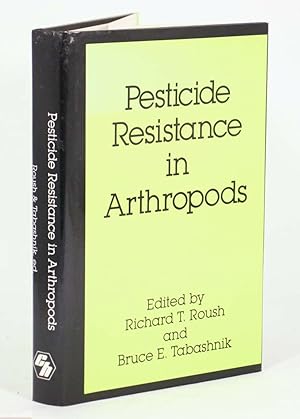
Pesticide resistance in arthropods.
Published by London: Chapman and Hall, 1990., 1990
Seller: Andrew Isles Natural History Books, Prahran, VIC, Australia
Association Member: ANZAAB ILAB
Seller rating 5 out of 5 stars
Octavo,303 pp.,fine copy in dustwrapper.
-
Pesticide Resistance in Arthropods
Seller: Ria Christie Collections, Uxbridge, United Kingdom
Seller rating 5 out of 5 stars
US$ 132.90
US$ 16.39 shipping
Ships from United Kingdom to U.S.A.Quantity: Over 20 available
Add to basketCondition: New. In.
-
Condition: New. pp. 316.
-

Pesticide Resistance in Arthropods
Language: English
Published by Springer US, Springer New York Jun 2012, 2012
ISBN 10: 1468464310 ISBN 13: 9781468464313
Seller: buchversandmimpf2000, Emtmannsberg, BAYE, Germany
Seller rating 5 out of 5 stars
Taschenbuch. Condition: Neu. Neuware -Bruce E. Tabashnik and Richard T. Roush Pesticide resistance is an increasingly urgent worldwide problem. Resistance to one or more pesticides has been documented in more than 440 species of insects and mites. Resistance in vectors of human dise8se, particularly malaria-transmit ting mosquitoes, is a serious threat to public health in many nations. Agricultural productivity is jeopardized because of widespread resistance in crop and livestock pests. Serious resistance problems are also evident in pests of the urban environ ment, most notably cockroaches. Better understanding of pesticide resistance is needed to devise techniques for managing resistance (Le. , slowing, preventing, or reversing development of resistance in pests and promoting it in beneficial natural enemies). At the same time, resistance is a dramatic example of evolution. Knowledge of resistance can thus provide fundamental insights into evolution, genetics, physiology, and ecology. Resistance management can help toreduce the harmful effects of pesticides by decreasing rates of pesticide use and prolonging the efficacy of environmentally safe pesticides. In response to resistance problems, the concentration or frequency of pesticide applications is often increased. Effective resistance management would reduce this type of increased pesticide use. Improved monitoring of resis tance would also decrease the number of ineffective pesticide applications that are made when a resistance problem exists but has not been diagnosed. Resistance often leads to replacement of one pesticide with another that is more expensive and less compatible with alternative controls.Springer Verlag GmbH, Tiergartenstr. 17, 69121 Heidelberg 316 pp. Englisch.
-
Pesticide Resistance in Arthropods
Language: English
Published by Springer US, Springer New York, 2012
ISBN 10: 1468464310 ISBN 13: 9781468464313
Taschenbuch. Condition: Neu. Druck auf Anfrage Neuware - Printed after ordering - Bruce E. Tabashnik and Richard T. Roush Pesticide resistance is an increasingly urgent worldwide problem. Resistance to one or more pesticides has been documented in more than 440 species of insects and mites. Resistance in vectors of human dise8se, particularly malaria-transmit ting mosquitoes, is a serious threat to public health in many nations. Agricultural productivity is jeopardized because of widespread resistance in crop and livestock pests. Serious resistance problems are also evident in pests of the urban environ ment, most notably cockroaches. Better understanding of pesticide resistance is needed to devise techniques for managing resistance (Le. , slowing, preventing, or reversing development of resistance in pests and promoting it in beneficial natural enemies). At the same time, resistance is a dramatic example of evolution. Knowledge of resistance can thus provide fundamental insights into evolution, genetics, physiology, and ecology. Resistance management can help toreduce the harmful effects of pesticides by decreasing rates of pesticide use and prolonging the efficacy of environmentally safe pesticides. In response to resistance problems, the concentration or frequency of pesticide applications is often increased. Effective resistance management would reduce this type of increased pesticide use. Improved monitoring of resis tance would also decrease the number of ineffective pesticide applications that are made when a resistance problem exists but has not been diagnosed. Resistance often leads to replacement of one pesticide with another that is more expensive and less compatible with alternative controls.
-
Pesticide Resistance in Arthropods
Published by Chapman and Hall, New York and London, 1990
Seller: Good Reading Secondhand Books, Benalla, VIC, Australia
Seller rating 4 out of 5 stars

Hard Cover. Condition: As New. Dust Jacket Condition: As New. Size: 8vo - over 7¾" - 9¾" tall.
-
Pesticide Resistance in Arthropods
Language: English
Published by Springer US Jun 2012, 2012
ISBN 10: 1468464310 ISBN 13: 9781468464313
Seller: BuchWeltWeit Ludwig Meier e.K., Bergisch Gladbach, Germany
Seller rating 5 out of 5 stars
Taschenbuch. Condition: Neu. This item is printed on demand - it takes 3-4 days longer - Neuware -Bruce E. Tabashnik and Richard T. Roush Pesticide resistance is an increasingly urgent worldwide problem. Resistance to one or more pesticides has been documented in more than 440 species of insects and mites. Resistance in vectors of human dise8se, particularly malaria-transmit ting mosquitoes, is a serious threat to public health in many nations. Agricultural productivity is jeopardized because of widespread resistance in crop and livestock pests. Serious resistance problems are also evident in pests of the urban environ ment, most notably cockroaches. Better understanding of pesticide resistance is needed to devise techniques for managing resistance (Le. , slowing, preventing, or reversing development of resistance in pests and promoting it in beneficial natural enemies). At the same time, resistance is a dramatic example of evolution. Knowledge of resistance can thus provide fundamental insights into evolution, genetics, physiology, and ecology. Resistance management can help to reduce the harmful effects of pesticides by decreasing rates of pesticide use and prolonging the efficacy of environmentally safe pesticides. In response to resistance problems, the concentration or frequency of pesticide applications is often increased. Effective resistance management would reduce this type of increased pesticide use. Improved monitoring of resis tance would also decrease the number of ineffective pesticide applications that are made when a resistance problem exists but has not been diagnosed. Resistance often leads to replacement of one pesticide with another that is more expensive and less compatible with alternative controls. 316 pp. Englisch.
-
US$ 113.13
US$ 58.32 shipping
Ships from Germany to U.S.A.Quantity: Over 20 available
Add to basketCondition: New. Dieser Artikel ist ein Print on Demand Artikel und wird nach Ihrer Bestellung fuer Sie gedruckt. Bruce E. Tabashnik and Richard T. Roush Pesticide resistance is an increasingly urgent worldwide problem. Resistance to one or more pesticides has been documented in more than 440 species of insects and mites. Resistance in vectors of human dise8se, particu.
-
US$ 158.82
US$ 8.89 shipping
Ships from United Kingdom to U.S.A.Quantity: 4 available
Add to basketCondition: New. Print on Demand pp. 316 66:B&W 7 x 10 in or 254 x 178 mm Perfect Bound on White w/Gloss Lam.
-
Condition: New. PRINT ON DEMAND pp. 316.


