
Bunuel: Signed (14 results)

Language: Spanish
Published by GERPER, VALLADOLID. 1959
- Softcover
- First Edition
- Signed
Seller: LIBRERÍA CASTREJÓN., Madrid., M, SpainLIBRERÍA CASTREJÓN.
Contact seller5-star sellerCondition: Used - Good
US$ 17.88
US$ 16.78 shippingShips from Spain to U.S.A.Quantity: 1 available
Encuadernación de tapa blanda. Condition: Bien. 1� Edición. 12X19 CM. 196 PÁGINAS. ENCUADERNACIÓN EDITORIAL RÚSTICA CON SOLAPAS. TAPAS FATIGADAS, INTERIOR BUENO. EXLIBRIS ANTERIOR PROPIETARIO EN PORTADA. EJEMPALR CON DEDICATORIA Y FIRMA AUTÓGRAFA DEL AUTOR. Dedicado por el Autor(es).

Language: Spanish
Published by Editorial Gerper 1959
- Softcover
- Signed
Seller: Librería Antonio Azorín, San Lorenzo de El Escorial, M, SpainLibrería Antonio Azorín
Contact seller5-star sellerCondition: Used - Very good
US$ 23.84
US$ 65.96 shippingShips from Spain to U.S.A.Quantity: 1 available
Encuadernación de tapa blanda. Condition: Bien. Idioma español. Buen estado. Dedicatoria y firma autógrafas del autor. Ilustraciones de Goñi. Dimensiones: 19x12 - 196 pp. Goñi (illustrator). Dedicatoria autógrafa del auto.

- Softcover
- Signed
Seller: Libros Tobal, Ajalvir, M, SpainLibros Tobal
Contact seller5-star sellerCondition: Used - Very good
US$ 25.76
US$ 31.82 shippingShips from Spain to U.S.A.Quantity: 1 available
Encuadernación de tapa blanda. Condition: Bien. Caja de Ahorros Provincial, Valladolid, 1969. Dedicado y firmado por el autor. 59 paginas. 19 x 12. Doce laminas con dibujos color a pagina completa. Tapa blanda de editorial ilustrada. Buen estado de conservación. Libro.
- Signed
- Manuscript
Seller: Herbst-Auktionen, Detmold, , GermanyHerbst-Auktionen
Contact seller3-star sellerCondition: Used
US$ 41.72
US$ 9.84 shippingShips from Germany to U.S.A.Quantity: 1 available
FOTOPORTRÄTPOSTKARTE, EIGENHÄNDIG SIGNIERT (photo signed by french actor and director).
 More images
Published by Arcadia,, Lisbon, 1974
- Softcover
- First Edition
- Signed
Seller: Burwood Books, Wickham Market, , United KingdomBurwood Books
Contact seller5-star sellerCondition: Used - Very good
US$ 75.95
US$ 30.17 shippingShips from United Kingdom to U.S.A.Quantity: 1 available
Paperback. Condition: Very Good. First Paperback Edition. 8vo. pp 118. Paperback. Original publisher's red covers, lettered green. J. F. Aranda was a film historian and critic. Text in Portuguese. Small attractive bookplate of John Lyle (1932-2002) writer on surrealism and collector, editor of 'Transformation' magazine and deale…r of surrealist books. Signed presentation from the author to John Lyle on the first blank page, "For John Lyle and his splendid Transformation J. F. Aranda." F Very good indeed. Signedes.
- Signed
- Manuscript
Seller: Herbst-Auktionen, Detmold, , GermanyHerbst-Auktionen
Contact seller3-star sellerCondition: Used
US$ 47.68
US$ 9.84 shippingShips from Germany to U.S.A.Quantity: 1 available
FOTO, EIGENHÄNDIG SIGNIERT 60'er.
Published by New York Simon & Schuster 1971 1971
- Softcover
- First Edition
- Signed
Seller: James Pepper Rare Books, Inc., ABAA, Santa Barbara, CA, U.S.A.James Pepper Rare Books, Inc., ABAA
Contact seller5-star sellerFirst American Edition. First Edition. Signed by actress Catherine Deneuve on a specially printed card affixed to the front free endpaper. The card has a picture of Deneuve in her role as Lila Crane and next to her signature is a color photo of the actress. Illustrated. The script of the classic Luis Bunuel directed film and one… of Catherine DeneuveÕs greatest roles. Paperbound. Near fine.

GUSTAVO ROJO (1923 auf dem Frachter Krefeld-2017 Mexiko Stadt) uruguayischer Schauspieler und Filmproduzent. Seine erste von vielen internationalen Rollen spielte er in Tarzan in Gefahr (1948) an der Seite von Johnny Weissmüller. Viele weitere Filmarbeiten in Mexiko (u. a. mit Regisseur Luis Buñuel) und Spanien folgten, zudem wirkte er in dem Monumentalfilm Alexander der Große (1956) an der Seite von Richard Burton, in Die Verlobten des Todes (1957) mit Hans Albers, Operation Tiger (1957) mit dem jungen Sean Connery und Hollywood-Produktionen mit Glenn Ford (Eine Tolle Nummer, 1960) oder Roger Moore (Die Madonna mit den zwei Gesichtern, 1959) mit; verheiratet mit der Österreicherin Erika Remberg
GUSTAVO ROJO (1923 auf dem Frachter Krefeld-2017 Mexiko Stadt) uruguayischer Schauspieler und Filmproduzent. Seine erste von vielen internationalen Rollen spielte er in Tarzan in Gefahr (1948) an der Seite von Johnny Weissmüller. Viele weitere Filmarbeiten in Mexiko (u. a. mit Regisseur Luis Buñuel) und Spanien folgten, zudem wirkte er in dem Monumentalfilm Alexander der Große (1956) an der Seite von Richard Burton, in Die Verlobten des Todes (1957) mit Hans Albers, Operation Tiger (1957) mit dem jungen Sean Connery und Hollywood-Produktionen mit Glenn Ford (Eine Tolle Nummer, 1960) oder Roger Moore (Die Madonna mit den zwei Gesichtern, 1959) mit; verheiratet mit der Österreicherin Erika Remberg
- Signed
- Manuscript
Seller: Herbst-Auktionen, Detmold, , GermanyHerbst-Auktionen
Contact seller3-star sellerCondition: Used
US$ 77.47
US$ 9.84 shippingShips from Germany to U.S.A.Quantity: 1 available
Albumblatt (kl. 8 to), eigenhändig signiert mit persönlicher Widmung a Attila, Empfehlung, Unterschrift - mit s/w-Repro-Porträtfoto unter dunkelblaues Passepartout (4 to) gerahmt.
 More images
Published by Le Grabuge. Carmelo Soria., Santiago de Chile 1952
- Signed
Seller: HS Rare Books, ILAB/ABAA, New York, NY, U.S.A.HS Rare Books, ILAB/ABAA
Contact seller4-star sellerCondition: Used - Fine
US$ 8,000.00
Free ShippingShips within U.S.A.Quantity: 1 available
Condition: Fine. Unique copy, with an original drawing by Salvador Dali [Dali, Salvador] Buñuel, Luis. Un perro andaluz, S.a. [c.1952]. Santiago de Chile. Le Grabuge. Carmelo Soria. Large folio, (370 x 260 mm). 4 ff. Original printed wrappers, some wear. Light toning, overall fine. A unique copy with an original signed double-pa…ge drawing by Salvador Dali, over the text of an important work on South American surrealist literature, art, and cinema. Characteristic of Dali's interventions with Goya's engravings, the illustration is comprised of ink stains that include a distinguishable crown and a llama wielding a sword. In the space between the neck and the sword appears a face, a method Dali called 'metodo paranoico-critic', which was also employed by him and Buñel for the writing of the script. The drawing bears an inscription over Dali's signature 'Avec Plaisir pour Le Grabuge', the editorial house of Braulio Arenas. The movie "Un perro andaluz" was the first by Luis Buñuel. He directed it in 1929 after co-writing the script with Dali. It was a sensational and highly controversial film, shot entirely in under 15 days. The text is rare in and of itself, printed by Carmelo Soria in a run of just 195 numbered copies - none of which appear to exist institutionally - and this particular copy is unnumbered. Buñuel's text, dated December 1929, states: "The publication of this scenario in "La Révolution surréaliste" is the only one I authorize. It expresses, without any reservation, my complete adherence to the thought and activity of surrealism." "Dalí and Buñuel, leading figures of the influential surrealist avant-garde, wrote the script using the cadavre exquis (exquisite corpse) method, which consists of writing a collective text based on sentences that describe the first images that pass through one's mind without seeking to explain or rationalize them. The script is then passed to another person, who writes another unconnected sentence, thus constructing a text that is like an unconscious montage without narrative continuity or rational explanation." From its premiere at the Studio des Ursulines in París, "Un perro andaluz" became a seminal work of Surrealist cinema, having influenced André Breton, who was present at the first screening along with Pablo Picasso, Le Corbusier and Jean Cocteau. A full description is available upon request. Signed by Author(s).
 More images
Juan Luis Buñuel (1934-2017) - Rare photo dédicacée - 2007
Juan Luis Buñuel (1934-2017) - Réalisateur et scénariste français
Language: French
- Signed
- Manuscript
Seller: PhP Autographs, Hastière, BelgiumPhP Autographs
Contact seller5-star sellerCondition: Used - Near fine
US$ 95.34
US$ 46.29 shippingShips from Belgium to U.S.A.Quantity: 1 available
Pas de couverture. Condition: Bon. Rare - Belle grande photo dédicacée personnellement en 2007. La dédicace est malheureusement peu visible car dans une partie sombre de la photo. Format : 20x30 cm. État : dédicace peu visible, voir scans svp. Provenance : collection PhP Autographs Authenticité garantie. Signé par l'auteur.

Juan Luis Bunuel (1934-2017) - In person signed photo - Brussels 2000s
Juan Luis Buñuel (1934-2017) - French film and television director, screenwriter, and actor
Language: French
- Signed
- Manuscript
Seller: PhP Autographs, Hastière, BelgiumPhP Autographs
Contact seller5-star sellerCondition: Used - Fine
US$ 119.18
US$ 46.29 shippingShips from Belgium to U.S.A.Quantity: 1 available
Pas de couverture. Condition: Très bon. Rare - Large photo signed (in capital letters) in person in Brussels in the 2000s. The photo showing me with the director will not be attached. Size : 20x30 cm. Condition : please see scans. Provenance : PhP Autographs collection. Certificate of Authenticity and lifetime guarantee. Signé p…ar l'auteur.

- Signed
Seller: Herbst-Auktionen, Detmold, , GermanyHerbst-Auktionen
Contact seller3-star sellerCondition: Used
US$ 148.99
US$ 9.84 shippingShips from Germany to U.S.A.Quantity: 1 available
E.Briefkarte mit Datum, Unterschrift signiert 29.XI.81 - dankt für einen Linolschnitt und Gedicht und freut sich, daß der Briefpartner für Amnesty International und in Gefängnissen arbeitet. (autograph card signed / see picture below / the photo above is gone).
 More images
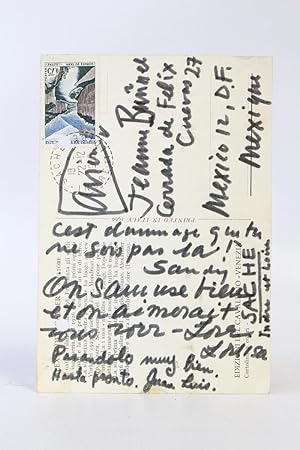
Carte postale autographe signée d'Alexander Calder et Juan Luis Buñuel adressée à Jeanne Rucar épouse Buñuel
Alexander CALDER - Juan-Luis BUÑUEL - (à Jeanne RUCAR épouse BUNUEL)
- First Edition
- Signed
- Manuscript
Seller: Librairie Le Feu Follet, Paris, , FranceLibrairie Le Feu Follet
Contact seller5-star sellerCondition: Used
US$ 1,918.98
US$ 34.72 shippingShips from France to U.S.A.Quantity: 1 available
autre. (Saché) 22 décembre 1966 | 14.70 x 10.40 cm | une carte postale | Carte postale autographe signée d'Alexander Calder et de Juan Luis Buñuel à Jeanne Buñuel, rédigée en français au feutre noir. Tampon postal de Saché (Indre-et-Loire). Adresse mexicaine de Jeanne Buñuel. Carte perforée en tête de deux trous. Photographie de… l'atelier de Calder à Saché au recto de la carte. Provenance : archives de la famille Buñuel. En 1939, Luis Buñuel, qui venait de recevoir une proposition de travail à Hollywood, décide, avec femme et enfant, de quitter la situation chaotique de l'Europe pour vivre l'American Dream. Les Buñuel, désargentés, transitent d'abord quelques mois par New York où ils vivent dans des conditions précaires. Luis Buñuel se voit contraint de demander à Dali - son ami de longue date en exil avec Gala dans ces mêmes années - de lui prêter de l'argent. Il essuie un violent refus qui met fin à l'amitié des deux hommes. C'est alors Calder, que Luis a peut-être déjà rencontré à Paris dans les années 1920, qui accueille toute la famille dans son appartement de l'Upper Side. Juan Luis Buñuel, filleul de l'artiste, suppose que son intérêt pour la sculpture a commencé à la même période : « Quand Dali dit à mon père qu'il ne lui prêterait pas d'argent, il l'a contacté [Calder]. Il nous a offert sa maison et nous avons vécu au côté de sa famille pendant quelque temps. Je ne m'en rappelle que vaguement, mais c'est alors que j'ai commencé à m'intéresser à la sculpture et il m'a encouragé. » (Anton Castro, Juan Luis una entrevista). En dépit de la distance géographique qui les séparera, Alexander Calder demeurera un ami de la famille Buñuel. La relation entre l'artiste et le cinéaste est cependant presque totalement absente des biographies et cette correspondance est un rare témoignage du lien profond entre le sculpteur et la famille Buñuel. | [ENGLISH DESCRIPTION FOLLOWS] Handwritten signed postcard from Alexander Calder and Juan Luis Buñuel to Jeanne Buñuel née RucarN. p. [Saché] December 22th 1966, 14,7 x 10,4 cm, one postcardHandwritten signed postcard from Alexander Calder and Juan Luis Buñuel to Jeanne Buñuel, written in French in black felt-tip. Saché postmark (Indre-et-Loire). Jeanne Buñuel's address in Mexico. Card perforated with two holes at the top. Photograph of Calder's studio in Saché on the front of the card. Provenance: Buñuel family archives.In 1939, Luis Buñuel, who had just received an offer to work in Hollywood, decided, with his wife and child, to leave the chaotic situation in Europe to go and live the American Dream. The penniless Buñuels initially spent a few precarious months living in New York. Luis Buñuel found himself forced to ask Dalihis longstanding friend in exile, along with Gala, during these yearsto lend him some money.His request was refused in no uncertain terms, putting an end to the two men's friendship. Thus it was Calder, whom Luis had perhaps already met in Paris in the 1920s, who put the whole family up in his Upper Side apartment. Juan Luis Buñuel, the artist's godson, sensed that his interest in sculpture began in this same period: "When Dali told my father he would not lend him any money, he contacted him [Calder]. He offered his house to us and we lived with his family for a time. I can only vaguely remember it, but it was then that I started to become interested in sculpture and he encouraged me" (Anton Casto, Juan Luis una entrevista). Despite the geographical distance that would come to separate them, Alexander Calder would remain a friend of the Buñuel family. The relationship between the artist and the film-maker is, however, almost entirely absent from the biographies, and this correspondence is a rare testimony to the profound connection between the sculptor and the Buñuel family. *.
 More images
- First Edition
- Signed
- Manuscript
Seller: Librairie Le Feu Follet, Paris, , FranceLibrairie Le Feu Follet
Contact seller5-star sellerCondition: Used
US$ 1,918.98
US$ 34.72 shippingShips from France to U.S.A.Quantity: 1 available
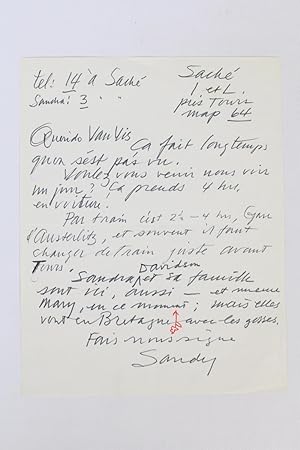
Pas de couverture. (Saché) s. d. [circa 1953] | 21 x 26.80 cm | une page sur un feuillet | Lettre autographe signée d'Alexander Calder à Juan Luis Buñuel, rédigée en français au feutre noir. Lettre perforée de deux trous en marge gauche. Coordonnées téléphoniques de Calder en haut à gauche, ainsi que plusieurs indications d'itin…éraire pour se rendre à Saché à droite. Petit signe au feutre rouge en fin de lettre. Deux corrections et ajouts de la main de Calder. Provenance : archives de la famille Buñuel. En 1939, Luis Buñuel, qui venait de recevoir une proposition de travail à Hollywood, décide, avec femme et enfant, de quitter la situation chaotique de l'Europe pour vivre l'American Dream. Les Buñuel, désargentés, transitent d'abord quelques mois par New York où ils vivent dans des conditions précaires. Luis Buñuel se voit contraint de demander à Dali - son ami de longue date en exil avec Gala dans ces mêmes années - de lui prêter de l'argent. Il essuie un violent refus qui met fin à l'amitié des deux hommes. C'est alors Calder, que Luis a peut-être déjà rencontré à Paris dans les années 1920, qui accueille toute la famille dans son appartement de l'Upper Side. Juan Luis Buñuel, filleul de l'artiste, suppose que son intérêt pour la sculpture a commencé à la même période : « Quand Dali dit à mon père qu'il ne lui prêterait pas d'argent, il l'a contacté [Calder]. Il nous a offert sa maison et nous avons vécu au côté de sa famille pendant quelque temps. Je ne m'en rappelle que vaguement, mais c'est alors que j'ai commencé à m'intéresser à la sculpture et il m'a encouragé. » (Anton Castro, Juan Luis una entrevista). En dépit de la distance géographique qui les séparera, Alexander Calder demeurera un ami de la famille Buñuel. La relation entre l'artiste et le cinéaste est cependant presque totalement absente des biographies et cette correspondance est un rare témoignage du lien profond entre le sculpteur et la famille Buñuel. | [ENGLISH DESCRIPTION FOLLOWS] Handwritten signed letter from Alexander Calder to Juan Luis BuñuelN. p. [Saché] n. d. [ca. 1953], 21 x 26,8 cm, one page on one leafHandwritten signed letter from Alexander Calder to Juan Luis Buñuel, written in French in black felt-tip. Letter perforated with two holes in the left-hand margin. Calder's telephone number in top left-hand corner, a few directions to get to Saché in right-hand corner. Small sign in red felt-tip at the end of the letter. Two corrections and additions in Calder's hand. Provenance: Buñuel family archives. In 1939, Luis Buñuel, who had just received an offer to work in Hollywood, decided, with his wife and child, to leave the chaotic situation in Europe to go and live the American Dream. The penniless Buñuels initially spent a few precarious months living in New York. Luis Buñuel found himself forced to ask Dalihis longstanding friend in exile, along with Gala, during these yearsto lend him some money. His request was refused in no uncertain terms, putting an end to the two men's friendship. Thus it was Calder, whom Luis had perhaps already met in Paris in the 1920s, who put the whole family up in his Upper Side apartment. Juan Luis Buñuel, the artist's godson, sensed that his interest in sculpture began in this same period: "When Dali told my father he would not lend him any money, he contacted him [Calder]. He offered his house to us and we lived with his family for a time. I can only vaguely remember it, but it was then that I started to become interested in sculpture and he encouraged me" (Anton Casto, Juan Luis una entrevista).Despite the geographical distance that would come to separate them, Alexander Calder would remain a friend of the Buñuel family. The relationship between the artist and the film-maker is, however, almost entirely absent from the biographies, and this correspondence is a rare testimony to the profound connection between the sculptor and the Buñuel family. *.


