Order Total (1 Item Items):
Shipping Destination:

Collected Vance Randolph Notes Herbert (2 results)
Skip to main search results
Search filters
Product Type
- All Product Types
- Books (2)
- Magazines & Periodicals (No further results match this refinement)
- Comics (No further results match this refinement)
- Sheet Music (No further results match this refinement)
- Art, Prints & Posters (No further results match this refinement)
- Photographs (No further results match this refinement)
- Maps (No further results match this refinement)
- Manuscripts & Paper Collectibles (No further results match this refinement)
Condition Learn more
- New (No further results match this refinement)
- As New, Fine or Near Fine (1)
- Very Good or Good (No further results match this refinement)
- Fair or Poor (No further results match this refinement)
- As Described (1)
Binding
- All Bindings
- Hardcover (1)
- Softcover (No further results match this refinement)
Collectible Attributes
- First Edition (2)
- Signed (No further results match this refinement)
- Dust Jacket (2)
- Seller-Supplied Images (2)
- Not Print on Demand (2)
Language (1)
Price
- Any Price
- Under US$ 25 (No further results match this refinement)
- US$ 25 to US$ 50 (No further results match this refinement)
- Over US$ 50
Free Shipping
Seller Location
Seller Rating
-
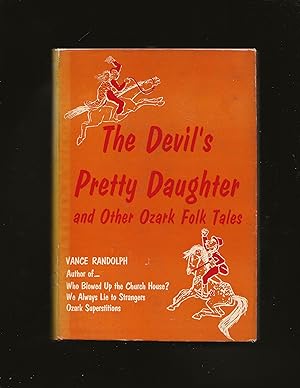
The Devil's Pretty Daughter and Other Ozark Folk Tales
Published by Columbia University Press, New York, 1955
First Edition
Hardcover. Condition: Near Fine. Dust Jacket Condition: Very Good. Glen Rounds (illustrator). 1st Edition. First Edition (SD). Both the book and the dust jacket are in nice condition, the book particularly. You can see the covers in the photos. They're very clean. The red lettering on the spine is nicely bright. The edges and corners are in very good shape. The spine ends have held up quite nicely. The page edges are very clean. The top page edge is a light red. The book is square and the spine is straight, the binding is very solid from cover to cover with nicely tight pages and nicely tight covers as well. The pages are exceptionally clean. I've scrolled through them several times without finding any creasing. There are four early pages with a tiny nick at the bottom edge. On the first front end paper there is a black stamped name in a calligraphic style ( 'Henry Heiman II, Littera Scripta Manet' (the written letter remains). There are no other stampings, no markings. There are no attachments of any kind. And no one has written anything anywhere in the book. You can see the dust jacket in the first two photos. It looks (and probably feels) better than me, although we were born the same year. It has a hard-to-see thin tear off the front top edge just adjacent to the spine, a few tiny tears off the rear bottom edge, as well as a tiny loss where the rear bottom edge meets the middle edge with the rear flap, all quite minor. The color of the spine is sun faded from orange to yellow and there are few little creases on it. The front and rear cover have some light handling soiling. The flaps are in very good condition, just a thin strip of toning off their top edges. The jacket is NOT price-clipped, not clipped at all. I have it in a fitted protective cover. From the dust jacket: 'You may take these tales as social documents or as entertainments or how you will, one thing is certain, you won't take them lightly. These are no light gags nor Sunday fictions. They are often hilarious and ribald, sometimes serene and beautiful, and they are always strong. The spirit of Rabelais continues in them unchecked, if not in its variety and power, at least in its pride, fearlessness, and good sense. It all goes to show what 'The Women-Haters Son' so clearly substantiates: 'You can't get away from nature just by hiding out in the woods somewhere.' Mr. Randolph has spent many years among the people of the Ozarks, where, until recently, the manners of civilized folk were inculcated upon the young by means of the fable (see 'Yellow Bread' ), and where storytelling was a high art. With the publication of this third volume of stories collected by Mr. Randolph, the preservation of a substantial portion of this proud and significant body of folk literature is assured. The stories were all taken down by Mr. Randolph on the spot of the telling.'.
-

Who Blowed Up the Church House?: And Other Ozark Folk Tales
Published by Columbia University Press, New York, 1952
Seller: Lorne Bair Rare Books, ABAA, Winchester, VA, U.S.A.
Association Member: ABAA ILAB IOBA
Seller rating 5 out of 5 stars

First Edition
First American Edition. First Printing. Octavo (22cm); tan cloth-covered boards with titling and illustrations stamped in red and black on spine and front cover; red topstain; dustjacket; xviii,[2],3-232,[2]pp; black-and-white illustrations to title page and throughout text. Mrs. John Froelich's ownership stamp with Illinois address to front endpaper. Light tanning to spine and board margins, with trace rubbing to board edges; Very Good. Dustwrapper, unclipped (priced $3.50), tanned, with tiny chips and tears to spine edges and extremities; Very Good. Collection of Ozark folk tales includes "The Cookstove and the Circus", "The Boy That Fooled His Folks", "Pennywinkle! Pennywinkle", and "Geometry Is What Done It". [85975].